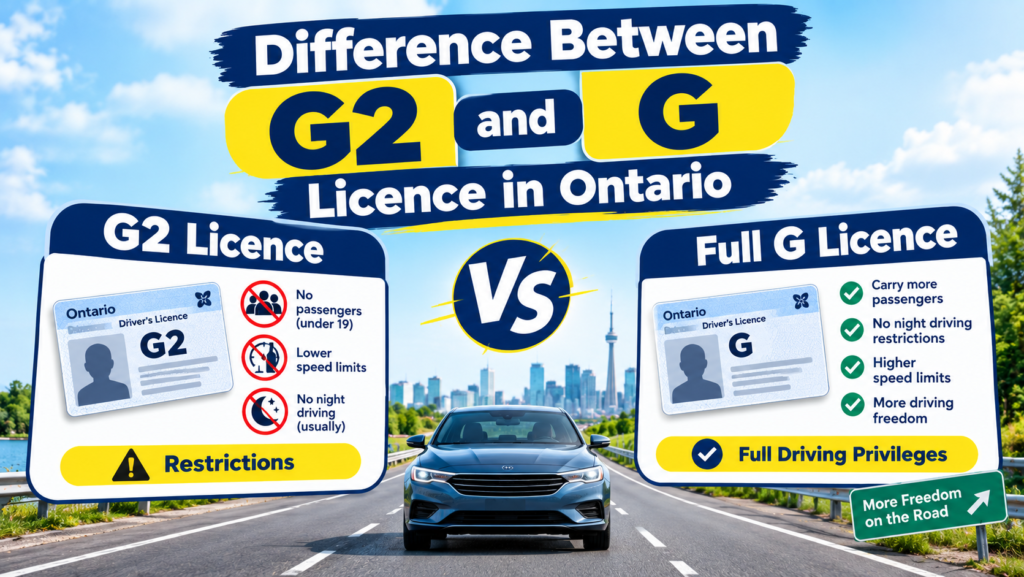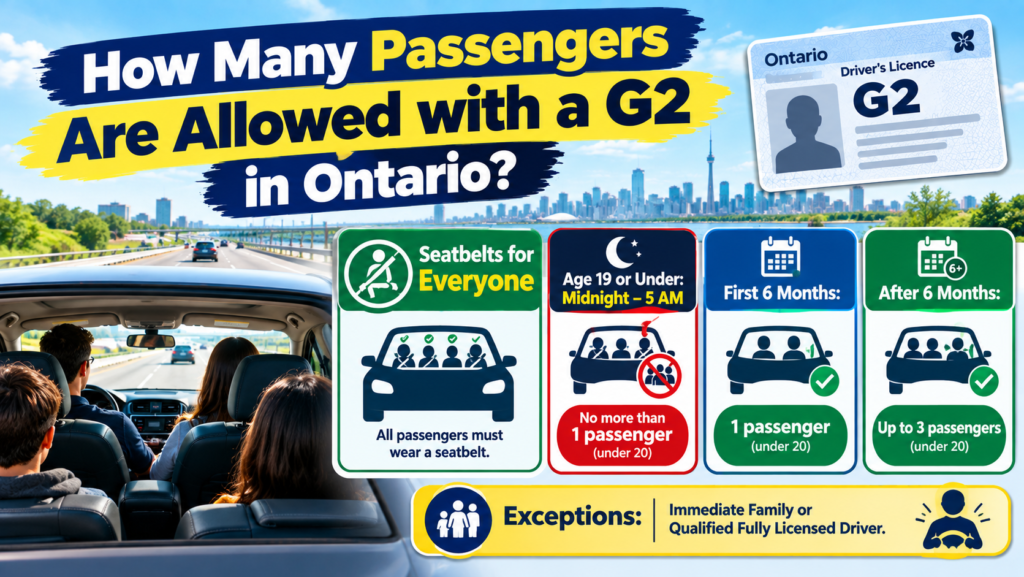
Getting your G2 is the moment driving gets real, and the moment insurance becomes your problem.
At the G2 stage you can buy your own policy for the first time. You’ll also find out that insurers treat new drivers as higher risk, and price accordingly.
This guide explains what affects car insurance for G2 drivers, what the numbers generally look like, and the practical ways to bring your premium down.
Car Insurance for G2 Drivers:Quick Answer
| Question | Answer |
| Can a G2 driver get their own policy? | Yes |
| Cheapest option for most young drivers | Being added to a parent’s or guardian’s policy |
| Biggest cost factors | Age, experience, driving record, vehicle, location |
| Does driver training help? | Many insurers offer a discount for an approved course |
| Does a failed road test raise your rate? | No, it isn’t a conviction on your record |
A note before we start: we’re an MTO-approved driving school, not an insurance broker. Use this as background, then get real quotes from insurers or a licensed broker for your own situation.
What Changes at the G2 Stage?
On a G1, you drive with a fully licensed driver beside you, and you’re covered under that vehicle’s policy. You can’t buy your own.
At the G2 stage, that changes. You can buy your own car and your own insurance policy.
The catch is that insurers see G2 drivers as novice drivers with limited experience, which is one of the strongest predictors of a claim. That’s why new-driver premiums are high.
How Much Is Insurance for G2 Drivers in Ontario?
There’s no single answer, and any site quoting one exact number is guessing about your situation.
Published estimates vary widely:
| Source | Reported Figures |
| ThinkInsure (data from Jan 2022 – Mar 2023) | G2 insurance “between $1,700-$5,000 per year” for drivers with clean records, and 25%–50% more than experienced drivers |
| Onlia | G2 holders averaged $5,091 a year, compared with premiums starting from $3,152 for G licence holders |
Two things matter more than any average:
1. Age. A 17-year-old and a 35-year-old with the same G2 will get very different quotes.
2. Whose policy you’re on. Joining a parent’s policy is usually far cheaper than a standalone one.
Because rates change and vary by insurer, treat these as background and get quotes.
What Affects Your G2 Insurance Cost
| Factor | Why It Matters |
| Age | Younger drivers are statistically higher risk, so premiums are highest in the teens |
| Years licensed | Experience lowers rates over time, even before you reach full G |
| Driving record | Tickets, at-fault accidents and suspensions raise rates sharply |
| Vehicle | Repair costs, theft rates and engine size all feed into the price |
| Location | Rates differ by postal code, based on local claims |
| Coverage choices | Deductibles and optional coverages change what you pay |
| Driver training | An approved course can qualify you for a discount |
Your Two Options: Parent’s Policy or Your Own
Option 1: Added to a Parent’s or Guardian’s Policy
Usually the cheapest route for a young G2 driver. You’re added as a driver on an existing policy, which already benefits from the main driver’s history.
Be honest about who drives the car most. If you’re the primary driver, the policy should say so. Misrepresenting that can cause problems at claim time.
Option 2: Your Own Policy
Necessary if you own your car or don’t live with the policyholder. It gives you your own insurance history, which builds over time, but it typically costs more at the start.
7 Ways G2 Drivers Can Lower Their Insurance
1. Complete an MTO-approved driver training course. Many insurers offer a discount for an approved Beginner Driver Education certificate. ThinkInsure reports savings of up to 10%.
2. Join a parent’s policy while you’re still living at home, if that fits your situation.
3. Choose a sensible car. A modest, safe, inexpensive-to-repair vehicle costs far less to insure than a sporty one.
4. Keep a clean record. One ticket can undo every other saving on this list.
5. Shop around, or use a broker. Quotes for the same driver vary a lot between insurers.
6. Ask about bundling, such as tenant or home insurance with the same company.
7. Get your full G. More experience and a full licence usually mean lower rates.
Our Online G1 Driving Classes are MTO-approved, and completing the course also lets you take your G2 road test after 8 months instead of 12. See how long after G1 to get G2.
What Raises a G2 Driver’s Insurance the Most
As a novice driver, penalties hit harder, and insurers notice.
- Tickets and demerit points. A G2 driver faces a 60-day suspension at 9 demerit points, while a full G driver isn’t suspended until 15.
- Distracted driving. For novice drivers, a first conviction brings a 30-day suspension instead of demerit points.
- Breaking your G2 conditions. Escalating sanctions start at a 30-day suspension.
- At-fault accidents. These usually affect your premium for years.
A suspension on your record is one of the most expensive things that can happen to a new driver’s insurance. See G2 restrictions in Ontario for the full list of rules to protect.
Does Failing Your Road Test Affect Your Insurance?
No. A failed road test isn’t a traffic conviction, so it doesn’t go on your driving record as one, and it isn’t something insurers price for.
What does affect your rate is what happens after you’re licensed: tickets, at-fault accidents and suspensions.
For more on results and retests, see how many mistakes are allowed in the G2 test.
Insurance After You Get Your Full G
Moving from G2 to full G usually helps, for two reasons: you’ve removed the novice label, and you’ve added another year of experience.
You must hold your G2 for 12 months before taking the G road test. Read how long after G2 to get your G, and when you’re ready, our Full G Road Test Preparation gets you highway-ready.
Train With an MTO-Approved School in Simcoe County
Good training does two things for your wallet: it can qualify you for a driver training discount, and it helps you avoid the tickets and collisions that raise premiums for years.
Road Safety Canada trains drivers across Barrie, Innisfil, Bradford, Orillia, Angus, Alliston and Collingwood.
For everything about this licence stage, see our G2 license Ontario guide.
Conclusion
You can’t change your age, but you can control your training, your record and your vehicle, and those are what shape your premium over time.
Road Safety Canada is an MTO-approved driving school helping new drivers across Barrie and Simcoe County build safe habits from day one.
Call 705-300-5570 or register online to start your MTO-approved course today.
Frequently Asked Questions
Can a G2 driver get their own car insurance in Ontario?
Yes. At the G2 stage you can buy your own vehicle and your own insurance policy, which you cannot do on a G1.
How much is insurance for G2 drivers in Ontario?
It varies widely by age, record, vehicle and location. Published estimates range from about $1,700 to $5,000 a year for drivers with clean records, with much higher figures for teenage drivers, so get quotes for your own situation.
Is it cheaper to be added to a parent’s policy?
For most young G2 drivers, yes. Being added to a parent’s or guardian’s policy is usually cheaper than buying a standalone policy.
Does driver training lower insurance for G2 drivers?
Many insurers offer a discount to drivers who complete an MTO-approved Beginner Driver Education course. Ask your insurer what discount applies before you enrol.
Does a failed G2 road test affect your insurance?
No. A failed road test is not a traffic conviction, so it does not go on your driving record as one and insurers do not price for it.
Why is G2 insurance so expensive?
Insurers price on risk, and novice drivers have less experience and a higher likelihood of claims. Age, vehicle type and location also push new-driver premiums higher.
Does insurance go down when you get your full G?
Usually. Moving to a full G removes the novice classification and adds another year of driving experience, which generally lowers premiums.