
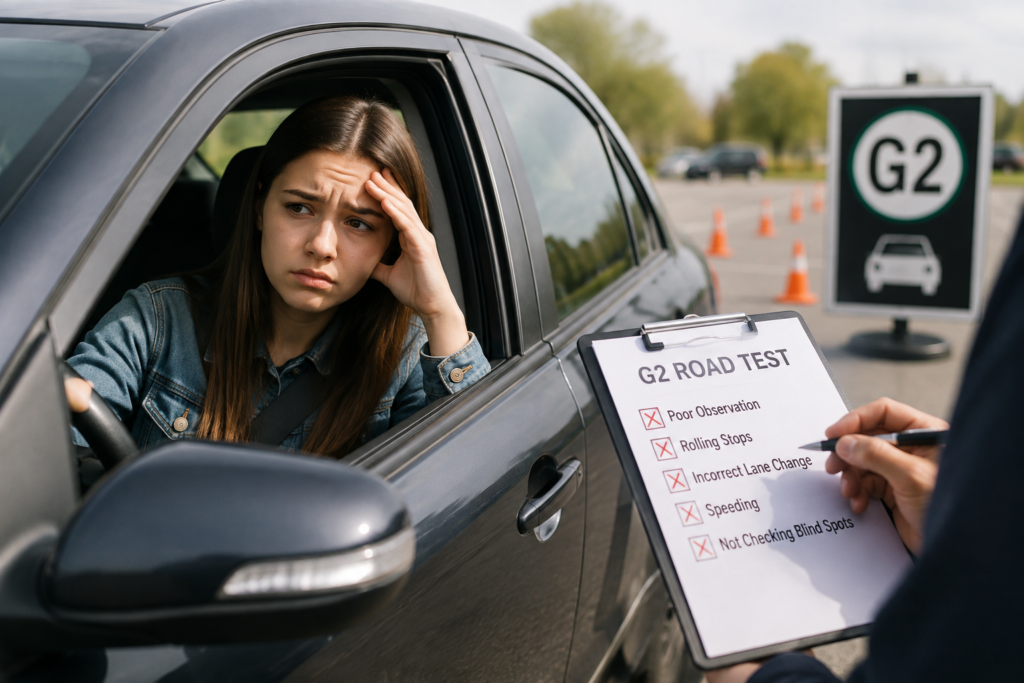
Passing your G2 road test — officially the G1 Exit Test — comes down to more than knowing how to drive. Most new drivers who don’t pass on their first attempt aren’t struggling with parallel parking or three-point turns. They’re losing marks on small, repeatable habits: a missed shoulder check, a rolling stop, a lane change without a signal. None of these come from a lack of driving ability. They come from habits that haven’t been tested under real pressure yet.
The good news is that almost every mistake on this list is preventable once you know what to watch for, and most students who understand these patterns ahead of time avoid making them on test day.
If you’re still unclear on what the test actually involves, our complete guide on how to pass the G2 test in Barrie covers the format and preparation basics first. Otherwise, here are the most common G2 road test mistakes new drivers make in Ontario, and what to do instead.
1. Rolling Through Stop Signs Instead of Coming to a Complete Stop
A “rolling stop” happens when you slow down at a stop sign but never fully stop before moving again. It’s one of the most consistently reported reasons for a failed G2 road test, because it signals to the examiner that you may not fully respect a basic road rule, not just that you made a small error.
How to avoid it: Come to a complete stop behind the stop line, check both directions, and count a full second before moving. It should feel like a deliberate pause, not a brief slowdown.
2. Skipping or Rushing Shoulder Checks
It’s easy to forget a shoulder check when you’re nervous, but it’s one of the first things a DriveTest examiner notices. Mirrors alone don’t show what’s in your blind spot, so skipping the shoulder check suggests incomplete observation, even if nothing was actually there.
How to avoid it: Build the habit of shoulder-checking before every lane change, turn, and merge, not just when you remember to. It should become automatic long before test day.
3. Forgetting to Check Mirrors Regularly
Beyond shoulder checks, examiners want to see ongoing mirror checks throughout the drive, not just before a specific maneuver. New drivers often focus so much on the road ahead that they forget to check what’s happening behind them.
How to avoid it: Get into the habit of checking your mirrors every five to ten seconds, even when nothing seems to be happening. Active, continuous awareness matters more than a single well-timed glance.
4. Changing Lanes Without Signaling Early Enough
Signaling late, or forgetting to signal at all, is one of the most common lane-change mistakes on the G2 road test. Even when the lane change itself is executed safely, a late or missing signal tells the examiner other drivers weren’t given enough warning.
How to avoid it: Signal well before you start moving, not at the same moment. Give other drivers time to see your intention and react.
5. Driving Too Fast or Too Slow for the Conditions
Speeding is an obvious mistake, but driving noticeably below the speed limit without a clear reason can be just as costly. It signals hesitation and a lack of confidence, and it can disrupt the flow of traffic around you.
How to avoid it: Aim to drive at the posted speed limit when conditions allow, and adjust smoothly for traffic, weather, or school and community safety zones rather than driving cautiously the entire route.
6. Poor Observation at Intersections
Examiners expect you to actively scan left, right, and ahead before proceeding through every intersection, not just look straight ahead. Missing a pedestrian, cyclist, or oncoming vehicle because you didn’t fully scan the intersection is a common and serious mistake.
How to avoid it: Treat every intersection the same way, whether it’s controlled by a light, a stop sign, or nothing at all. Scan deliberately before proceeding, every time.
7. Parking Mistakes During Parallel and Reverse Parking
Parallel parking and reverse parking are often what new drivers worry about most, but they’re not usually the top reason for failing. Common issues include hitting the curb, taking too many corrections, or ending up too far from the curb to be considered a safe, controlled park.
How to avoid it: Practice parking in a few different real-world spots, not just one familiar driveway or lot. Comfort with the technique matters more than memorizing one specific scenario.
8. Turning Too Wide or Cutting Corners
Turning too wide can put you in the wrong lane after completing a turn, while cutting a corner too tightly can bring you into oncoming traffic or over a curb. Both mistakes usually come from misjudging the turning radius rather than a lack of driving ability.
How to avoid it: Slow down before the turn, not during it, and aim to stay centred in your lane as you complete the turn rather than drifting toward either edge.
9. Following Too Closely
Tailgating, even briefly, is a common mistake under the pressure of a road test. New drivers sometimes close the gap behind slower traffic without realizing it, especially in stop-and-go conditions.
How to avoid it: Use the three-second rule: pick a fixed point on the road, and make sure at least three seconds pass between the vehicle ahead of you passing it and you reaching the same point.
10. Letting Nerves Take Over Behind the Wheel
Nervousness itself isn’t a mistake, but it often leads to hesitation, missed checks, and second-guessing that compound into real errors. Examiners are trained to notice indecisive driving, since it can be just as unsafe as overconfidence.
How to avoid it: Familiarity is the best antidote to nerves. The more comfortable you are with the vehicle and general driving conditions, the less likely nervousness is to affect your decisions during the test.
11. Showing Up With an Unroadworthy Vehicle or Missing Documents
A vehicle with a burnt-out brake light, low fuel, expired registration, or a cracked windshield in your direct line of sight can get your test cancelled before it even starts. Missing documents, like your G1 licence or proof of insurance, can cause the same result.
How to avoid it: Check your vehicle thoroughly the day before your test, not the morning of, and lay out every required document ahead of time so nothing is a last-minute scramble.
12. Not Yielding the Right-of-Way Correctly
Uncontrolled intersections, four-way stops, and left turns across oncoming traffic all require judgment about who has the right-of-way. New drivers sometimes hesitate too long out of caution, or misjudge their turn and proceed when they shouldn’t have. Both versions of this mistake stand out clearly to an examiner.
How to avoid it: Review the right-of-way rules for four-way stops, uncontrolled intersections, and turns before your test, and practice them specifically rather than assuming general driving experience covers it.
13. Poor Positioning Within the Lane
Drifting toward the edge of a lane, hugging the centre line, or straddling two lanes briefly during a turn are common signs of inconsistent steering control. On their own these may seem minor, but examiners are watching for steady, predictable positioning throughout the drive.
How to avoid it: Practice keeping a consistent position in your lane, especially on wider roads where drifting is easier to miss. Small steering corrections should feel smooth, not sudden.
14. Not Practicing Enough Before Test Day
This isn’t a single mistake so much as the root cause of several others on this list. Rolling stops, late signals, and hesitant intersection decisions often come down to simply not having enough consistent, structured practice before test day. If you’re not sure how much practice is enough, our G2 driving lessons are built around exactly this kind of structured, test-focused preparation.
How to avoid it: Prioritize consistency over volume. A few focused practice sessions each week in the lead-up to your test tends to build stronger habits than one long session the day before.
How to Avoid These Mistakes on Your G2 Road Test
Most of the mistakes above share a common thread: they’re habits, not knowledge gaps. New drivers usually know the rules, but under the pressure of a real test, small habits slip, a mirror check gets skipped, a signal comes a beat too late, a stop feels complete when it wasn’t quite. That’s why consistent practice, ideally with feedback from someone other than yourself, tends to matter more than last-minute cramming the night before.
If you’re still building your foundational knowledge, our guide to getting a new driver’s licence in Barrie, Ontario walks through the G1 rules, the G2 stage and its restrictions, and what to expect once you’ve passed, all in one place.
Conclusion:
A structured lesson plan with a certified instructor helps because it catches habits you may not notice on your own, like a mirror check you’re skipping without realizing it, or a turn you’re consistently cutting too tight. With Road Safety Canada, instead of guessing what went wrong after a failed attempt, you get direct, specific feedback before test day, while there’s still time to fix it.
G2 driving lessons in Barrie cover exactly what’s included, from mock road tests designed to mirror the real evaluation to one-on-one coaching focused on the specific habits examiners look for most.
Frequently Asked Questions
What is the most common reason drivers fail the G2 road test?
It varies by driver, but rolling stops, missed shoulder checks, and late or missing signals are among the most consistently reported mistakes across Ontario road tests.
Is one mistake enough to fail the G2 test?
Not usually. A single minor error may not cause a failure on its own, but a serious safety issue, or a pattern of repeated mistakes, generally will.
Can nervousness alone cause you to fail?
Nervousness itself isn’t scored directly, but it often leads to the hesitation, missed checks, and indecision that examiners do evaluate.
Do I need perfect parallel parking to pass?
No. A few corrections during parking are generally acceptable as long as the maneuver is completed safely and under control.
How can I find out exactly what went wrong if I don’t pass?
The examiner will explain the reasons for a failed result at the end of the test, which is the most reliable way to know what to focus on before your next attempt.
Are the same mistakes evaluated on the full G test too?
Many of the same fundamentals apply, but the G test also includes highway driving, which brings its own set of skills, like merging and lane changes at higher speeds, that aren’t tested during the G2 road test.
Should I take a mock road test before my actual G2 test?
It can help. A mock test run through the kinds of situations you’ll face on test day and gives you specific feedback on habits you might not notice yourself, without the pressure of an official result.

