
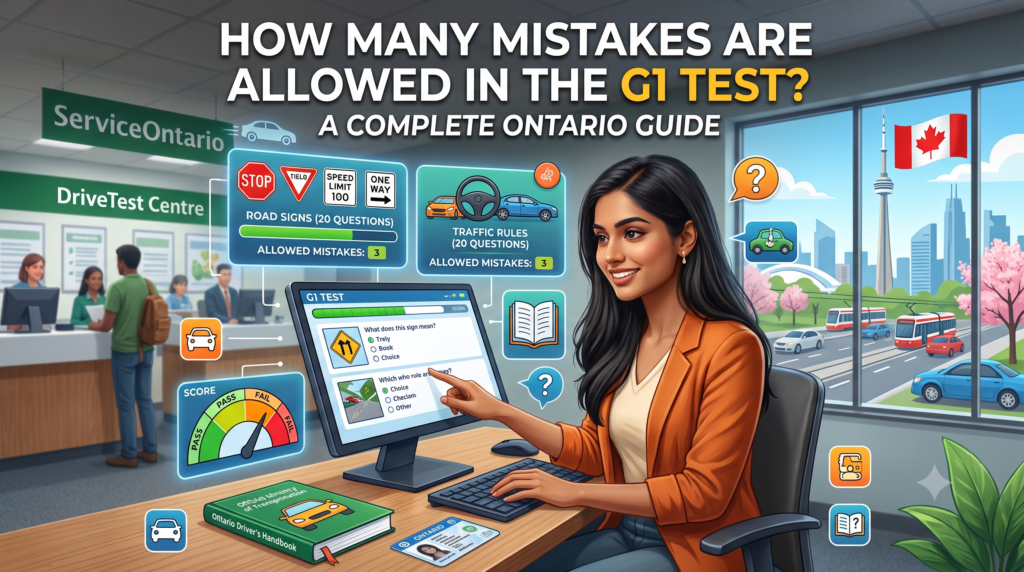
If you are preparing for the Ontario G1 test, one of the first questions you probably have is simple: how many mistakes are allowed in the G1 test? The short answer is that the G1 knowledge test is scored in two parts, and you need to answer at least 16 out of 20 questions correctly in each section to pass.
That means you cannot rely on a strong score in one section to cover mistakes in the other; both road signs and rules of the road matter equally.
For many new drivers, the G1 written test feels stressful because it is not just about memorizing answers. It checks whether you actually understand basic driving rules, road signs, and safe driving behavior in Ontario.
The good news is that with the right strategy, it is a very manageable test. Most ranking articles on this topic focus on study tips, common mistakes, practice tests, and clear pass/fail guidance, which shows that searchers want practical help rather than vague advice
If you’re just starting your licensing journey, it also helps to understand how to get a new driver’s license in Ontario before diving into test prep.
How Many Mistakes Are Allowed in the G1 Test?
The G1 test has 40 questions total, divided into two sections: road signs and rules of the road. Each section has 20 questions, and you need to answer at least 16 correctly in each section to pass. In simple terms, that means you can make up to 4 mistakes in each section, but no more.
This is an important detail because many learners think they can make a total number of mistakes across the whole test and still pass. That is not how the Ontario G1 knowledge test works.
Even if you score well in road signs, you still need to pass the rules section, and the same is true in reverse. So the safest mindset is to prepare for both parts equally
A simple example makes this easier to understand. Suppose you get 18/20 in road signs and 15/20 in rules of the road. Your total is 33/40, which may look decent, but you would still fail because the rules section is below the passing mark. That is why focused preparation is more important than overall guesswork.
What Is the G1 Written Test Be Like?
The G1 written test is the knowledge test you take to begin the Ontario licensing process. It checks whether you understand traffic signs, road rules, and basic driving safety. The exam is multiple-choice and is usually taken at a DriveTest center or an approved testing location.
The two sections are designed to test different skills. Road signs questions check whether you can recognize signs, warnings, restrictions, and instructions on the road.
Rules of the road questions check whether you understand right-of-way, speed limits, turning rules, parking, lane use, and safe driving behavior. This split is why many blogs give separate practice strategies for each section.
The best way to think about the test is this: road signs are about recognition, while rules are about understanding. A learner who memorizes signs but ignores the handbook may do poorly on rules. On the other hand, someone who reads the handbook but never practices sign recognition may lose easy marks on the signs section.
G1 Mistakes You Should Avoid
One of the biggest mistakes is rushing through practice tests without reviewing the wrong answers. Practice only works when you learn why an answer is correct, not just when you see a score go up. If you keep repeating the same test without studying your weak areas, you may feel ready when you are not.
Another common mistake is confusing similar road signs. Many signs look alike at first glance, especially when they differ only in shape, colour, or wording. Because road signs are a high-weight part of the exam, a few careless sign errors can quickly cost you marks
Many learners also underestimate the handbook. They depend too much on online quizzes and skip the official material. That is risky because practice tests are useful for checking readiness, but the handbook gives the logic behind the answers. If you only memorize answers, you may struggle when the question wording changes slightly.
A final mistake is not preparing separately for each section. The G1 test is not one combined score where good performance in one area fixes weak performance in another. You need to treat both sections like separate mini-exams.
G1 Written Test Mistakes That Cost Marks
The wording of a question matters a lot. Words like “must,” “except,” “not,” and “always” can completely change the meaning of the question. A rushed reader may know the topic but still select the wrong answer because they missed one word.
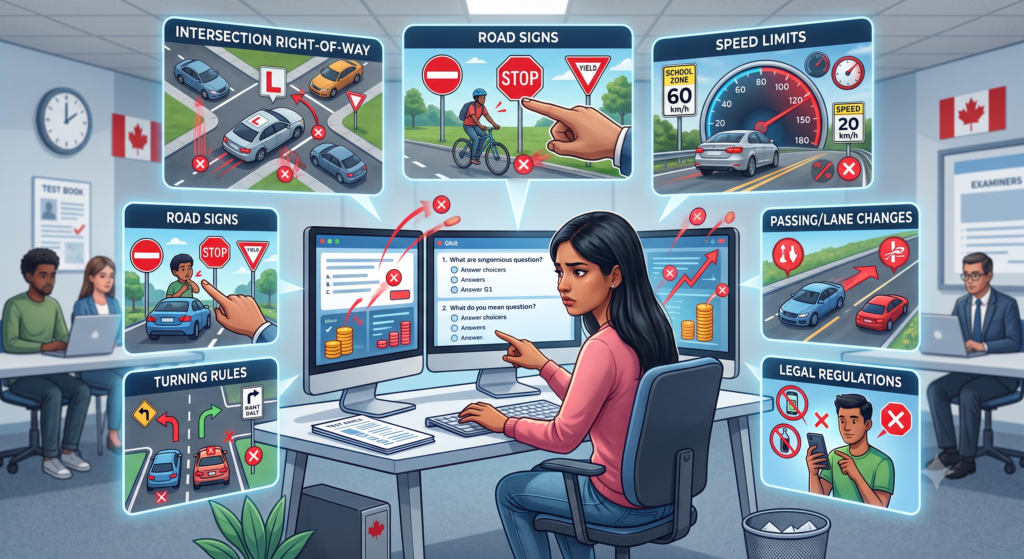
Another costly mistake is guessing too early. Guessing is sometimes unavoidable, but many learners guess before fully reading the sign or question. In a test with only 4 mistakes allowed per section, careless guessing can be expensive. The better habit is to eliminate obviously wrong options first and then choose the best answer.
Some people also forget the practical side of Ontario driving rules. They may know a definition but not understand how it applies on the road. Questions about right-of-way, pedestrian safety, school zones, and speed limits often require understanding, not just memory. This is why strong preparation should combine reading, practice, and review.
What Is the Hardest Part of the G1 Test?
For many learners, the hardest part is the road signs section. The reason is simple: many signs look similar, and small visual differences can change the meaning completely. If you do not practice enough, these questions can feel confusing even when you know the general driving rules.
For other learners, the rules of the road section is harder. This usually happens when they understand the idea but not the exact Ontario rule. For example, they may know what safe driving is in general, but the test asks for a specific legal or safety action. That is why the hardest part is often the section where the learner has less direct practice.
A useful way to reduce difficulty is to study the test in two layers. First, learn the basic idea. Then, do practice questions until the answer becomes automatic. That is the same pattern seen in many high-ranking guides: explain the topic, then train with practice questions.
What If I Fail the G1 Test?
Failing the G1 test is disappointing, but it is not unusual. Many new drivers fail the first time simply because they depended on general knowledge instead of studying the Ontario handbook and practicing properly. The important part is not the failure itself, but how you prepare for the next attempt.
If you fail, the smartest step is to review the section where you lost the most marks. Do not restart from zero mentally; instead, focus on the topics that caused confusion. For example, if road signs were weak, spend a few days just on sign recognition. If the rules section was weak, go back to the handbook and practice rule-based questions.
It also helps to take one or two full mock tests after you study. That gives you a better idea of whether you are truly ready. The goal is not just to pass eventually, but to pass with confidence and fewer surprises.
Can You Retake G1 Immediately?
In practical terms, retaking depends on the booking system and availability at the testing location, so you should always check the rebooking process before planning your next attempt. Even when a retake is possible soon, it is usually better to wait until you have corrected your weak areas. A fast retake without study may lead to the same result again.
If your schedule allows, give yourself a short reset period. Use that time to focus on the parts of the handbook you missed. The second attempt should be smarter, not just faster.
What Happens If You Cheat on Your G1 Test?
Cheating is a serious mistake and can lead to the test being invalidated and further consequences. It is not worth the risk, especially for a knowledge test that is already manageable with proper study. A better approach is to prepare honestly and build confidence through practice.
The G1 test is designed to check whether you understand the basics of safe driving. If you try to cheat, you are not solving the real problem, which is learning the rules you will later need on the road. Honest preparation is both safer and smarter.
What Is the Easiest Way to Pass the G1 Test?
The easiest way to pass is to study in a structured way instead of cramming. Start with the official handbook, then divide your preparation into road signs and rules of the road. After that, take practice tests and review every wrong answer carefully.If you’d rather learn from a certified instructor, it’s worth checking why a certified driving school can make this whole process faster and less stressful.
A simple study approach works well for most learners:
- Spend the first part of your study time on road signs.
- Move to rules of the road.
- Take short practice tests every day.
- Revisit the questions you got wrong.
- Take one final mock test before exam day.
This method works because it combines reading with repetition. It is also more effective than trying to memorize hundreds of questions without understanding them. The ranking pages on this topic consistently support this style of preparation.
G1 Test Study Plan for Canada
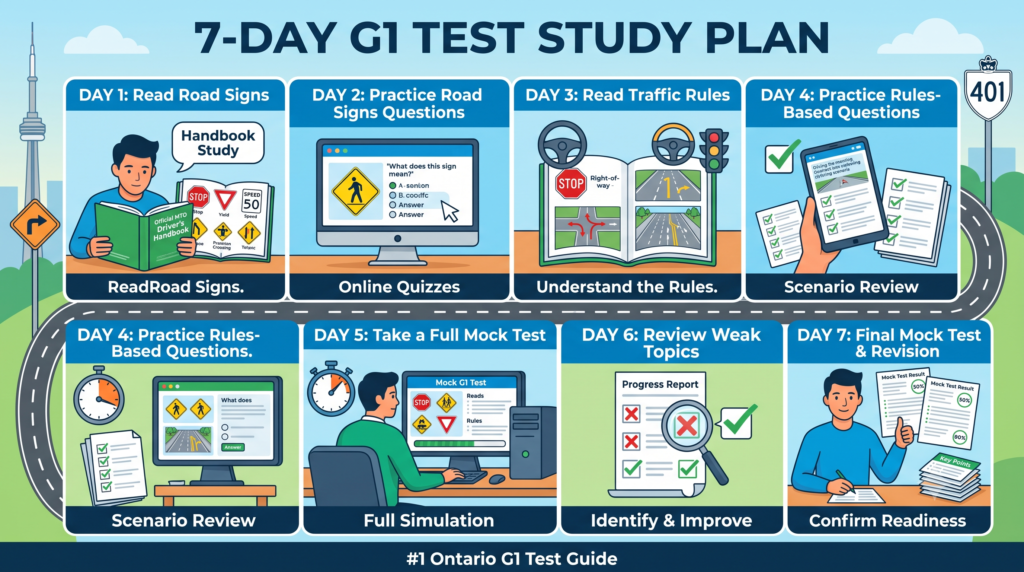
If you want a simple 7-day plan, here is a practical version:
Day 1: Read the road signs section of the handbook.
Day 2: Practice road signs questions.
Day 3: Read the rules of the road section.
Day 4: Practice rules-based questions.
Day 5: Take a full mock test.
Day 6: Review weak topics and wrong answers.
Day 7: Take another mock test and revise key points.
This type of plan works well because it keeps the workload manageable. You do not need to study all day; short, focused sessions are enough if you stay consistent. Many modern preparation guides use similar structured plans because they are easier for beginners to follow.
Conclusion
So, how many mistakes are allowed in the G1 test? The practical answer is up to 4 mistakes in each section, because you need at least 16 correct answers out of 20 in both road signs and rules of the road. That means the key to passing is balanced preparation, not just overall guessing.
If you study the handbook, practice signs separately, and review your weak areas, passing becomes much easier. The G1 test is designed to test readiness, and with a structured plan, most learners can handle it confidently.
At Road Safety Canada, we help new drivers confidently prepare for their G2 and Full G road tests. After passing your G1 test, the next step is choosing a trusted driving school that provides professional instruction and practical driving experience. Our certified instructors in Barrie will help you build safe driving habits and give you the confidence to pass your G2 or Full G test on your first attempt. Contact us today to book your Online driving Class.

