Class G, Class D, Class A, M2… Ontario’s licence system can look like alphabet soup.
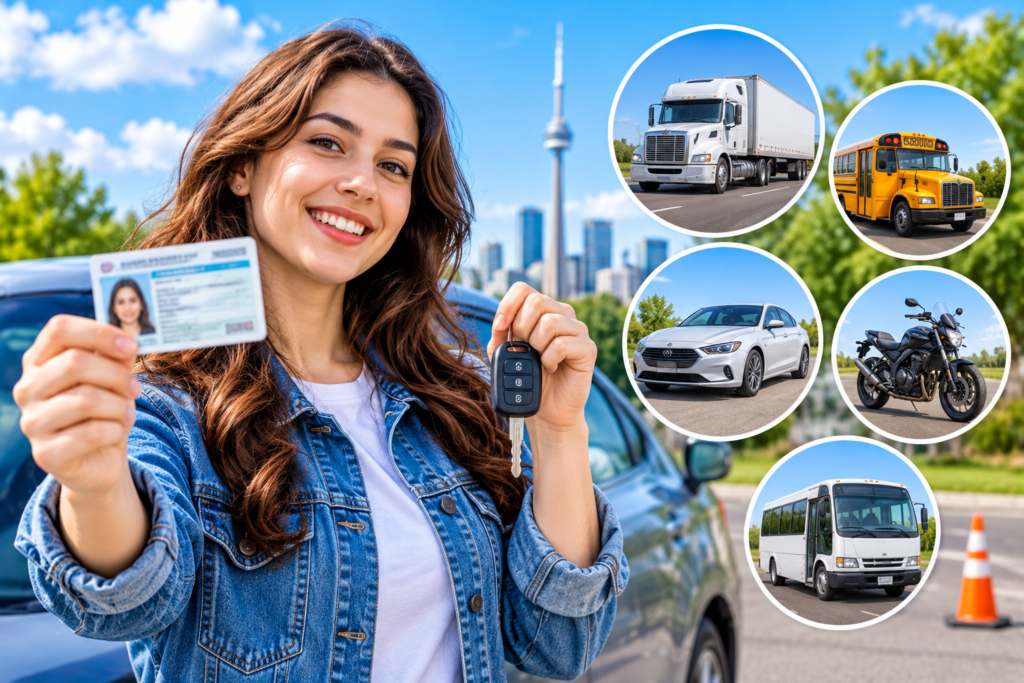
The good news: most people only ever need one of them, a Class G licence, to drive a car, SUV, minivan or pickup. The other Ontario licence classes are for motorcycles, trucks, buses and ambulances.
This guide explains what every class lets you drive, which licence you actually need, and how to get your G, step by step.
In this guide9 sections
Ontario Licence Classes at a Glance
| Class | What you can drive | Also lets you drive |
|---|---|---|
| G | Cars, vans, SUVs, small trucks and recreational vehicles, towing up to 4,600 kg | n/a |
| G1 / G2 | Class G vehicles, with learner conditions | n/a |
| M | Motorcycles, motor tricycles, scooters and mopeds | G (with G1 conditions) |
| A | Any tractor-trailer combination | D, G |
| B | Any school bus | C, D, E, F, G |
| C | Any regular bus | D, F, G |
| D | Trucks and other motor vehicles over 11,000 kg | G |
| E | School bus carrying up to 24 passengers | F, G |
| F | Regular bus carrying up to 24 passengers, and ambulances | G |
Which Licence Do I Need?
- Car, SUV, minivan or pickup: Class G
- Pickup towing a camper or boat: usually Class G, if the trailer is 4,600 kg or less
- Motorcycle: Class M
- Moped or motorized scooter: Class M with an L condition
- Moving truck or straight truck over 11,000 kg: Class D
- Tractor-trailer: Class A
- School bus: Class B (or E for 24 passengers or fewer)
- City bus: Class C (or F for 24 passengers or fewer)
- Ambulance: Class F
Class G: The Licence Most Ontario Drivers Need
A Class G licence lets you drive cars, vans, SUVs, small trucks and recreational vehicles. It’s the licence nearly every Ontario driver has, and you get it through graduated licensing: three stages, G1, G2 and full G.
You must be at least 16 to start, and the whole process takes at least 20 months.
G1: Your learner’s licence
You get a G1 by passing a vision test and a written knowledge test. With a G1, you:
- must drive with a fully licensed driver who has at least 4 years of experience
- must have zero blood alcohol
- can’t drive between midnight and 5 a.m.
- can’t drive on 400-series highways, unless you’re with a certified driving instructor
The G1 stage lasts 12 months, or 8 months if you complete an approved Beginner Driver Education course. Start with our G1 licence guide.
G2: Driving on your own
Pass your first road test and you move to a G2. You can drive alone, at any time and on any road, but you still need zero blood alcohol, and there are passenger limits at night for drivers 19 and under. After at least 12 months, you can take your final road test. See our guide to G2 restrictions in Ontario.
Full G: No more learner conditions
Pass your G road test and you have a full licence. You have 5 years from starting to finish the whole process, or you’ll have to start over. Not sure what changes? Read about the difference between G2 and G.
What can you tow with a Class G licence?
With a G, you can tow a trailer weighing up to 4,600 kg, as long as the combined weight is 11,000 kg or less. That covers most boats and campers. Heavier trailers need a Class D or A.
Start your G journey the right way. Road Safety Canada is an MTO-approved driving school in Barrie. Our online driving classes can shorten your G1 wait to 8 months, and our G2 driving lessons get you road-test ready.
Class M: Motorcycles, Scooters and Mopeds
Riding a motorcycle in Ontario needs a Class M licence, earned in stages:
- M1: a learner stage, valid for 90 days. You can take your first road test after 60 days.
- M2: zero blood alcohol. You can take the final road test after 22 months, or 18 months with an approved motorcycle safety course.
- M: full motorcycle licence.
For mopeds and motorized scooters, you need an M with an L condition. A Class G licence doesn’t cover them. An M with an M condition covers motor tricycles only.
Commercial Licence Classes in Ontario
Classes A to F are for people who drive trucks, buses and ambulances. You need a full Class G licence before you can apply for any of them, and you’ll also need to be at least 18, pass a medical, and pass a knowledge test and a road test.
Road Safety Canada focuses on Class G training. For commercial licences, look for an MTO-approved commercial training provider.
Class A licence in Ontario
A Class A licence lets you drive any tractor-trailer combination, and it also covers Class D and G vehicles.
- New Class A applicants generally must complete mandatory entry-level training (MELT) of at least 103.5 hours with an approved provider before the road test.
- If you take the road test in a combination without air brakes, you get a restricted Class AR licence instead.
- From January 1, 2027, you’ll need to have held a G (or higher) licence for at least 6 months before your Class A road test.
Class B licence in Ontario
A Class B licence is for school buses of any size. It also covers Classes C, D, E, F and G.
Class C licence in Ontario
A Class C licence is for regular buses, such as city transit buses. It also covers Classes D, F and G.
Class D licence in Ontario
A Class D licence lets you drive trucks and other motor vehicles over 11,000 kg, or a truck towing a vehicle up to 4,600 kg. It also covers Class G. A D with a Q condition is limited to large recreational vehicles.
Class E licence in Ontario
A Class E licence covers school buses carrying up to 24 passengers. It also covers Classes F and G.
Class F licence in Ontario
A Class F licence covers regular buses carrying up to 24 passengers, and ambulances. It also covers Class G.
Endorsements
- Z endorsement: needed to drive any vehicle with air brakes.
- RV endorsement: on a G, E or F licence, lets you drive a recreational vehicle over 11,000 kg and up to 14,000 kg.
Can One Licence Cover Several Classes?
Yes. Higher classes include lower ones: a Class A includes D and G, and a Class B includes C, D, E, F and G. You can also combine a car or commercial class with a motorcycle licence, for example GM if you can drive both a car and a motorcycle.
Start With Your G: We’ll Get You There
Every Ontario licence starts with a Class G. At Road Safety Canada, we help new drivers across Barrie and Simcoe County move from G1 to full G with confidence:
- Online driving classes: MTO-approved BDE that can cut your G1 wait to 8 months
- G2 driving lessons in Barrie
- Road test preparation
Call 705-300-5570 or register online.
Conclusion:
Ontario’s licence classes run from G for everyday cars, through M for motorcycles, to A to F for trucks, buses and ambulances. Each higher class builds on the ones below it, and every commercial class requires a full G first.
For most drivers, the only class that matters is Class G, and the fastest, safest way to get it is with proper training.
At Road Safety Canada, our MTO-approved instructors guide new drivers across Barrie and Simcoe County from G1 to full G. Call 705-300-5570 or start your journey today.
Frequently Asked Questions
What is a Class G licence in Ontario?
A Class G licence lets you drive cars, vans, small trucks and recreational vehicles, and tow a trailer up to 4,600 kg. You get it in three stages: G1, G2 and full G.
What can you drive with a Class D licence in Ontario?
Trucks and other motor vehicles over 11,000 kg, or a truck towing a vehicle up to 4,600 kg. A Class D also lets you drive Class G vehicles.
What is a Class A licence in Ontario?
A Class A licence lets you drive any tractor-trailer combination. It also covers Class D and Class G vehicles.
What’s the difference between Class B and Class C?
Class B is for school buses, and Class C is for regular buses such as city transit buses. Class B also covers Class C vehicles.
What is a Class F licence?
A Class F licence lets you drive a regular bus with up to 24 passengers, as well as ambulances.
Do I need a full G licence before getting a commercial licence?
Yes. You need a full Class G licence before you can apply for Class A, B, C, D, E or F.
Can I drive a moped with a car licence in Ontario?
No. Mopeds and motorized scooters need a motorcycle licence with an L condition, which is limited to limited-speed motorcycles and mopeds.
Ready to practise with an MTO-approved instructor?
Build real confidence in traffic with G2 lessons and Full G road test preparation in Barrie and across Simcoe County.