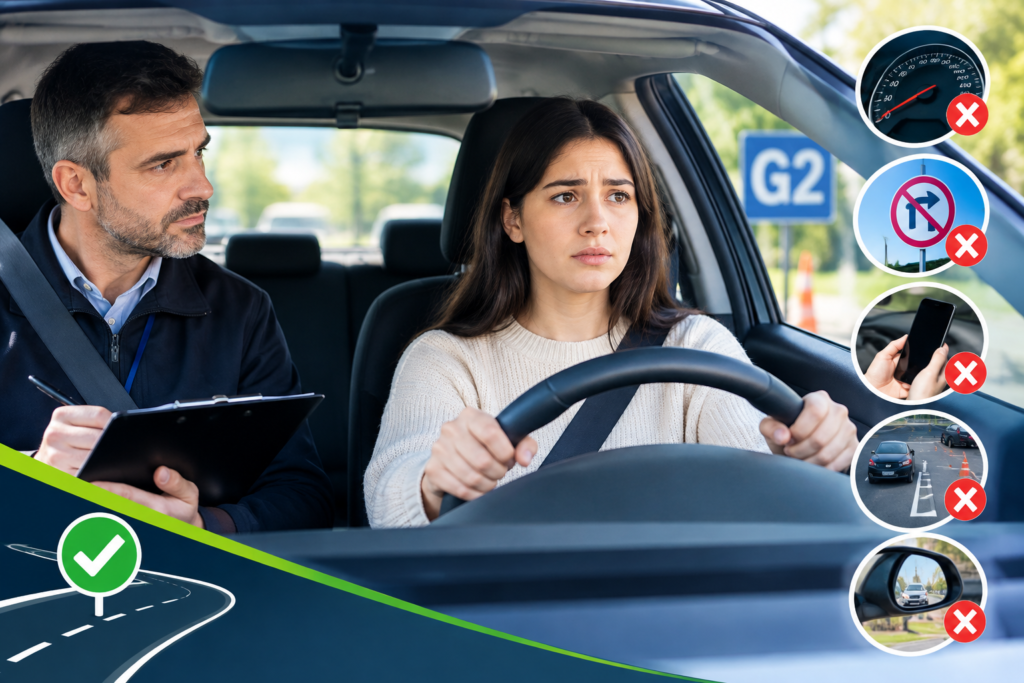
Failing your G2 road test can feel discouraging, especially after weeks of practice. The good news is that most failures come down to a small, predictable list of mistakes.
Ontario’s G2 pass rate typically sits around 50-60% on the first attempt. That’s not because the test is unfair — it’s because small habits add up fast under pressure.
This guide breaks down the most common reasons drivers fail, and exactly how to avoid each one before your test day arrives.
The G2 test focuses entirely on real city driving — lane changes, turns, intersections, and one parking or turning maneuver. Highway driving is saved for your full G test later.
In this guide12 sections
- 1. Rolling Through Stop Signs
- 2. Missing Blind Spot Checks
- 3. Improper Lane Changes
- 4. Poor Speed Control
- 5. Failing to Yield Right-of-Way
- 6. Wide Turns and Cutting Corners
- 7. Parking or Three-Point Turn Mistakes
- 8. Nerves in the First Few Minutes
- What Happens If You Fail Your G2 Test?
- How Road Safety Canada Helps You Avoid These Mistakes
- Ready to Book Your G2 Lessons?
- Frequently Asked Questions
1. Rolling Through Stop Signs
A rolling stop is one of the single biggest reasons new drivers fail. Slowing down isn’t the same as stopping — your wheels need to be completely still.
Examiners are trained to watch for this specifically, and even a small rolling motion can count as a major error, especially near school zones.
How to avoid it: Come to a full stop behind the line, count “one-one-thousand” in your head, then check both directions before moving again.
This applies at every stop sign on the route, not just the ones close to the DriveTest centre. Examiners are watching the entire drive, not just a few key moments.
2. Missing Blind Spot Checks
Checking your mirrors isn’t enough on its own. Examiners want to see a clear, physical head turn before every lane change, merge, or turn.
Skipping this step — even when the road looks empty — is one of the most commonly missed points on the entire test.
Some students get so used to checking mirrors at home that they forget the shoulder check entirely once nerves kick in.
How to avoid it: Make the head turn a habit in every single lesson, not just when you remember. It should feel automatic by test day.
3. Improper Lane Changes
A proper lane change has a specific order: mirror, signal, shoulder check, then move. Skipping or rushing any one of these steps stands out immediately to an examiner.
Signaling too late, or not signaling at all, is a common and completely avoidable mistake that costs students real points.
How to avoid it: Practice the full sequence slowly at first — mirror, signal, shoulder check, move — until it becomes second nature, not something you have to think through.
4. Poor Speed Control
Many new drivers assume driving slowly and carefully is always the safer choice. On the G2 test, driving too far under the speed limit can actually count against you.
Examiners are also watching for the opposite problem — speeding, even by a small margin, especially near schools or crosswalks.
How to avoid it: Practice matching the posted speed limit consistently, adjusting only for genuine road conditions like weather, traffic, or visibility.
School and playground zones often have reduced limits at specific times of day. Forgetting to slow down there is a common and costly mistake.
5. Failing to Yield Right-of-Way
Not yielding properly to pedestrians, cyclists, or other vehicles is treated as a serious safety concern. In many cases, it results in an automatic fail on the spot.
This mistake often happens at crosswalks and four-way stops, where new drivers misjudge who has the right to go first.
How to avoid it: When in doubt, slow down and let others go first. Hesitation is never penalized on this test — unsafe assumptions are.
6. Wide Turns and Cutting Corners
Turning too wide, or cutting a corner too tightly, both stand out to an examiner. It signals a lack of control over the vehicle’s positioning on the road.
This often happens when drivers focus too much on other cars and forget to watch their own lane position through the turn itself.
How to avoid it: Practice turns slowly in quiet neighbourhoods first, focusing on staying centred in your lane from entry to exit.
7. Parking or Three-Point Turn Mistakes
Every G2 test includes either a parallel park or a three-point turn, and examiners expect it done cleanly, not necessarily perfectly on the first try.
Common mistakes include ending up too far from the curb, taking too many correction moves, or forgetting to check surrounding traffic during the maneuver itself.
How to avoid it: Practice both maneuvers repeatedly in a quiet parking lot before test day, so muscle memory takes over instead of guesswork.
8. Nerves in the First Few Minutes
Most test failures don’t happen because of one big mistake. They happen because a small error in the first five minutes shakes a driver’s confidence for the rest of the test.
Nervous energy leads to rushed decisions, missed checks, and hesitation at exactly the wrong moments — often on maneuvers the driver had already mastered in practice.
How to avoid it: Arrive early, take a few deep breaths before you start, and treat the first few minutes like any other part of the drive, not a special moment to get perfect.
What Happens If You Fail Your G2 Test?
A failed test isn’t the end of the road. Most drivers pass on a later attempt once they’ve addressed the specific feedback they were given.
You’ll need to wait a mandatory period before rebooking, and real DriveTest appointment availability can add extra weeks on top of that minimum.
The examiner’s feedback sheet is genuinely useful. It tells you exactly which errors counted against you, so your next round of practice can target them directly instead of guessing.
How Road Safety Canada Helps You Avoid These Mistakes
Every mistake on this list is fixable with focused, honest practice — which is exactly what our in-car lessons are built around.
Our certified instructors identify your specific habits early, so you’re not just driving more hours, you’re correcting the exact patterns that cause most G2 failures.
We also practice parking, turns, and realistic test routes similar to what Barrie and Simcoe County DriveTest centres use, so nothing on test day feels unfamiliar.
If you’ve already got your G1 and you’re getting ready for your G2, our full guide on how to pass the G2 test in Barrie covers local test routes and what to expect on the day.
And if you’re just starting your licensing journey, our complete G1 license guide walks you through everything from your first knowledge test to this exact stage.
Whether you’re testing out of Barrie, Orillia, or anywhere else in Simcoe County, the same core habits apply everywhere the G2 test is given.
Ready to Book Your G2 Lessons?
Every mistake on this list is preventable with the right preparation. That’s exactly what our G2 road test lessons are designed to fix, one habit at a time.
Book your G2 driving lessons with Road Safety Canada and get personalized, test-specific coaching from certified instructors across Barrie and Simcoe County.
Frequently Asked Questions
How many times can I fail the G2 road test?
There’s no limit on attempts, but you’ll need to pay the test fee again each time and wait a mandatory period before rebooking.
What counts as an automatic fail on the G2 test?
Actions like running a red light, failing to yield to a pedestrian, or creating a dangerous situation typically result in an immediate fail, regardless of your overall performance.
Does nervousness actually affect my score?
Not directly. Examiners can’t mark you down for being nervous, but nervous mistakes, like missed checks or hesitation at the wrong moment, absolutely can.
Is the G2 test harder than the G1 test?
It’s different, not necessarily harder. The G1 test checks your knowledge, while the G2 test checks whether that knowledge translates into safe, consistent habits behind the wheel.
Should I take lessons even if I’ve been practicing with family?
Yes. Family practice is valuable, but a certified instructor can spot habits that you and your supervising driver may not notice on your own.
What should I bring on G2 test day?
Bring your valid G1 license, plus a vehicle that passes a basic safety check with valid insurance and registration. Missing any of these can mean forfeiting your test fee.
Written by the Road Safety Canada Team
MTO-Approved Driving School · Barrie & Simcoe County
Our instructors teach new drivers across Barrie, Innisfil, Bradford, Orillia, Angus, Alliston and Collingwood. We write these guides to answer the questions our students ask us most.
Ready to practise with an MTO-approved instructor?
Build real confidence in traffic with G2 lessons and Full G road test preparation in Barrie and across Simcoe County.
Keep reading
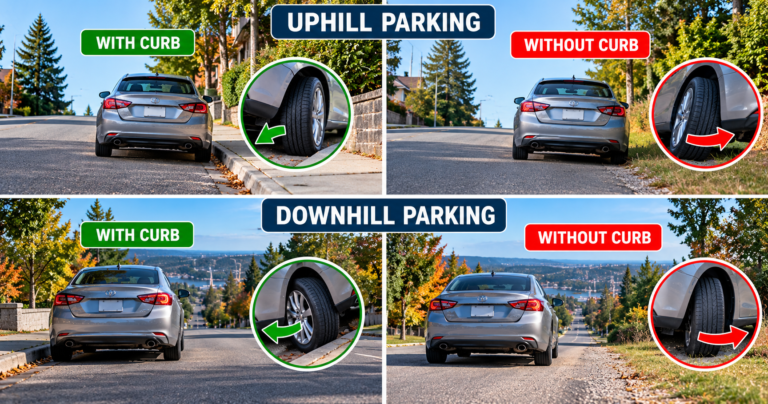
Uphill and Downhill Parking: How to Park on a Hill With and Without a Curb
24 Oct 2026 · 7 min read
The 2-Second Rule: Safe Following Distance in Ontario and Why Examiners Watch It
24 Oct 2026 · 7 min read
Ontario Lane Rules: Two-Way Left Turn Lanes, Passing on the Right and Turning Correctly
20 Oct 2026 · 9 min read