
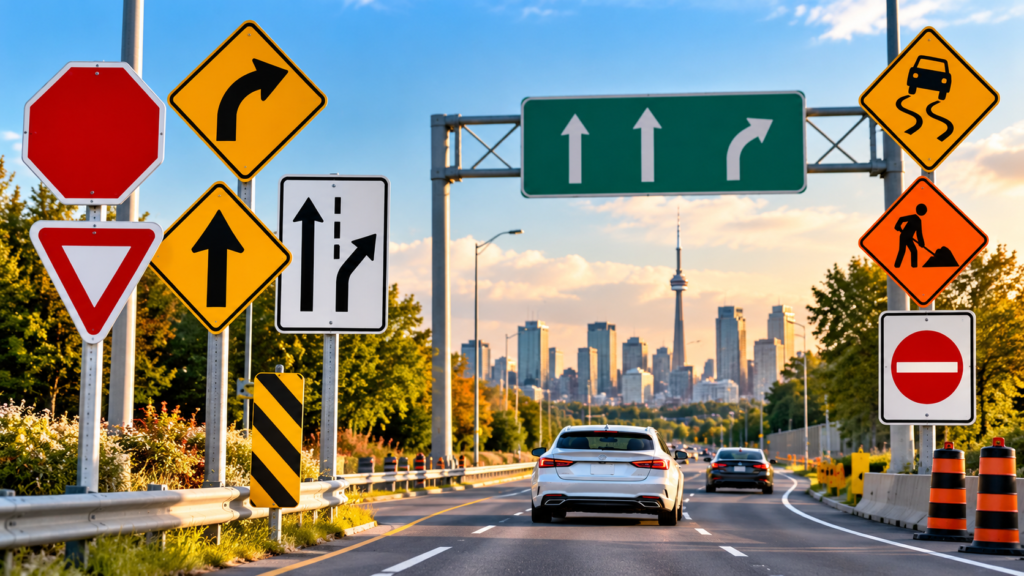
Drive 20 minutes from downtown Barrie to Highway 400 and you’ll pass dozens of signs. Some tell you what you must do, some warn you about what’s ahead, and others just help you find your exit.
For a new driver, that’s a lot to take in. The good news is that Ontario road signs follow a simple system. Once you know what each shape and colour means, you can understand almost any sign at a glance, even one you’ve never seen before.
This visual guide walks you through every major type of road sign in Ontario, based on the Official MTO Driver’s Handbook. It covers what each one means and what to do when you see it, so you’re ready for your G1 knowledge test and your first drives behind the wheel.
How to Read Any Ontario Road Sign: Shape and Colour
Before you memorise individual signs, learn the code behind them. In Ontario, a sign’s shape and colour tell you its job before you even read the words.
| Shape / colour | What it means | Example |
| Octagon (8 sides), red | Stop | Stop sign |
| Triangle, white with red border | Yield | Yield sign |
| Diamond, yellow | Warning of a hazard ahead | Winding road, deer crossing |
| Diamond, orange | Temporary condition or construction | Road work ahead |
| Rectangle or square, white or black | Regulatory: a rule you must obey | Speed limit, one way |
| Rectangle, green | Direction and distance | Highway exit signs |
| Pentagon (5 sides), fluorescent yellow-green | School zone | School zone sign |
| X shape, white with red outline | Railway crossing | Railway crossing sign |
Two more rules make regulatory signs easy:
- A green circle means you may or must do the action shown.
- A red circle with a line through it means the action is not allowed.
So if someone asks you what shape a stop sign is, the answer is an eight-sided red octagon. It’s the only sign in Ontario with that shape, so you can recognise it even from behind or covered in snow.
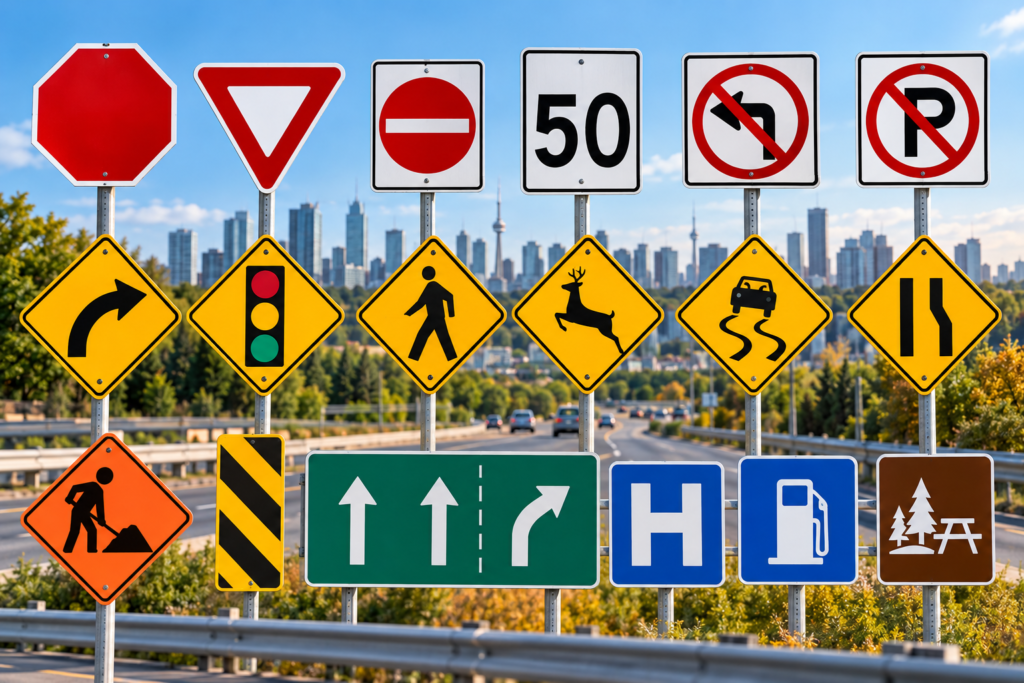
Regulatory Signs: Signs You Must Obey
Regulatory signs tell you the law: what you must do, and what you can’t do. They’re usually rectangular or square, with a white or black background. Ignoring one can mean a ticket and demerit points.
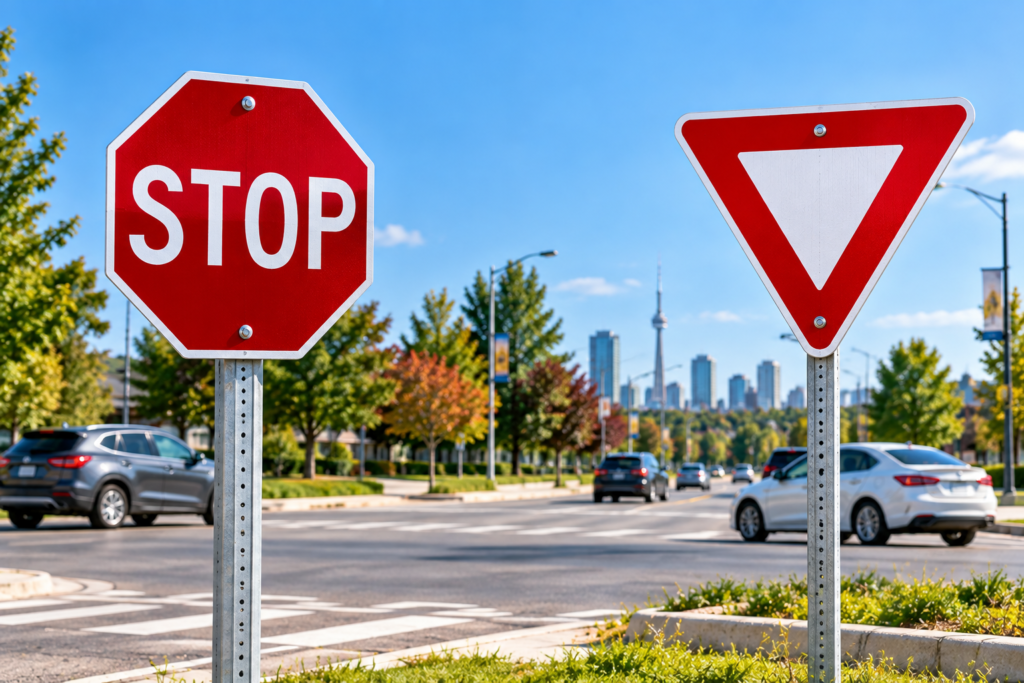
Stop, Yield and All-Way Stop Signs
- Stop sign: come to a complete stop at the stop line. If there’s no line, stop at the crosswalk; if there’s no crosswalk either, stop at the edge of the sidewalk or the intersection. Go only when the way is clear.
- Yield sign: slow down and let traffic in or near the intersection go first. Stop if you need to.
- All-way stop: a small tab under the stop sign means every direction has to stop. The first vehicle to stop goes first.
Do Not Enter, One Way and Two-Way Left Turn Lane
- Do not enter: you may not drive onto this road. You’ll usually see it at the wrong end of a one-way street or a highway exit ramp.
- One way sign: traffic moves only in the direction of the arrow.
- Two-way left turn lane: the centre lane is shared by drivers turning left from both directions. Use it only to turn, never to pass.
Turn Restriction Signs
- No left turn and no U-turn signs use the red circle and slash.
- No right turn on red means you must wait for a green light, even after stopping.
- Some signs show times underneath, such as “no left turn 7–9 a.m.” Outside those hours, the turn is allowed.
- Overhead lane signs show which lane turns left, goes straight or turns right. Choose your lane early.
Speed, Passing and Keep-Right Signs
- Speed limit signs show the maximum speed in good conditions. A “speed limit changes ahead” sign gives you warning to adjust.
- Do not pass means no passing on this stretch of road.
- Slow traffic keep right applies on multi-lane roads. It also appears on two-lane roads with climbing or passing lanes.
- Keep right of the traffic island or divider.
Parking, Stopping and Standing Signs
These three are easy to mix up, and they come up on the G1 test:
- No stopping: don’t stop at all between the signs, even for a moment.
- No standing: you may stop only to load or unload passengers.
- No parking: you may stop only to load or unload passengers or goods.
Accessible parking signs reserve spaces for vehicles with a valid Accessible Parking Permit.
HOV and Reserved Lane Signs
A white diamond marks a reserved lane. High Occupancy Vehicle (HOV) lanes are only for buses or cars carrying the minimum number of people shown. Other reserved lanes may be for buses, taxis or bicycles, all day or at set hours.
School Zone and Community Safety Zone Signs
These signs protect the most vulnerable people on the road, and Ontario treats them seriously.
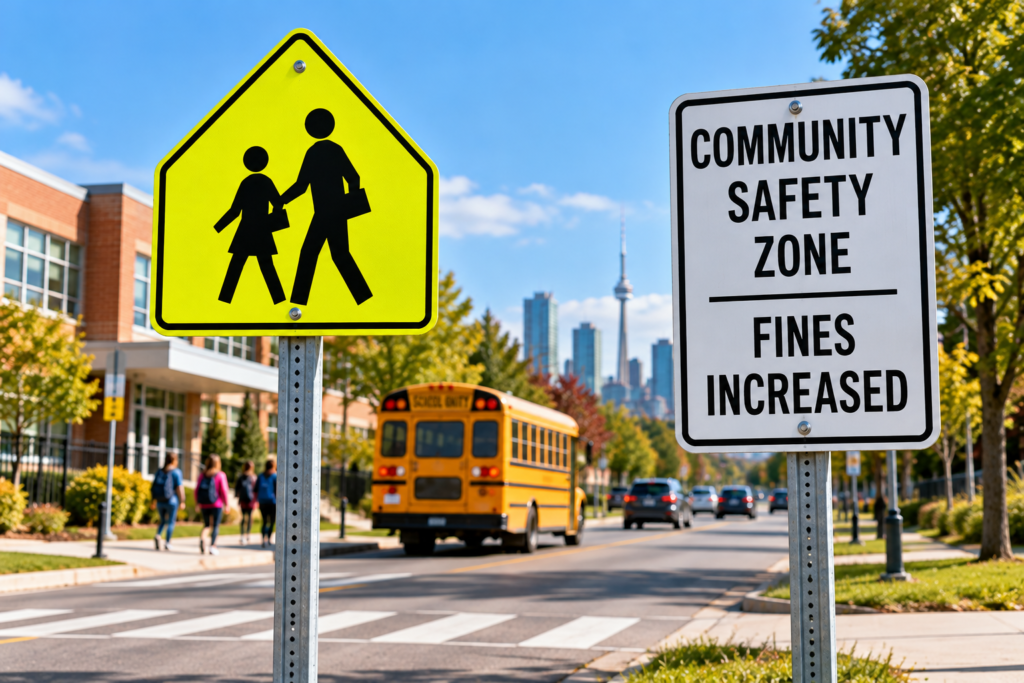
- School zone sign: a five-sided, fluorescent yellow-green sign. Slow down and watch for children.
- School zone speed limit: a lower speed limit that applies during school hours. When the yellow lights on the sign are flashing, obey the posted limit.
- School crossing: watch for children, and follow the directions of the crossing guard or school safety patroller.
- Stop for school bus when signals are flashing: you must stop when a school bus has its red lights flashing. On a road with no centre median, traffic in both directions must stop.
- Community safety zone: marks an area with a higher risk for pedestrians, often near schools, parks or seniors’ residences. Fines for traffic offences are increased inside the zone.
- Pedestrian crossover: be ready to stop and yield to pedestrians who are crossing.
Warning Signs: What’s Ahead on the Road
Warning signs are usually yellow diamonds with black symbols. They don’t give you an order. They tell you something on the road ahead may need you to slow down or change what you’re doing.
Road Shape Signs
- Curve or bend ahead: a curved arrow shows the direction. A sharp-turn sign with a checkerboard border means real danger, so slow right down.
- Chevron signs: arrowhead signs posted in a row to guide you around a sharp curve.
- Curve advisory speed: a small plate under a curve sign shows the maximum safe speed for that curve.
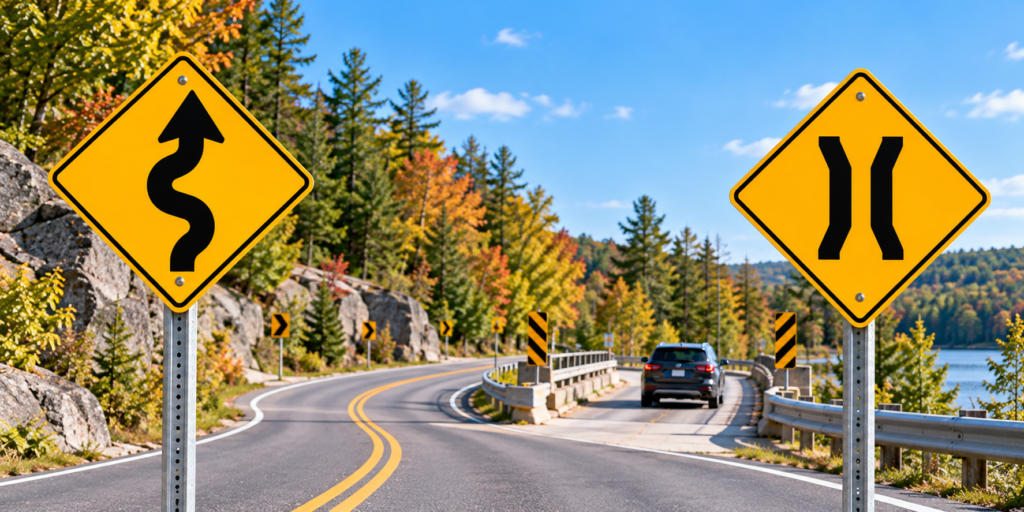
- Winding road ahead: a series of curves is coming. Keep your speed steady and stay in your lane.
- Narrow bridge ahead: the road gets narrower at the bridge, so watch for oncoming traffic.
- Pavement narrows ahead: the road surface is getting narrower.
Divided Highway Begins and Divided Highway Ends
These two signs confuse a lot of new drivers, and they’re common on the roads around Simcoe County.
- Divided highway begins: a median or barrier is about to separate the two directions of traffic. Each side becomes one-way, so keep to the right.
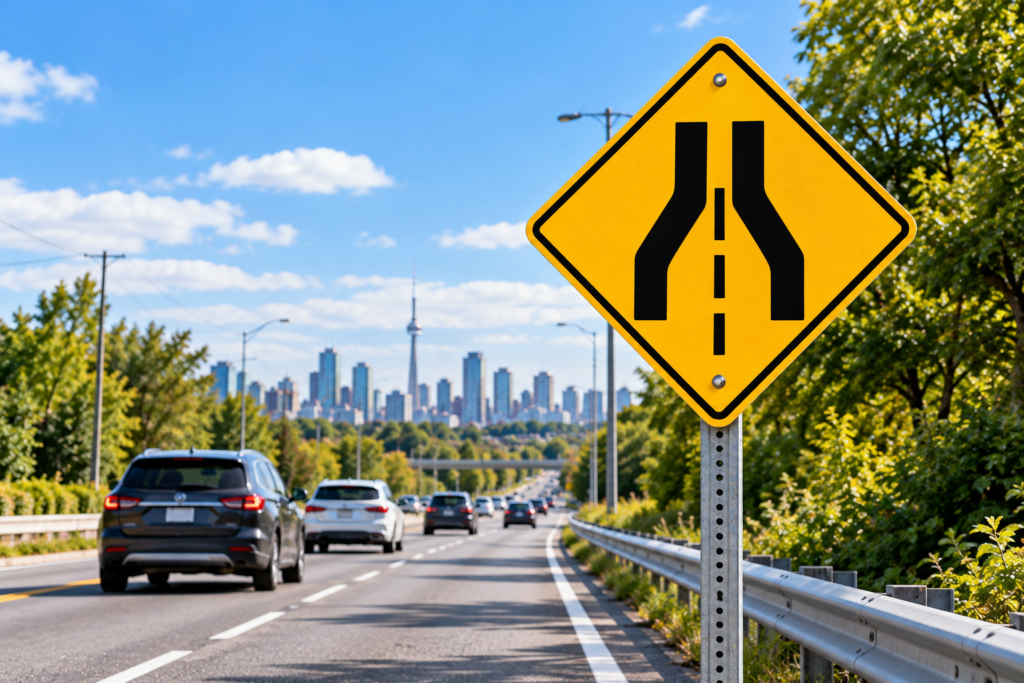
- Divided highway ends: the median ends and traffic will travel in both directions on the same road. Keep right, and remember that oncoming cars will now be on the other side of a painted line, not a barrier.
In short, the divided highway ends sign is your warning that two-way traffic is coming back.
Intersection and Merge Signs
- Intersection ahead: the symbol shows which direction has the right-of-way.
- Hidden intersection: drivers on the side road can’t see you well. Slow down and be ready to react.
- Stop ahead and traffic lights ahead: slow down, because you’ll need to stop soon.
- Merging traffic sign: two roads join into one. Drivers on both roads share responsibility for merging safely.
- Right lane ends: merge safely into the lane to your left. Our guide to the zipper merge, lane changes and blind spots explains how to do it.
- Roundabout ahead: reduce your speed. The arrows show that traffic moves counter-clockwise.
Road Surface Signs
- Slippery when wet: take extra care in rain, and leave more distance to the car ahead. This sign matters even more in an Ontario winter; see our tips for winter driving safety in Canada.
- Bump or uneven pavement ahead.
- Paved surface ends: the road changes to gravel.
- Steep hill ahead: you may need a lower gear, especially going down.
- Water may be flowing over the road.
- Fallen rock ahead.
Crossing Signs
- Deer crossing: deer regularly cross here. This is very common on rural roads across Simcoe County, especially at dawn and dusk.
- Snowmobile crossing, bicycle crossing and pedestrians ahead: watch for them and share the road.
- Share the road: a reminder to give cyclists and other road users room.
- Railway crossing ahead: the sign shows the angle of the tracks. Slow down, look both ways and be ready to stop.
Bus, Fire Truck and Truck Entrance Signs
- Hidden school bus stop ahead: slow down and watch for children and flashing red lights.
- Bus, fire truck or truck entrance: be ready to yield to large vehicles pulling onto the road.
Studying for your G1? Our MTO-approved online driving course covers every sign you need to know, at your own pace.
Construction and Temporary Condition Signs
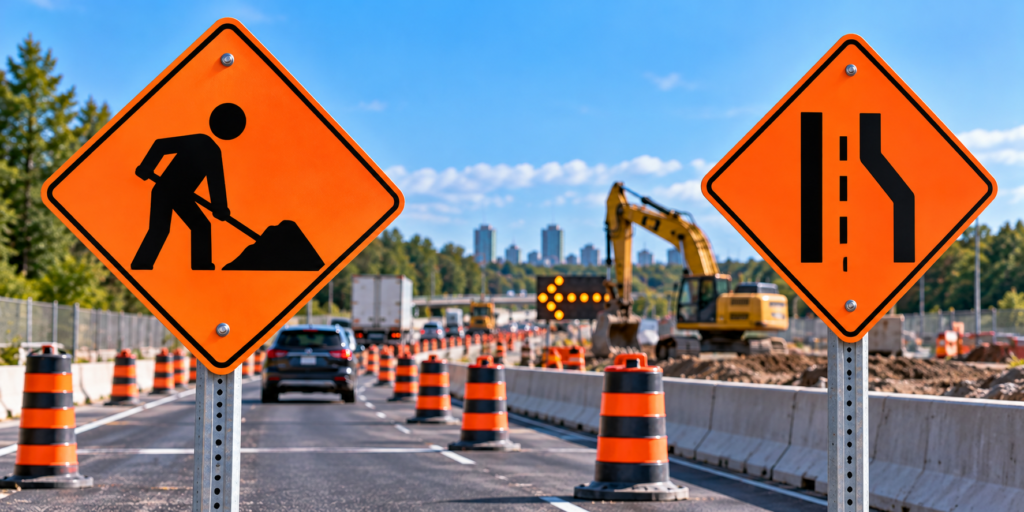
Orange means temporary. These diamond-shaped signs warn you about roadwork, detours and other short-term changes. In Ontario’s summer construction season, you’ll see plenty of them on Highway 400 and Highway 11 around Barrie and Orillia.
- Construction work one kilometre ahead and road work ahead: get ready to slow down.
- Entering a construction zone: drive with extra caution and expect a lower speed limit.
- Traffic control person ahead: a worker with a sign will direct traffic. Follow their instructions; they override other signs.
- Survey crew working ahead: workers may be close to the road.
- Lane closed ahead: obey the speed limit and merge into the open lane.
- Detour signs: follow the detour markers until you’re back on your regular route.
- Flashing arrow boards: show the direction to move.
- Grooved or milled pavement: your stopping distance may be longer, and motorcyclists have less grip.
Important: speeding fines are doubled in a designated construction zone when workers are present. Slow down even when the road looks clear.
Highway and Direction Signs
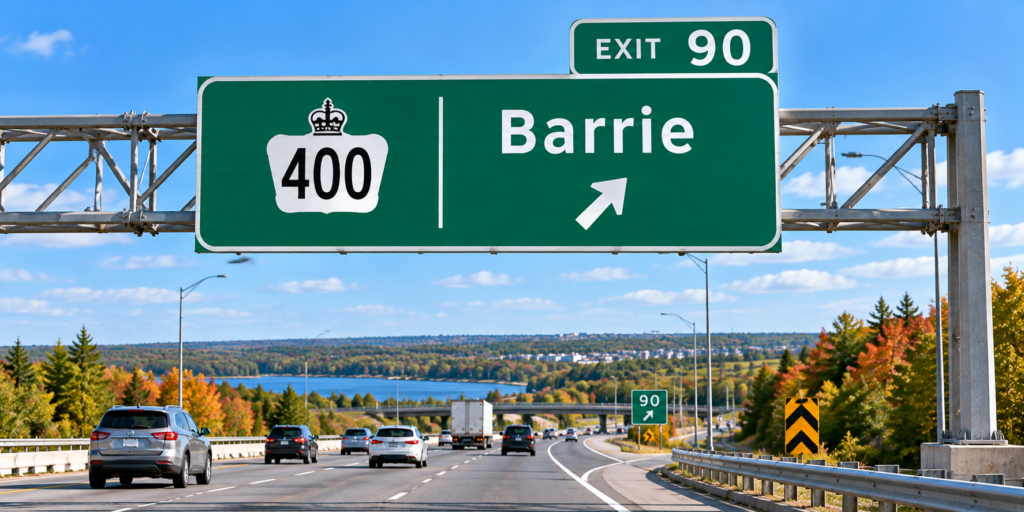
Green signs with white letters help you find your way. They don’t give orders, but missing one can mean missing your exit.
Destination and Distance Signs
These show the direction and distance, in kilometres, to towns and cities along the road. A VIA sign tells you which roads to take to reach a destination.
Freeway Exit Signs
On 400-series highways, exit signs appear well before the exit itself:
- Advance signs show which lanes lead off the highway, with arrows over or beside each lane.
- Exit lane signs have a yellow “EXIT” box under the arrow. If you’re in that lane, it will take you off the highway.
- Exit signs at the ramp confirm you’re in the right place.
If you miss your exit, don’t stop or reverse. Just take the next one.
Interchange Numbers
Interchange numbers tell you how many kilometres you are from the start of the highway. For example, the Official MTO Driver’s Handbook notes that interchange 204 on Highway 401 is 204 km from Windsor. To find the distance between two exits, subtract one number from the other.
Changeable Message Signs
These electronic signs over the highway show current delays, collisions and lane closures ahead. Read them early so you have time to change lanes or routes.
Other Signs You Should Know
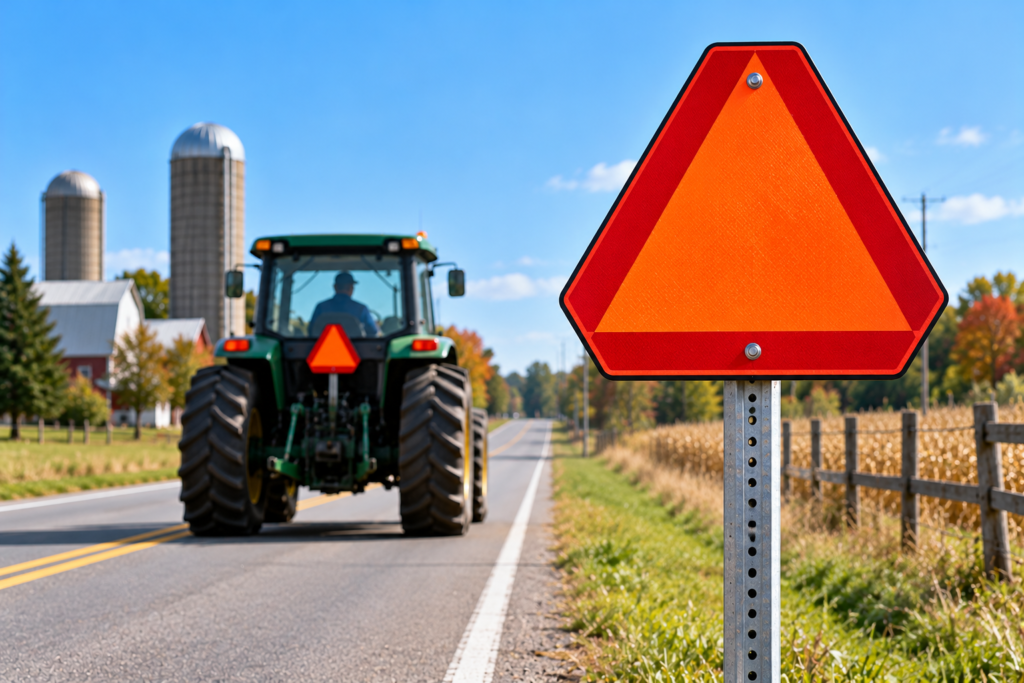
- Slow-moving vehicle sign: an orange triangle with a red border on the back of a vehicle that travels at 40 km/h or less. You’ll see it on tractors and farm equipment across rural Simcoe County. Slow down and pass only when it’s safe.
- Emergency Detour Route (EDR) markers: when the OPP close a provincial highway, these markers guide you around the closure and back onto the highway.
- Long commercial vehicle (LCV) placard: marks a double-trailer truck up to 40 metres long. Leave extra room before you pass it.
- Bilingual signs: in designated bilingual areas, signs may show English and French together, or as two signs side by side. Read the language you understand best.
Road Signs on the G1 Test: How to Study Them
The G1 knowledge test has two parts: road signs and rules of the road. You have to pass each part separately, so you can’t make up for weak sign knowledge with strong rules knowledge. Read our breakdown of how many questions are on the G1 test and how many mistakes are allowed.
Here’s how to study Ontario road signs without cramming:
- Learn shapes and colours first. Use the table at the top of this guide. If you get stuck on a test question, the shape and colour often give you the answer.
- Study by category. Learn regulatory signs, then warning signs, then construction signs. Grouped signs are easier to remember than a random list.
- Use the official source. The Official MTO Driver’s Handbook is what the test is based on.
- Say what you’d do, not just what it means. For each sign, ask yourself “What action do I take?” That’s how many test questions are worded.
- Spot signs on real drives. As a passenger, name each sign you pass, and you’ll learn them quickly.
For the full picture of the first licensing step, see our G1 licence guide for Ontario. If you want structured study, our MTO-approved online driving classes cover road signs alongside everything else new drivers need.
Learn to Read the Road With Road Safety Canada
Knowing signs for a test is one thing. Reacting to them in real traffic, at speed, with other drivers around you, is another.
At Road Safety Canada, our MTO-approved instructors help new drivers across Barrie, Innisfil, Bradford, Orillia, Angus, Alliston and Collingwood turn sign knowledge into confident driving.
- Online driving classes: study signs and the rules of the road at your own pace.
- G2 driving lessons in Barrie: practise on real local roads, from school zones to Highway 400.
Call 705-300-5570 or register online to get started.
Conclusion:
Ontario road signs aren’t random. Shape and colour tell you a sign’s job:
- red octagons stop you;
- yellow diamonds warn you;
- orange signs mean construction;
- white rectangles set the rules;
- green signs point the way.
Learn that code, study the signs by category, and you’ll walk into your G1 test ready to pass.
When you’re ready to put that knowledge on the road, Road Safety Canada is here to help. Our MTO-approved instructors serve Barrie and all of Simcoe County with online driving classes and G2 lessons. Call 705-300-5570 to book your first lesson.
Frequently Asked Questions
What are the main types of road signs in Ontario?
Ontario road signs fall into four main groups: regulatory signs, warning signs, temporary condition signs and information and direction signs. There are also a few other signs, such as the slow-moving vehicle sign and emergency detour route markers.
What shape is a stop sign?
A stop sign is an eight-sided red octagon with white letters. It is the only sign in Ontario with that shape, so drivers can recognise it even from behind or when it is covered in snow.
What does a yellow diamond sign mean?
A yellow diamond is a warning sign. It tells you about a hazard or change in the road ahead, such as a curve, a hidden intersection or a deer crossing. An orange diamond means a temporary condition, such as construction.
What does the divided highway ends sign mean?
The divided highway ends sign means the median or barrier is ending. Traffic will now travel in both directions on the same road, so keep to the right and watch for oncoming vehicles.
What is the difference between no stopping, no standing and no parking?
No stopping means you cannot stop at all between the signs, even for a moment. No standing lets you stop only to load or unload passengers. No parking lets you stop only to load or unload passengers or goods.
Are road signs on the G1 test?
Yes. Road signs are one of the two parts of the Ontario G1 knowledge test, along with the rules of the road. You must pass each part separately, so it is worth studying signs by shape, colour and category.
What does a community safety zone sign mean?
A community safety zone sign marks an area with a higher risk for pedestrians. Fines for traffic offences are increased inside the zone, so slow down and watch carefully for people crossing.

