
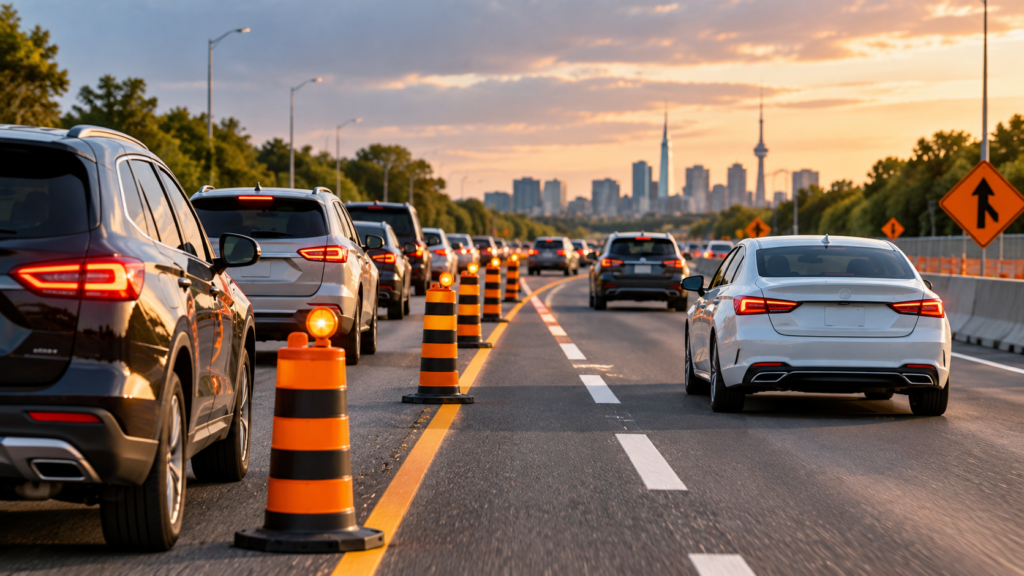
It’s a Friday afternoon on Highway 400, just south of Barrie. An orange sign says “Right lane closed ahead.”
Within seconds, half the drivers squeeze into the left lane and slow to a crawl. The right lane sits half empty. A few drivers fly up it and force their way in at the last second. Horns go off and everyone ends up later than they needed to be.
There’s a better way to handle it, called the zipper merge. In this guide, you’ll learn how the zipper merge works in Ontario and how to merge onto the highway. You’ll also learn how to check your blind spot properly and what examiners look for when you merge on your G2 and G road tests.
What Is a Zipper Merge?
A zipper merge is when drivers use both lanes all the way to the merge point, then take turns entering the open lane, one vehicle at a time. It looks like the teeth of a zipper coming together.
It feels wrong to many drivers. We’re taught that getting over early is polite, and that driving to the end of a closing lane is “cutting in.” In heavy traffic, though, merging early actually makes things worse.
When everyone crowds into one lane early, the backup gets much longer, and the open lane goes to waste. Speeds also become uneven, so drivers brake hard and make sudden lane changes. The zipper merge fixes that.
The main benefits are:
- Shorter backups. The City of Brantford says the zipper merge can cut traffic backups by up to 40%.
- Even speeds in both lanes. There’s less stop-and-go driving.
- Safer merging. There are fewer sudden stops and fewer last-second swerves.
- Less road rage. Everyone gets a fair turn, so no one feels cut off.
Zipper Merge in Heavy Traffic vs Light Traffic
The zipper merge is mainly for heavy, slow-moving traffic. That usually means construction zones, lane closures and rush hour.
In light traffic, it’s fine to merge early, as long as you can do it smoothly without making anyone slow down. The goal is always the same: keep traffic moving and keep a safe space around your car.
Is the Zipper Merge the Law in Ontario?
No. Ontario’s Highway Traffic Act does not require drivers to zipper merge. You can’t be ticketed just for merging early.
That said, police services and cities across Ontario actively encourage it. In May 2026, Kingston Police reminded drivers to use both lanes up to the merge point and then alternate. Two rules always come first:
- Posted signs win. If a sign or a flag person tells you to merge at a certain spot, do it there.
- Safety is the law. Blocking a merging driver or forcing your way in can still lead to a ticket for an unsafe lane change.
How to Zipper Merge Step by Step
Here’s how to do a zipper merge safely, whether you’re in the lane that’s ending or the lane that stays open.
- Spot the sign early. Watch for “Lane Ends,” “Right Lane Closed Ahead” or merge signs. They give you time to plan.
- Stay in your lane. In heavy traffic, don’t rush to move over. Keep a steady speed and leave a safe gap to the car ahead, at least two seconds.
- Match the speed of the other lane. As you near the merge point, try to roll alongside the gaps in the open lane. Don’t race ahead or brake hard.
- Signal, check, then merge. At the merge point, signal, check your mirror and do a quick shoulder check. Then move over smoothly.
- Take turns. One car from each lane, like a zipper. If you’re in the open lane, let one car in ahead of you and leave room for it.
A few things to avoid:
- Don’t straddle both lanes to stop others from passing.
- Don’t speed up to close a gap on someone who’s merging.
- Don’t stop in the closing lane and wait for a “perfect” opening unless traffic has fully stopped.
A local example: summer construction often narrows Highway 11 near Orillia, or the 400 near Barrie, from two lanes to one. If drivers zipper at the cones, the line moves steadily. If they all merge a kilometre early, the backup can stretch for several kilometres.
In construction zones, also slow down, obey every posted sign and watch for workers. In Ontario, speeding fines increase in a construction zone when workers are present.
Merging Traffic Signs You’ll See in Ontario
Most merges start with a sign. Knowing what each one means gives you a few extra seconds to plan, and that’s often what separates a smooth merge from a panicked one.
- Merging traffic sign. A yellow diamond showing two roads joining. Traffic from another road or ramp will enter your lane ahead, so be ready to adjust your speed or make room.
- Lane ends sign. A yellow diamond showing one lane narrowing into the other, on the right or the left. The lane that bends in is the one ending, so plan your merge.
- Lane closed ahead. An orange construction sign showing which lane is closed. This is where the zipper merge works best.
- Construction zone signs. Orange signs mean slower speeds, workers nearby and sometimes a flag person. Their instructions override everything else.
If road signs still confuse you, our guide to Ontario road signs and their meanings covers every major sign on the G1 test.
How to Merge Onto the Highway
Merging onto a 400-series highway is one of the most stressful moments for new drivers. Traffic is moving at 100 km/h or more, and you have a short ramp to join it.
The good news is that it gets much easier once you follow the same steps every time. Here’s the method the Official MTO Driver’s Handbook teaches.
1. Read the Traffic From the Ramp
As you come down the entrance ramp, look ahead and check your mirrors and blind spot. Watch the traffic in the right lane of the highway and pick out a gap you can aim for.
2. Use the Acceleration Lane to Match Speed
The acceleration lane is there so you can speed up to match highway traffic before you merge. Use all of it.
The most common mistake is merging too slowly. A car entering at 70 km/h forces highway traffic to brake hard, and that’s when crashes happen.
3. Signal, Shoulder Check and Merge
Turn on your signal early so highway drivers know what you’re planning. Do a final shoulder check, then move smoothly into your gap.
Don’t stop at the end of the acceleration lane unless traffic is completely jammed. Starting from 0 km/h onto a highway is far more dangerous than adjusting your speed to fit a gap.
Watch for Left-Side Ramps
A few Ontario entrance ramps join the highway on the left. That puts you straight into the fastest lane, so check your left blind spot carefully and get up to speed even faster.
Already on the Highway? Make Room
Merging is a two-way job. The MTO handbook asks drivers already on the freeway to move over, when it’s safe, to leave room for merging vehicles. If you can’t change lanes, ease off the gas slightly so the merging driver can slot in.
Local tip: if you’re learning in Simcoe County, the Highway 400 on-ramps in Barrie are great practice. They’re busy enough to be realistic, and highway merging is part of the G road test.
Nervous about merging onto the 400? Practise it with an MTO-approved instructor in a dual-brake car. Book a G2 driving lesson in Barrie.
How to Change Lanes Safely: Mirror, Signal, Blind Spot
Every merge is really a lane change, and many lane-change crashes come down to one thing: the driver didn’t see the other car. The fix is a simple routine you repeat every single time.
The 5-Step Lane Change
- Mirrors. Check your rear-view mirror, then your side mirror. Is there a safe gap?
- Signal. Signal well before you move, so other drivers have time to react. As the MTO handbook puts it, signalling alone isn’t enough. You still have to check that the way is clear.
- Shoulder check. Turn your head and look over your shoulder into your blind spot.
- Move gradually. Steer smoothly into the new lane with both hands on the wheel. Keep your speed steady.
- Cancel your signal. A signal left on confuses everyone around you.
Instructors often shorten this to “mirror, signal, blind spot.” If you remember nothing else, remember those three words.
How to Check Your Blind Spot
Your blind spot is the area beside and slightly behind your car that your mirrors can’t show. A whole car can hide there.
To check it properly:
- Turn your head about 90 degrees, just enough to see over your shoulder through the side window.
- Keep it quick. A glance of under a second is enough, and then your eyes go back to the road ahead.
- Don’t turn your whole body or the steering wheel when you look.
- Check the side you’re moving to: right shoulder for a move to the right, left shoulder for a move to the left.
On your road test, examiners watch your head, not your mirrors. If they don’t see your head turn, they’ll mark it as a missed check.
Blind Spots of Trucks and Buses
Transport trucks and buses have huge blind spots on all four sides. A simple rule: if you can’t see the driver’s face in their mirror, they can’t see you.
Don’t linger beside a truck, especially near its right side. Pass it with steady speed and only move back in once you can see its whole front in your rear-view mirror.
Passing and Lane Rules on Ontario Highways
Good merging also depends on everyone using the right lane. These are the rules that matter most:
- Keep right except to pass. On multi-lane highways, the right lanes are for cruising and the left lanes are for passing.
- Don’t camp in the far-left lane. The MTO handbook says to use it for passing slower traffic, then move back to the right.
- Never cut in front of faster traffic. The handbook calls it “dangerous and illegal” for a slower vehicle to cut in front of a faster one.
- Leave room after you pass. Move back only when you can see the car you passed in your rear-view mirror.
Can You Pass Another Vehicle on the Right?
On a multi-lane highway, passing on the right is allowed when it can be done safely, for example when a driver is sitting in the left lane. It is riskier, though, because the other driver may not expect you there. Never use the paved shoulder to pass.
Merging and Lane Changes on Your G2 and G Road Test
Lane changes come up again and again on both Ontario road tests. On the G test, the highway section adds merging at full speed.
Driving examiners pay close attention to:
- A shoulder check on every lane change, not just some of them
- Signalling early and cancelling the signal afterward
- Choosing a safe gap, without forcing other drivers to brake
- Speed on the ramp, which means reaching highway speed in the acceleration lane
- Smooth steering, with no sudden swerves into the new lane
Common Merging Mistakes That Cost Points
- Forgetting the shoulder check, which is one of the most common mistakes we see
- Merging onto the highway too slowly
- Stopping or hesitating at the end of the acceleration lane
- Leaving the signal on after the lane change
- Changing lanes too close behind another vehicle
Our guides to common G2 road test mistakes and why drivers fail the G2 road test cover more of what examiners look for.
If your G test is coming up, our full G road test preparation includes real highway merging practice. Still on your G2? Find out whether you can drive on the highway with a G2 and how the G2 and G licences differ.
Unsafe Lane Change in Ontario: Fines and Demerit Points
A bad merge isn’t just risky; it can also cost you money and points. Under Ontario’s Highway Traffic Act, an unsafe lane change is usually charged under one of two sections:
| Charge | HTA section | Demerit points |
| Change lane – not in safety | 142(1) | 2 |
| Unsafe move – lane or shoulder | 154(1) | 3 |
The set fine is $85 plus a $25 victim fine surcharge, for $110 in total. If the charge goes to court on a summons, the fine can reach $1,000.
For G1 and G2 drivers, the cost can go further. Novice drivers face extra consequences under Ontario’s graduated licensing rules, and any conviction can raise your insurance premium for years. Read more about car insurance for G2 drivers in Ontario.
Practise Merging With a Barrie Driving Instructor
Reading about merging helps, but confidence comes from doing it with someone who knows exactly what examiners want to see.
At Road Safety Canada, our MTO-approved instructors teach new drivers across Barrie, Innisfil, Bradford, Orillia, Angus, Alliston and Collingwood. Lessons cover real-world merging and lane changes, from busy city streets to the 400.
- G2 driving lessons in Barrie: build your lane-change routine and highway confidence.
- Full G road test preparation: practise the highway section before test day.
Call 705-300-5570 or register online to book your first lesson.
Conclusion:
Safe merging comes down to a few habits. Use both lanes and take turns in a zipper merge, and match highway speed before you join traffic. Then run through mirror, signal and blind spot on every single lane change.
Do those things consistently and merging stops being scary. It also stops costing you points on your road test.
If you’d like hands-on practice, Road Safety Canada can help. Our MTO-approved instructors serve Barrie and all of Simcoe County, and we’ll help you merge with confidence before your G2 or G road test. Book your lesson today or call 705-300-5570.
Frequently Asked Questions
What is a zipper merge?
A zipper merge is when drivers use both lanes right up to the merge point, then take turns entering the open lane one vehicle at a time. It keeps both lanes moving, balances speeds and can shorten backups in construction zones and lane closures.
Is the zipper merge legal in Ontario?
Yes. The zipper merge is legal in Ontario, but the Highway Traffic Act does not require it. Ontario police services and cities encourage drivers to use both lanes until the merge point and then alternate. Posted signs and flag persons always take priority.
Who has the right of way when merging onto a highway?
Traffic already on the highway has the right of way. The merging driver must use the acceleration lane to match highway speed and find a safe gap. Drivers on the highway should move over or adjust their speed, when safe, to make room.
How do you check your blind spot?
Check your mirrors first, then turn your head and look quickly over your shoulder in the direction you plan to move. Keep the glance short and don’t turn the steering wheel. Mirrors alone cannot show your blind spot.
Is it illegal to change lanes in an intersection in Ontario?
The Highway Traffic Act has no specific rule banning lane changes in an intersection. However, any lane change that is not made safely can still be charged as an unsafe lane change. The safest habit is to choose your lane before you reach the intersection.
What is the fine for an unsafe lane change in Ontario?
The set fine for an unsafe lane change in Ontario is $85 plus a $25 victim fine surcharge, for $110 in total. The charge carries 2 demerit points under section 142(1) or 3 demerit points under section 154(1) of the Highway Traffic Act.
Will I have to merge onto the highway on my G road test?
Yes. The G road test includes a highway section, so you will merge onto and exit a highway. Examiners watch your speed in the acceleration lane, your signal, your shoulder check and how safely you choose a gap.

