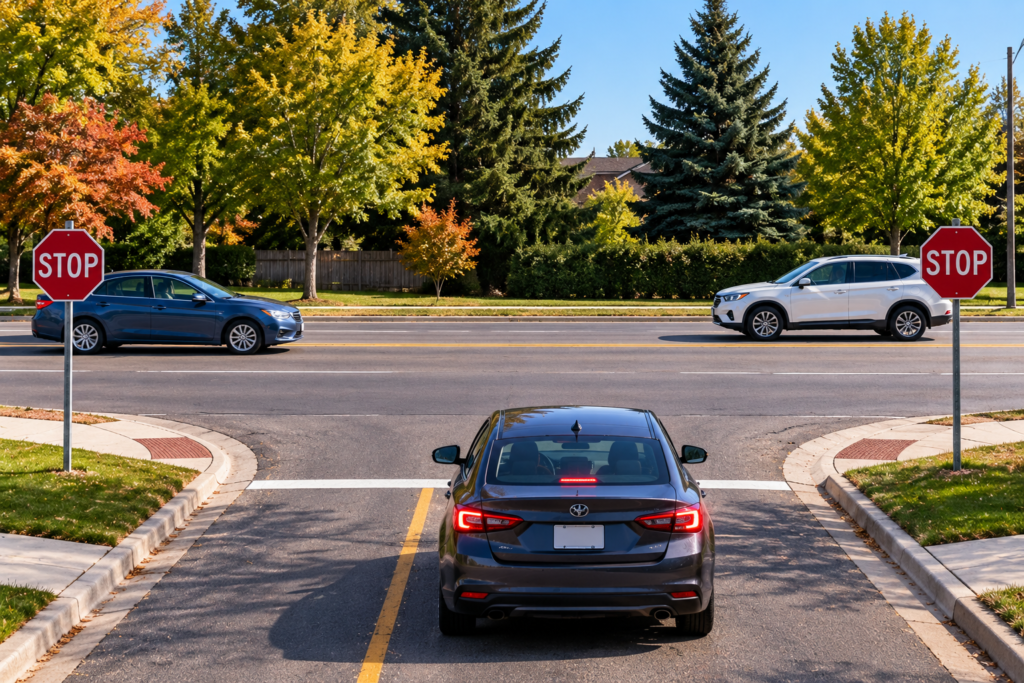
Four cars pull up to an all-way stop on a quiet Innisfil road. Everyone waves, nobody moves, and then two drivers go at the same time.
Sound familiar? Confusion about who goes first causes a lot of near misses, and a lot of failed road tests.
The good news is that the right of way rules in Ontario are clear once you know them. This guide covers every common situation, based on the Official MTO Driver’s Handbook: 4-way stops, uncontrolled intersections, two-way stops, turns, pedestrians and emergency vehicles.
In this guide14 sections
- What Does Right of Way Rules In Ontario Mean?
- Who Goes First at a 4-Way Stop?
- Uncontrolled Intersections: Yield to the Right
- Two-Way Stops and T-Intersections
- Yield Signs
- Turning Left and Right: Who Yields?
- Driveways, Parking Lots and Private Roads
- Pedestrians, Crossovers and School Crossings
- Emergency Vehicles and the Move Over Law
- Roundabouts
- Right-of-Way on Your G2 and G Road Test
- Practise Intersections With Road Safety Canada
- Conclusion
- Frequently Asked Questions
What Does Right of Way Rules In Ontario Mean?
Right-of-way decides which road user must yield (wait and let the other go first) when two people want the same space.
The most important thing to understand is that right-of-way is something the law tells you to give, not something you can take. Even when it’s your turn, you still have to make sure the other driver is actually yielding.
The MTO Driver’s Handbook also points out that signalling does not give you the right-of-way. Your signal tells others what you plan to do. It doesn’t make it safe.
Controlled vs Uncontrolled Intersections
- Controlled intersections have traffic lights, stop signs or yield signs that tell drivers what to do.
- Uncontrolled intersections have no signs or lights at all. They’re common on quiet residential streets and rural roads.
Who Goes First at a 4-Way Stop?
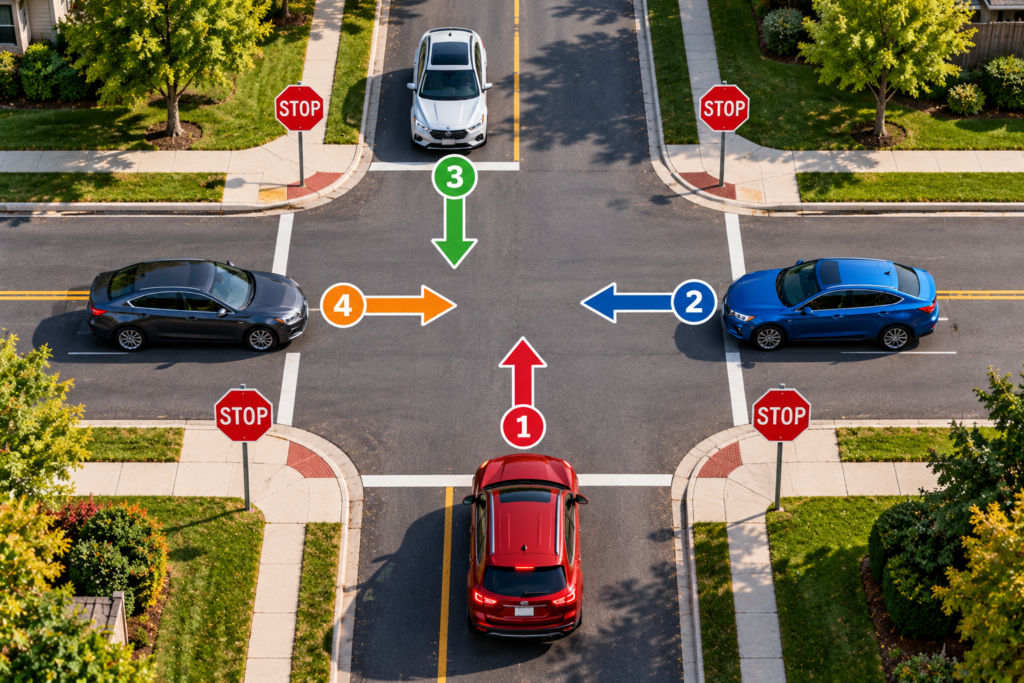
Quick answer: At a 4-way (all-way) stop in Ontario, the first vehicle to come to a complete stop goes first. If two vehicles stop at the same time, the driver on the left yields to the driver on the right.
You’ll know it’s an all-way stop when you see a small “ALL WAY” or “4-WAY” tab under the stop sign. Here’s how the rules work in real situations.
When You Arrive First
Stop completely at the stop line, then go when it’s safe. Any vehicles arriving after you wait for their turn.
When Two Cars Stop at the Same Time
Look at where the other car is.
- Car on your right: let it go first.
- Car on your left: you go first, but only once you can see the other driver is waiting.
When the Other Car Is Facing You and One of You Is Turning Left
If you and an oncoming driver stop at the same time, you can both usually go together if you’re both going straight or turning right.
If one of you is turning left, the left-turning driver waits. The MTO handbook says a driver turning left must wait for approaching traffic to pass or turn.
When Four Cars Arrive at Once
No rule settles a perfect four-way tie. Make eye contact, be patient, and when someone clearly waves or starts to move, let them go. Don’t creep forward while another driver is also creeping. That’s how the “we both went” crashes happen.
3-Way Stops
Three-way stops, often at T-intersections, follow exactly the same rules. The first to stop goes first, and on a tie, yield to the vehicle on your right.
Freeze at busy intersections? Practise all-way stops and tricky turns with an MTO-approved instructor. Book a G2 driving lesson in Barrie.
Uncontrolled Intersections: Yield to the Right
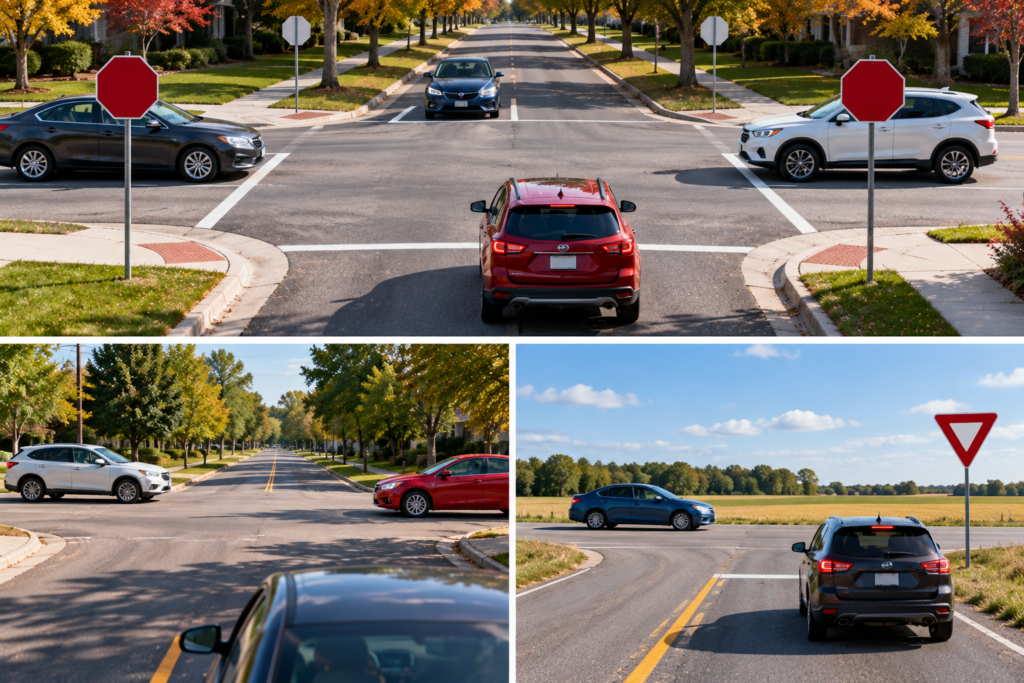
Quick answer: At an uncontrolled intersection, the first vehicle to arrive goes first. If two vehicles arrive at the same time from different roads, the driver on the left must let the driver on the right go first.
This is often called the “rule of the right hand” or “yield to the right.”
You’ll find uncontrolled intersections on quiet subdivision streets and rural concession roads across Simcoe County, from Angus and Alliston to the back roads of Innisfil. They can feel relaxed, but they need extra care because nobody is told to stop.
To drive through one safely:
- Slow down as you approach, and be ready to stop.
- Look left, right and left again for other vehicles, cyclists and pedestrians.
- Yield to anyone already in the intersection or arriving before you.
- Yield to the vehicle on your right if you arrive together.
- Never assume the other driver knows the rule. Make eye contact before you go.
Two-Way Stops and T-Intersections
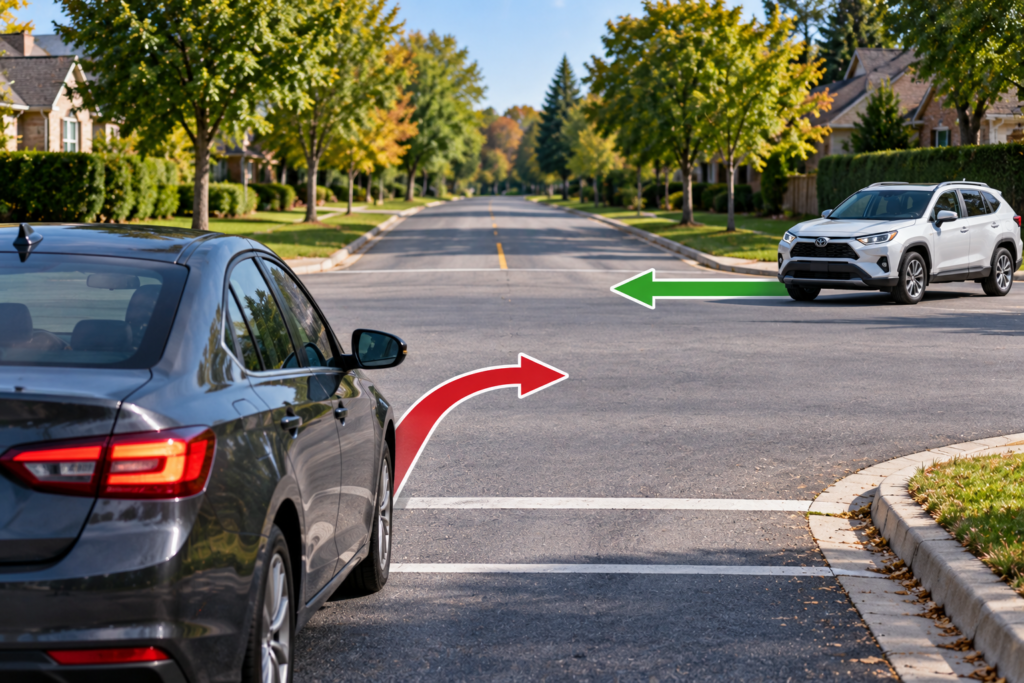
Quick answer: At a two-way stop, traffic on the road without stop signs has the right-of-way. If you face the stop sign, stop completely and drive through only when the way is clear.
At a two-way stop, only one road has stop signs. The cross traffic does not stop, and that’s where new drivers get caught out.
- Check the sign. If there’s no “ALL WAY” tab under your stop sign, assume cross traffic won’t stop.
- Stop at the line, then creep forward slowly if you need a better view.
- Wait for a safe gap in both directions before you go.
- Turning left? You need a gap in both directions, plus room to finish your turn.
T-Intersections
At a T-intersection with a stop sign, the same rule applies. You stop, and traffic on the through road keeps its right-of-way. If a T-intersection has no signs at all, it’s an uncontrolled intersection, so use the yield-to-the-right rule above.
Yield Signs
A yield sign is a white triangle with a red border. It means you must slow down, or stop if necessary, and give the right-of-way to traffic in the intersection or on the road you’re entering.
Unlike a stop sign, you don’t have to stop if the way is clear. But if you need to stop, stop at the line just as you would at a stop sign. Learn more in our guide to Ontario road signs and their meanings.
Turning Left and Right: Who Yields?
- Turning left: you must wait for approaching traffic to pass or turn before you go. Oncoming vehicles going straight or turning right have the right-of-way over you.
- Turning right: you must wait for pedestrians who are crossing, or about to cross, the road you’re turning onto.
At traffic lights, a green light still doesn’t let you turn through pedestrians or oncoming cars. Our guide to Ontario traffic lights explains advance greens, green arrows and turning on red.
Driveways, Parking Lots and Private Roads
When you enter a road from a driveway, parking lot or private road, you must yield to vehicles on the road and to pedestrians on the sidewalk. Stop before the sidewalk, look both ways, and pull out only when there’s a safe gap.
Pedestrians, Crossovers and School Crossings
- Pedestrian crossovers: marked with signs and road markings. Stop and wait until pedestrians have completely crossed the road before you go.
- School crossings with a crossing guard: stop when the guard displays the stop sign, and wait until everyone, including the guard, is off the road.
- Walk signals: pedestrians crossing on a walk signal have the right-of-way. They keep it until they reach the other side, even if the signal changes.
Emergency Vehicles and the Move Over Law
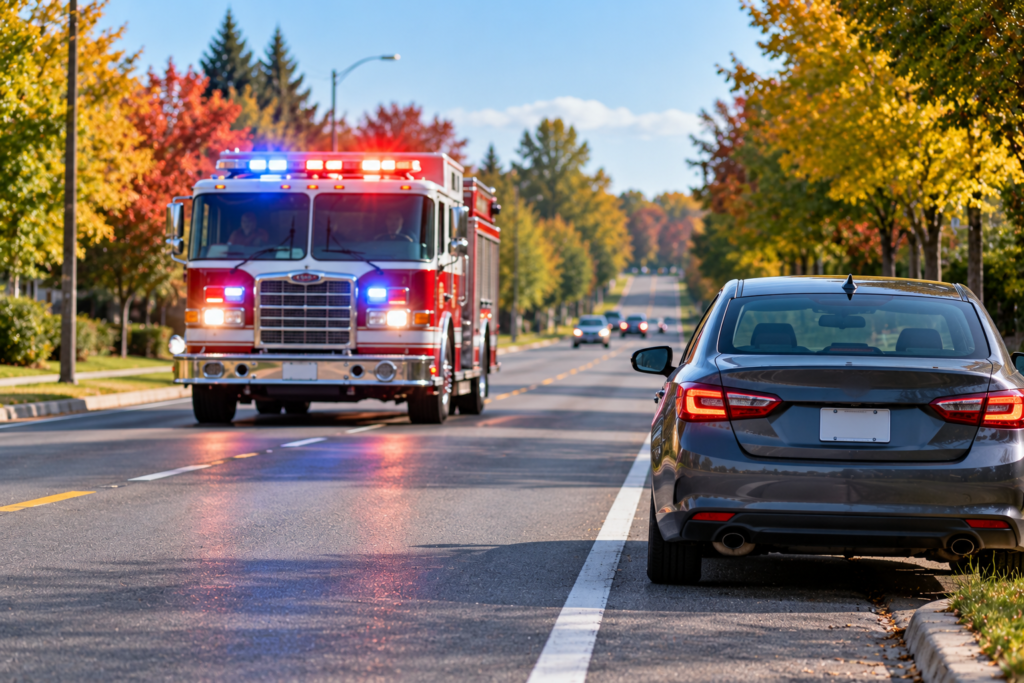
When an Emergency Vehicle Is Coming
If an emergency vehicle approaches with flashing red or red-and-blue lights, or a siren, you must stop immediately:
- pull as close to the right-hand edge of the road as is safe;
- stop parallel to the road, clear of intersections;
- don’t stop on the shoulder, because emergency vehicles may need it.
Stopped Emergency Vehicles and Tow Trucks
When you approach a stopped emergency vehicle with its lights flashing, or a tow truck with flashing amber lights, slow down and pass with caution. If there are two or more lanes going your way, move into a lane away from it if it’s safe. Signal and check your blind spot first.
Roundabouts
In a roundabout, traffic already in the roundabout has the right-of-way. Slow down as you approach, yield to vehicles coming from your left, and enter when there’s a safe gap. Our step-by-step guide to driving through a roundabout in Ontario covers lane choice and exiting.
Right-of-Way on Your G2 and G Road Test
Right-of-way mistakes are among the quickest ways to lose points, or fail outright, on an Ontario road test. Examiners watch for:
- Rolling stops. Your wheels must stop completely at every stop sign.
- Stopping in the wrong place. Stop at the stop line, not past it.
- Taking your turn out of order at an all-way stop.
- Waving other drivers through when it’s your turn. Being “too polite” causes confusion and can count against you.
- Not yielding to pedestrians when turning right or left.
- Turning left in front of oncoming traffic without a safe gap.
Our guides to common G2 road test mistakes and why drivers fail the G2 road test go deeper. If your G test is next, our full G road test preparation puts these situations into practice.
Practise Intersections With Road Safety Canada
Knowing the rules is one thing. Using them calmly at a busy intersection, with cars, cyclists and pedestrians all moving, takes practice.
At Road Safety Canada, our MTO-approved instructors teach new drivers across Barrie, Innisfil, Bradford, Orillia, Angus, Alliston and Collingwood. We practise the exact intersections and situations you’ll face on test day.
- G2 driving lessons in Barrie: build confidence at all-way stops, uncontrolled intersections and left turns.
- Full G road test preparation: get test-ready with real road practice.
Call 705-300-5570 or register online to book your first lesson.
Conclusion:
Most right-of-way situations come down to a few rules:
- At an all-way stop, the first to stop goes first.
- At an all-way stop or an uncontrolled intersection, if you tie, yield to the right.
- Through traffic has priority at a two-way stop.
- Left turns wait for oncoming traffic.
- Pedestrians and emergency vehicles always come first.
Above all, remember that right-of-way is something you give, not something you take. When in doubt, yield.
When you’re ready to practise these rules on real roads, Road Safety Canada can help. Our MTO-approved instructors serve Barrie and all of Simcoe County. Book your lesson today or call 705-300-5570.
Frequently Asked Questions
Who has the right of way at a 4-way stop in Ontario?
At a 4-way stop in Ontario, the first vehicle to come to a complete stop goes first. If two vehicles stop at the same time, the driver on the left must yield to the driver on the right.
Who goes first at an uncontrolled intersection?
At an uncontrolled intersection, the first vehicle to arrive goes first. If two vehicles arrive at the same time from different roads, the driver on the left must let the driver on the right go first.
Who has the right of way at a two-way stop?
Traffic on the road without stop signs has the right of way. If you face the stop sign, you must come to a complete stop and wait until the way is clear in both directions before you go.
Does a car turning left have to yield?
Yes. A driver turning left must wait for approaching traffic to pass or turn before going. Oncoming vehicles going straight or turning right have the right of way over a left-turning driver.
What does it mean to yield the right of way?
Yielding the right of way means letting another driver, cyclist or pedestrian go first. You slow down, or stop if needed, and only continue once it is safe and the other road user has gone.
Does signalling give you the right of way?
No. The MTO Driver’s Handbook says signalling does not give you the right-of-way. A signal only shows other road users what you plan to do, so always make sure the way is clear before you move.
What should you do when an emergency vehicle approaches?
When an emergency vehicle approaches with flashing lights or a siren, pull as close to the right edge of the road as is safe and stop, clear of any intersection. Wait until it has passed before you continue.
Ready to practise with an MTO-approved instructor?
Build real confidence in traffic with G2 lessons and Full G road test preparation in Barrie and across Simcoe County.