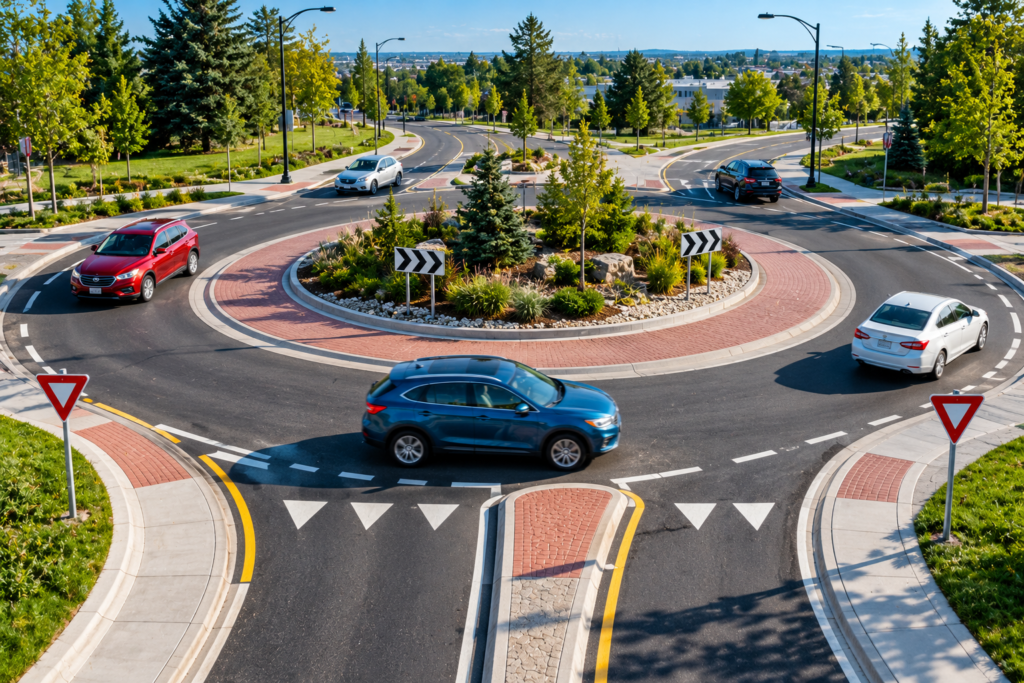
If you drive between Innisfil and Barrie, you’ve probably met the new two-lane roundabout at Yonge Street (County Road 4) and 9th Line. For a lot of local drivers, it’s the first multi-lane roundabout they’ve used, and it shows.
Roundabouts aren’t hard once you know the rules. In fact, they’re one of the simplest intersections to drive through, because everyone moves in the same direction and nobody has to turn left across oncoming traffic.
This step-by-step guide explains roundabout rules in Ontario: who yields, which lane to choose, when to signal, and how to share the roundabout with trucks, cyclists and pedestrians.
In this guide11 sections
- What Is a Roundabout?
- Roundabout vs Traffic Circle: What’s the Difference?
- Roundabout Signs to Watch For
- How to Use a Single-Lane Roundabout: 5 Steps
- How to Use a Two-Lane Roundabout
- Signalling in a Roundabout
- Sharing the Roundabout
- Common Roundabout Mistakes on Your Road Test
- Practise Roundabouts With Road Safety Canada
- Conclusion
- Frequently Asked Questions
What Is a Roundabout?
A roundabout is a circular intersection where traffic travels counter-clockwise around a central island. Drivers entering the roundabout yield to traffic already in it, then join the flow and exit at their street.
Roundabouts are built to keep speeds low and traffic moving. There are no traffic lights to wait at, and no left turns across oncoming lanes. That’s why more and more Ontario communities, including Simcoe County, are building them at busy intersections.
Key Parts of a Roundabout
- Yield line: a thick dashed line where you wait for a gap.
- Splitter islands: raised islands between the entry and exit lanes that guide traffic and give pedestrians a safe midway stop.
- Central island: the middle of the roundabout. Never drive or walk across it.
- Truck apron: on many roundabouts, a raised, textured strip around the central island that long trucks can ride over.
Roundabout vs Traffic Circle: What’s the Difference?
People use the names interchangeably, but there are real differences:
| Modern roundabout | Older traffic circle (rotary) | |
| Size | Compact | Usually much larger |
| Speed | Low, about 30–40 km/h | Often higher |
| Who yields | Entering traffic yields to traffic inside | Varies; sometimes traffic inside yields |
| Entry design | Curved entries that slow you down | Often straight, faster entries |
In Ontario, almost every new circular intersection is a modern roundabout. So the rule to remember is simple: traffic already in the roundabout has the right-of-way.
Roundabout Signs to Watch For
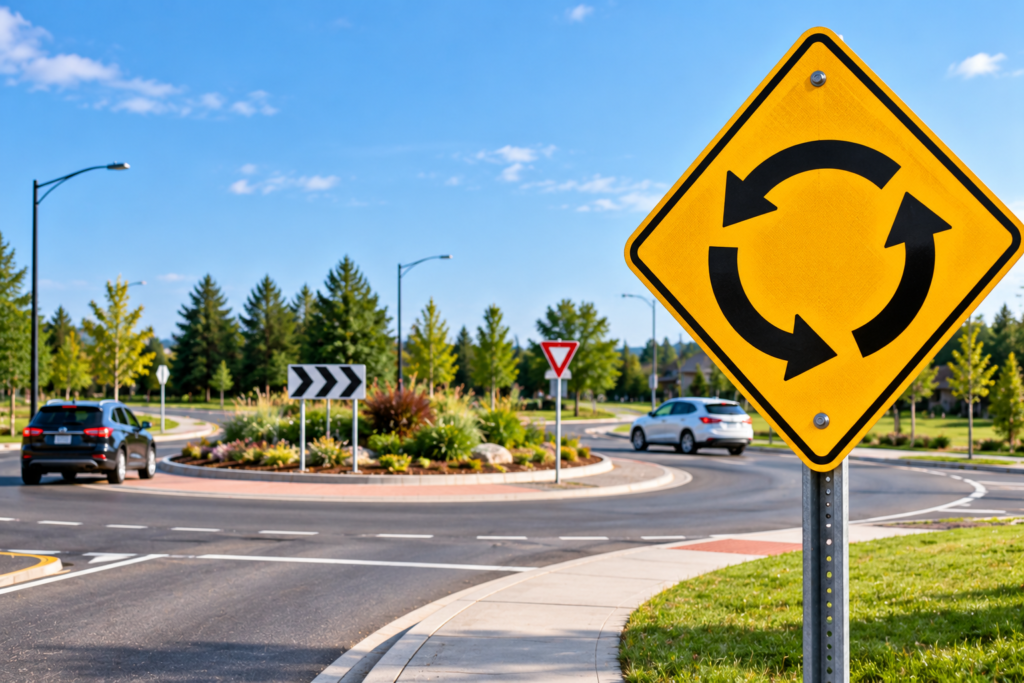
- Roundabout ahead sign: a yellow diamond with arrows in a circle, showing traffic moving counter-clockwise. It tells you to slow down.
- Yield sign and yield line: where you stop if traffic is coming.
- Lane designation signs: on two-lane roundabouts, they show which lane goes where. Read them before you reach the yield line.
- Destination signs: show which exit leads to which street or town.
For more signs, see our guide to Ontario road signs and their meanings.
How to Use a Single-Lane Roundabout: 5 Steps
- Slow down and choose your exit. As you approach, read the signs so you know which exit you need. Slow to a speed that lets you stop if necessary.
- Watch for pedestrians. Crosswalks usually sit just before the yield line. Stop for anyone crossing.
- Yield to traffic already in the roundabout. Look left, because that’s where circulating traffic comes from. Wait for a safe gap. If the way is clear, you don’t need to stop; just enter smoothly.
- Travel counter-clockwise and keep moving. Once you’re inside, you have priority over entering traffic. Don’t stop, and don’t pass other vehicles or cyclists.
- Signal right and exit. Just before your exit, turn on your right signal so drivers waiting to enter know you’re leaving. Watch for pedestrians and cyclists at the exit crosswalk.
Missed your exit? Don’t panic, stop or reverse. Just go around again and take it on the next lap.
How to Use a Two-Lane Roundabout
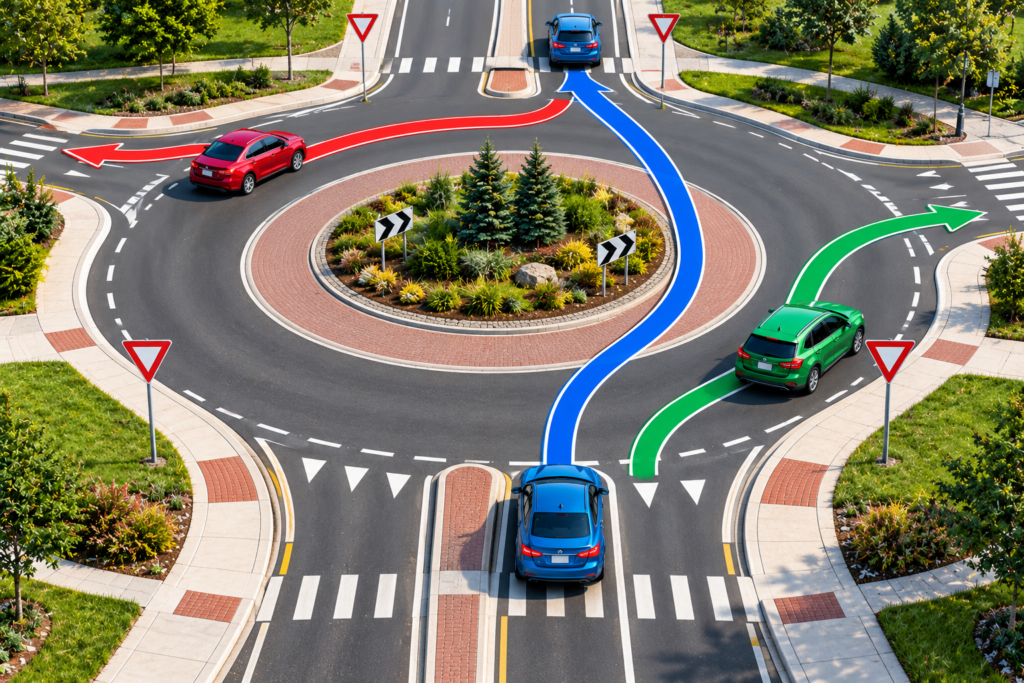
Two-lane roundabouts, like the new one at Yonge Street and 9th Line in Innisfil, follow the same rules with one extra job: choose the right lane before you enter.
| Where you’re going | Which lane to use |
| Turning left (or a U-turn) | Left lane |
| Going straight | Either lane, unless signs say otherwise |
| Turning right | Right lane |
Always follow the lane signs and pavement arrows. They override this general rule.
The Golden Rules for Two-Lane Roundabouts
- Don’t change lanes inside the roundabout. Stay in the lane you entered in.
- Exit from the same lane you entered in. If you entered in the left lane, exit from the left lane.
- Watch the vehicle beside you. A driver in the inside (left) lane may be exiting across your path, so never assume it will keep circling.
- Never drive beside a large truck. It may need both lanes to get around.
Turning Left in a Two-Lane Roundabout, Step by Step
- Enter in the left lane after yielding to traffic coming from your left.
- Stay in the left lane as you go around.
- Signal right just before your exit.
- Exit from the left lane into the matching exit lane, checking for vehicles on your right.
Nervous about the new Innisfil roundabout? Practise two-lane roundabouts with an MTO-approved instructor. Book a G2 driving lesson in Barrie.
Signalling in a Roundabout
- Always signal right before you exit. This is the most important signal, because it tells waiting drivers they can go.
- When entering: guidance varies. The City of Ottawa recommends signalling left as you enter if you’re turning left, and right if you’re turning right. CAA says a signal isn’t required on entry. Signalling your intention on entry is the safer habit, and it does no harm.
- If you ever need to change lanes (which you should avoid), signal first and check your blind spot.
Sharing the Roundabout
Large Trucks
Tractor-trailers often need both lanes of a two-lane roundabout to get around, and may ride over the truck apron in the middle. Give them plenty of room:
- Don’t enter beside a truck or try to pass one inside the roundabout.
- Stay well back so you’re not in the driver’s blind spot.
Cyclists
Cyclists may ride in the middle of the lane just like a car, or get off and use the crosswalk. If a cyclist is in the lane ahead of you, stay behind them. Don’t pass a cyclist inside a roundabout.
Pedestrians
Pedestrians cross at marked crosswalks before the yield line and at the exits, using the splitter island as a safe stopping point. Yield to pedestrians both when you enter and when you exit. They should never walk across the circle to the central island.
Emergency Vehicles
If you hear a siren or see flashing lights:
- Not yet in the roundabout? Pull to the right and stop before you enter, leaving room for the emergency vehicle.
- Already inside? Don’t stop in the roundabout. Continue to your exit, leave the roundabout, then pull over to the right and stop.
Common Roundabout Mistakes on Your Road Test
These are the mistakes we see most often, and the ones that cost points on a G2 or G road test:
- Not yielding to traffic already in the roundabout.
- Stopping inside the roundabout when there’s no reason to.
- Stopping at the yield line when the way is clearly free, which can confuse drivers behind you.
- Changing lanes inside a two-lane roundabout.
- Choosing the wrong lane, for example turning left from the right lane.
- Forgetting to signal your exit.
- Passing cyclists or trucks inside.
Our guide to common G2 road test mistakes covers more of what examiners look for. If your G test is next, see our full G road test preparation.
Practise Roundabouts With Road Safety Canada
The best way to feel confident in a roundabout is to drive through a few with an instructor beside you.
At Road Safety Canada, our MTO-approved instructors teach new drivers across Barrie, Innisfil, Bradford, Orillia, Angus, Alliston and Collingwood. We’ll take you through local roundabouts until lane choice and yielding feel automatic.
- G2 driving lessons in Barrie: build confidence on real local roads.
- Driving lessons in Innisfil: learn close to home.
Call 705-300-5570 or register online to book your first lesson.
Conclusion:
Roundabouts come down to a short routine:
- Slow down and pick your lane.
- Yield to traffic coming from your left.
- Go counter-clockwise without stopping or changing lanes.
- Signal right as you leave.
Once you’ve done it a few times, roundabouts are often easier than a busy traffic light.
When you’re ready to practise, including the new two-lane roundabout in Innisfil, Road Safety Canada can help. Our MTO-approved instructors serve Barrie and all of Simcoe County. Book your lesson today or call 705-300-5570.
Frequently Asked Questions
Who has the right of way in a roundabout?
Vehicles already in the roundabout have the right of way. When you enter, yield to traffic coming from your left and wait for a safe gap. Once you are inside, you have priority over vehicles waiting to enter.
Which lane should I use in a two-lane roundabout?
Use the left lane to turn left or make a U-turn, the right lane to turn right, and either lane to go straight. Always follow the lane signs and pavement arrows, because they override this general rule.
Do you signal when exiting a roundabout?
Yes. Signal right just before your exit so drivers waiting to enter know you are leaving. Signalling your intention as you enter is also a good habit, especially when you are turning left or right.
Can you change lanes in a roundabout?
No. You should not change lanes inside a roundabout. Choose the correct lane before you enter, stay in it as you go around, and exit from the same lane you entered in.
What should I do if I miss my exit in a roundabout?
If you miss your exit, do not stop or reverse. Simply go around the roundabout again and take your exit on the next lap. It is completely legal and much safer.
What is the difference between a roundabout and a traffic circle?
A modern roundabout is compact and slow, and traffic entering it must always yield to traffic already inside. Older traffic circles are usually larger and faster, and their right-of-way rules can vary.
What do I do if an emergency vehicle comes while I am in a roundabout?
Do not stop inside the roundabout. Continue to your exit, leave the roundabout, then pull over to the right and stop. If you have not entered yet, pull to the right and wait before entering.
Ready to practise with an MTO-approved instructor?
Build real confidence in traffic with G2 lessons and Full G road test preparation in Barrie and across Simcoe County.