You’re driving up Highway 11 when you realise your turn signal has stopped working. Or the low winter sun is so bright that the driver behind you can’t see your blinker. How do you tell other drivers what you’re about to do?
With your arm. Hand signals when driving are your legal backup for signal lights and brake lights in Ontario. They’re also a classic G1 test topic.
There are only three to learn: left turn, right turn and stop. This guide shows you each one, explains when to use them, and covers what Ontario’s Highway Traffic Act says about signalling.
In this guide11 sections
- The 3 Driving Hand Signals at a Glance
- Left Turn Hand Signal
- Right Turn Hand Signal
- Stop or Slow Down Hand Signal
- When Do You Need Hand Signals in Ontario?
- Hand Signals From Cyclists: What Drivers Should Know
- Hand Signals on the G1 Test and Road Test
- Failing to Signal in Ontario
- Learn the Rules of the Road With Road Safety Canada
- Conclusion
- Frequently Asked Questions
The 3 Driving Hand Signals at a Glance
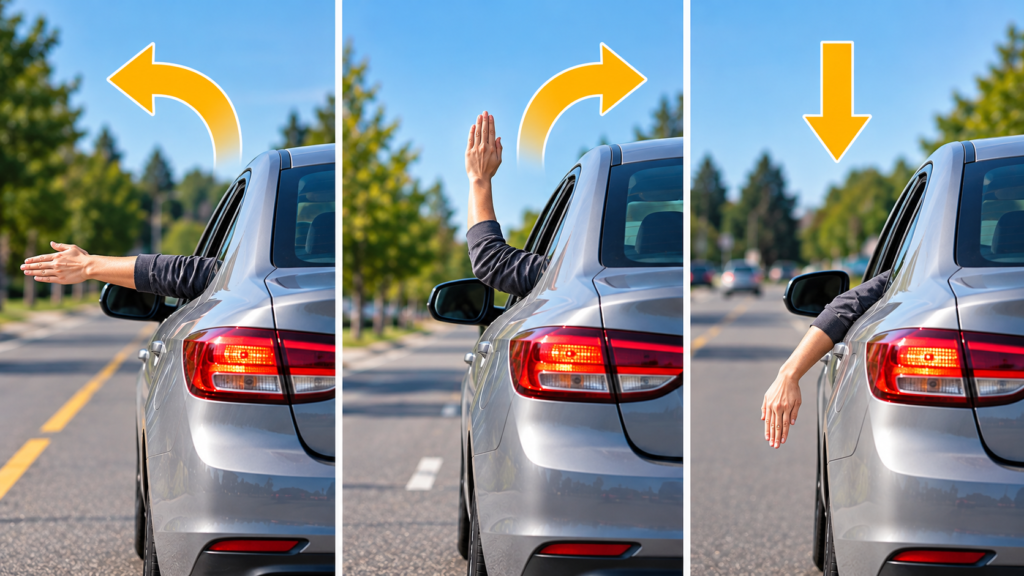
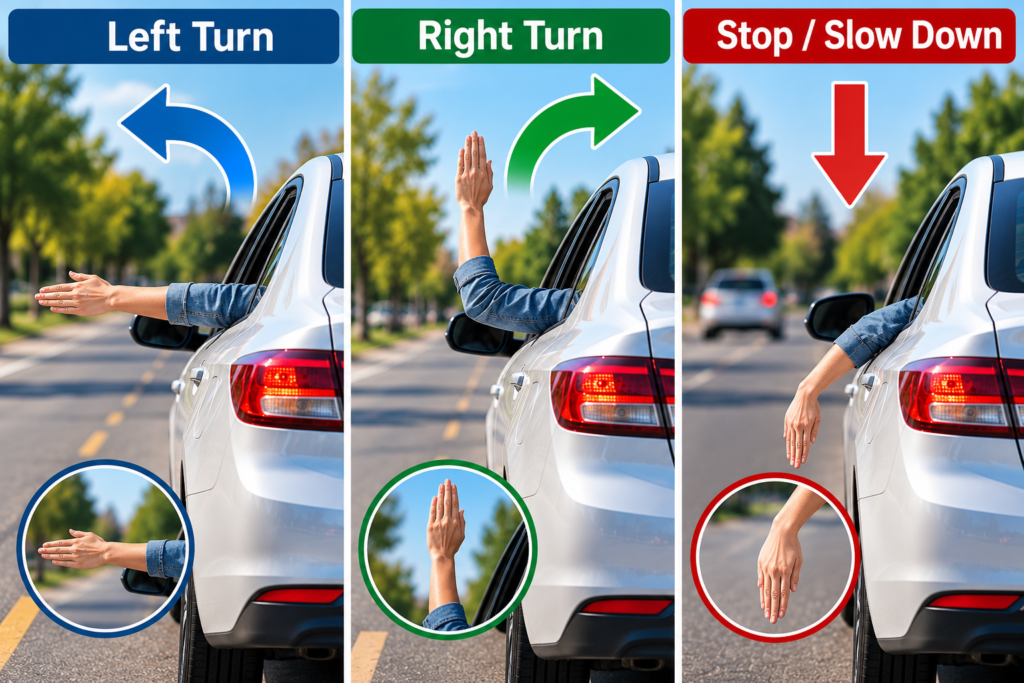
All three hand signals are given with your left arm, out the driver’s side window.
| Signal | What to do with your left arm | Meaning |
| Left turn | Extend it straight out, level with the ground | “I’m turning left” |
| Right turn | Extend it out, then bend it upward at the elbow | “I’m turning right” |
| Stop or slow down | Extend it out, then bend it downward at the elbow | “I’m stopping or slowing down” |
An easy way to remember them: straight out for left, up for right, down for stop.
Left Turn Hand Signal
To signal a left turn, extend your left arm straight out the window, horizontally, with your hand and arm past the side of the vehicle.
- Keep your arm level and steady so it’s clear from behind and from the front.
- Give the signal well before you turn, just as you would with your signal light.
- Bring your arm back in and put both hands on the wheel before you start turning.
Right Turn Hand Signal
To signal a right turn, extend your left arm out the window and bend it upward at the elbow, so your forearm and hand point to the sky.
Why use your left arm for a right turn? Because you’re sitting on the left side of the car. If you stuck your right arm out the passenger window, the drivers behind and beside you probably wouldn’t see it. The raised left arm is visible to everyone.
Stop or Slow Down Hand Signal
To signal that you’re stopping or slowing down, extend your left arm out the window and bend it downward at the elbow, with your palm facing back.
Under Ontario’s Highway Traffic Act, if stopping or suddenly slowing down could affect other vehicles, you must give a visible signal. That signal can be your brake lights or this hand signal. So if your brake lights aren’t working, the hand signal is how you warn the driver behind you.
When Do You Need Hand Signals in Ontario?
Ontario’s Highway Traffic Act says you must signal before you turn, change lanes or pull out from a parked spot, whenever the move could affect other road users. You can give that signal by hand and arm, or with a working signal light.
In everyday driving your signal lights do the job. Hand signals become important when:
- A signal light or brake light burns out. Use hand signals until you can get it fixed.
- Your signal is hard to see. Bright sun, heavy snow or a dirty light can hide your blinker. A hand signal adds a clear backup.
- You’re driving a vehicle without signal lights, such as some older or farm vehicles.
Whichever method you use, signal well before you act, and make sure the way is clear first. A signal tells others what you plan to do; it doesn’t give you the right-of-way. Learn more in our guide to right-of-way rules in Ontario.
Hand Signals From Cyclists: What Drivers Should Know
Cyclists use the same hand signals as drivers, with one exception. Ontario law also lets a cyclist signal a right turn by extending the right arm straight out to the right.
So if you see a cyclist pointing right with the right arm, they’re turning right. When a cyclist signals, slow down and give them room to make their move safely.
Hand Signals on the G1 Test and Road Test
On the G1 Knowledge Test
Hand signals are a favourite G1 topic. Expect questions such as “Which hand signal means a right turn?” or “What does an arm bent downward mean?” If you remember straight out, up and down, you’ll get them right.
For more on the test, read our breakdown of how many questions are on the G1 test and our G1 licence guide for Ontario.
On Your Road Test
Most of your road test is about using your signal lights correctly: signalling early, before every turn and lane change, and cancelling the signal afterwards. Many instructors also recommend knowing your hand signals well enough to show them if asked. Missed or late signals are common reasons for lost points; see our guide to common G2 road test mistakes.
Failing to Signal in Ontario
Not signalling a turn or lane change, when the move could affect other road users, is an offence under section 142 of the Highway Traffic Act. It can mean a fine and demerit points. More importantly, it’s a common cause of collisions, because other drivers can’t predict what you’ll do.
Learn the Rules of the Road With Road Safety Canada
Hand signals are a small part of becoming a safe, confident driver, and our instructors cover them along with everything else on the G1 test and road test.
At Road Safety Canada, our MTO-approved instructors serve Barrie, Innisfil, Bradford, Orillia, Angus, Alliston and Collingwood.
- Online driving classes: learn signals, signs and the rules of the road at your own pace.
- G2 driving lessons in Barrie: practise signalling, lane changes and turns on real roads.
Call 705-300-5570 or register online to get started.
Conclusion:
Driving hand signals take seconds to learn and could save you from a collision when your lights fail. Remember:
- Left turn: left arm straight out.
- Right turn: left arm bent up.
- Stop or slow down: left arm bent down.
Know them for the G1 test, use them whenever your signal lights or brake lights can’t be seen, and always signal well before you move.
When you’re ready to learn the rest of the rules of the road, Road Safety Canada is here to help. Our MTO-approved instructors serve Barrie and all of Simcoe County. Start with our online driving classes or call 705-300-5570.
Frequently Asked Questions
What are the 3 hand signals for driving in Ontario?
The three driving hand signals in Ontario all use the left arm. For a left turn, extend your arm straight out. For a right turn, bend your arm upward at the elbow. To stop or slow down, bend your arm downward at the elbow.
What is the hand signal for a right turn?
To signal a right turn, extend your left arm out of the driver’s window and bend it upward at the elbow, so your forearm and hand point to the sky. Cyclists may also signal a right turn by extending their right arm straight out.
What is the hand signal for a left turn?
To signal a left turn, extend your left arm straight out of the driver’s window, level with the ground. Give the signal well before the turn, then return both hands to the wheel before you start turning.
What is the hand signal to stop or slow down?
To signal that you are stopping or slowing down, extend your left arm out of the driver’s window and bend it downward at the elbow. Use it when your brake lights are not working or may not be seen.
Why do drivers use their left arm for a right turn?
Drivers sit on the left side of the car, so a right arm stuck out the passenger window would be hard for other drivers to see. Raising the left arm upward makes the right-turn signal visible to everyone around you.
When do you use hand signals instead of signal lights?
Use hand signals when your turn signals or brake lights are not working, when your signal lights are hard to see in bright sun or heavy snow, or when driving a vehicle that has no signal lights.
Are hand signals on the G1 test?
Yes. Hand signals are a common topic on the Ontario G1 knowledge test. Remember that all three use the left arm: straight out for a left turn, up for a right turn and down for stopping or slowing down.
Ready to practise with an MTO-approved instructor?
Build real confidence in traffic with G2 lessons and Full G road test preparation in Barrie and across Simcoe County.