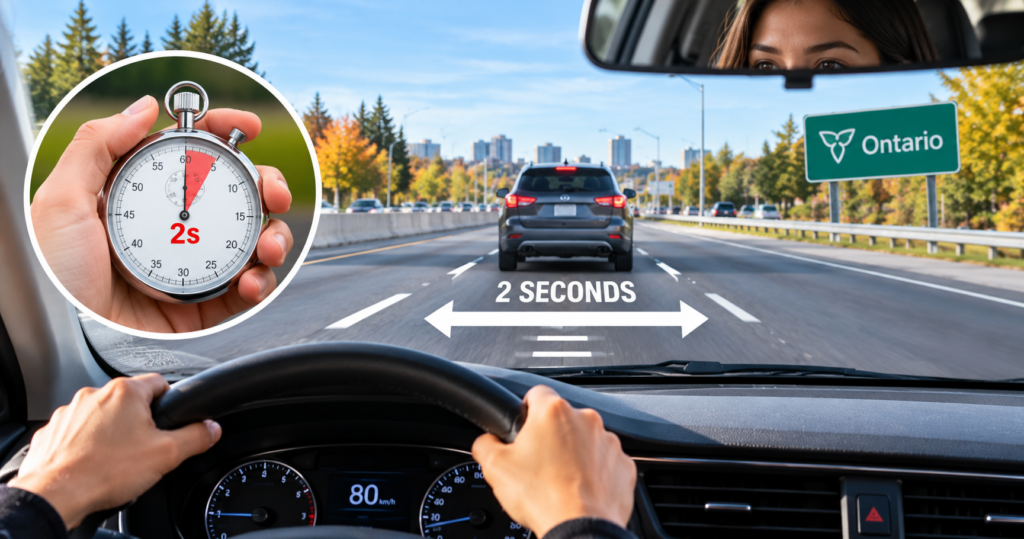
Traffic on Highway 400 is moving fast. Suddenly, brake lights flash three cars ahead, and the car in front of you stops hard. Whether you stop in time depends almost entirely on one thing: the gap you left.
That’s what the 2-second rule is for. It’s the simplest safety habit in driving, it’s on the G1 test, and road test examiners watch it closely. Here’s how it works in Ontario, how to measure it, and when two seconds isn’t enough.
In this guide11 sections
- What Is the 2-Second Rule?
- How to Measure the 2-Second Rule
- How Far Is 2 Seconds in Metres?
- When 2 Seconds Isn’t Enough
- Your Stopping Gap at Lights and Stop Signs
- What to Do When Someone Tailgates You
- Following Too Closely in Ontario: The Penalty
- Why Road Test Examiners Watch Your Following Distance
- Build Safe Habits With Road Safety Canada
- Conclusion
- Frequently Asked Questions
What Is the 2-Second Rule?
The 2-second rule is used to determine a safe following distance. According to the Official MTO Driver’s Handbook, a safe following distance is at least two seconds behind the vehicle in front of you.
Two things matter here:
- Two seconds is a minimum, not a target.
- It applies only in ideal driving conditions: dry roads, good visibility and normal traffic.
The rule uses time instead of distance, so it works at any speed. At higher speeds, two seconds automatically means a bigger gap.
How to Measure the 2-Second Rule
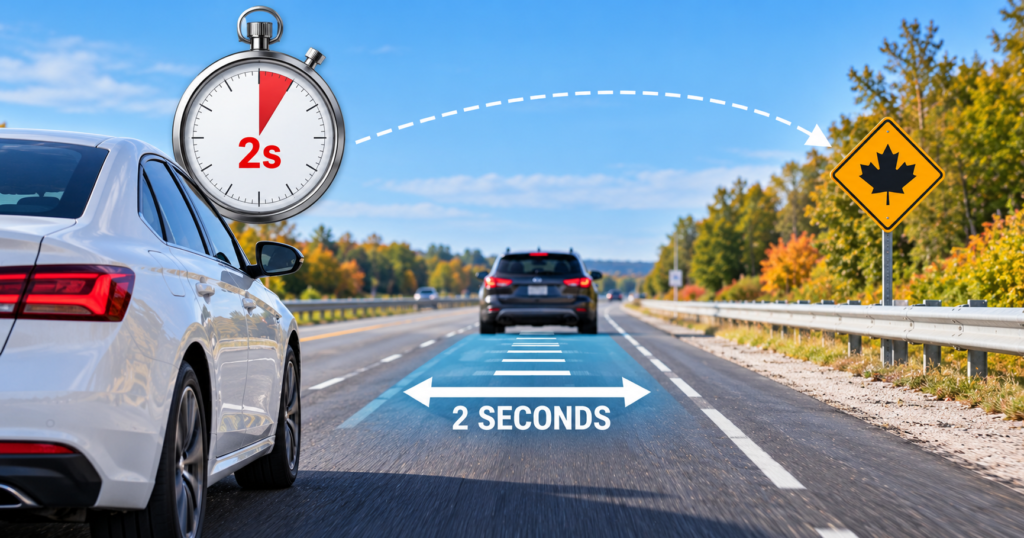
- Pick a fixed marker on the road ahead, such as a road sign, telephone pole or overpass.
- When the rear of the vehicle ahead passes the marker, start counting: “one thousand and one, one thousand and two.”
- When the front of your vehicle reaches the marker, stop counting. If you reach it before you finish “one thousand and two,” you’re following too closely. Ease off the gas and let the gap grow.
Check your gap regularly, especially after someone merges in front of you.
How Far Is 2 Seconds in Metres?
If you prefer to think in distance, here’s roughly how far your car travels in two seconds:
| Speed | Distance covered in 2 seconds |
| 50 km/h | about 28 metres |
| 60 km/h | about 33 metres |
| 80 km/h | about 44 metres |
| 100 km/h | about 56 metres |
That’s the minimum gap in good conditions. Remember that following distance is not your full stopping distance. The 2-second gap mainly gives you time to notice the car ahead braking and to react. Your car still needs room to actually stop, which is why you need more space when roads are slippery.
When 2 Seconds Isn’t Enough
The MTO Driver’s Handbook says you’ll need extra space in certain situations:
- Bad weather. Rain, snow and ice all increase the distance you need to stop.
- Following motorcycles. They can stop very quickly.
- Following large trucks. They block your view of the road ahead.
- Carrying a heavy load or towing. Your car takes longer to stop.
In Simcoe County winters, with snow squalls coming off Georgian Bay and black ice on rural roads, it’s common sense to double or even triple your gap. Many instructors teach 4 seconds or more on snow and ice. Our guide to winter driving safety in Canada has more tips.
Leave a bigger gap too:
- at night or in fog, when you can’t see as far ahead;
- on unfamiliar or winding roads;
- when you’re a new driver still building your reaction time.
Your Stopping Gap at Lights and Stop Signs
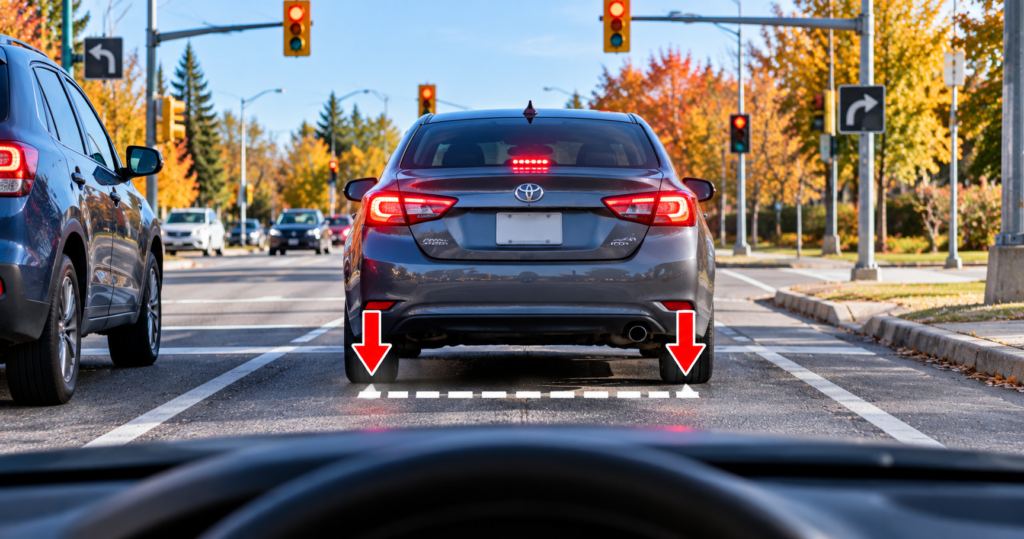
The 2-second rule is for moving traffic. When you’re stopped behind another vehicle at a light or stop sign, a common instructor tip is to stop where you can see the rear tires of the car ahead touching the road.
That gap gives you room to steer around the car if it stalls. It also keeps you from being pushed into it if you’re hit from behind.
What to Do When Someone Tailgates You
You can control your own following distance, but not the driver behind you. If someone is tailgating:
- Don’t brake-check or speed up. Both make a crash more likely.
- Increase the gap in front of you. That gives you room to brake gently, so the tailgater has more time to react too.
- Move right and let them pass when it’s safe.
- Signal early before turning or stopping, so they get as much warning as possible.
This is defensive driving in action. Learn more in our guides to the benefits of defensive driving and our road safety guide to defensive driving.
Following Too Closely in Ontario: The Penalty
Tailgating isn’t just unsafe; it’s an offence. Following too closely is charged under section 158 of the Highway Traffic Act. It carries a fine and 4 demerit points, and for G1 and G2 drivers it can also lead to a licence suspension under Ontario’s novice-driver rules.
Why Road Test Examiners Watch Your Following Distance
On your G2 and G road tests, the examiner watches how much space you leave, both in town and on the highway. Following too closely tells them you might not be able to react to a sudden stop, and it’s a common reason for lost points.
To show good habits on test day:
- keep at least a 2-second gap, and more on the highway or in poor weather;
- leave a stopping gap when you stop behind a vehicle;
- rebuild your gap after someone merges in front of you;
- don’t tailgate to keep up with traffic.
See our guides to common G2 road test mistakes and full G road test preparation.
Build Safe Habits With Road Safety Canada
Following distance is easy to understand but harder to keep up in real traffic, especially when others crowd you. At Road Safety Canada, our MTO-approved instructors teach new drivers across Barrie, Innisfil, Bradford, Orillia, Angus, Alliston and Collingwood. We teach safe space management from your very first lesson.
- G2 driving lessons in Barrie: practise space management in city and highway traffic.
- Full G road test preparation: get test-ready on the highway.
Call 705-300-5570 or register online to book your first lesson.
Conclusion:
The 2-second rule is the easiest safety habit you’ll ever learn. Pick a marker, count two seconds, and back off if you’re too close. Leave even more space in bad weather, behind trucks and motorcycles, and on Simcoe County’s winter roads.
It keeps you safe, keeps demerit points off your licence, and shows your road test examiner you’re ready to drive on your own.
When you’re ready to practise, Road Safety Canada can help. Our MTO-approved instructors serve Barrie and all of Simcoe County. Book your lesson today or call 705-300-5570.
Frequently Asked Questions
What is the 2-second rule in driving?
The 2-second rule means staying at least two seconds behind the vehicle in front of you. According to the MTO Driver’s Handbook, it is the minimum safe following distance and applies only in ideal driving conditions.
What is the two-second rule used to determine?
The two-second rule is used to determine a safe following distance. It tells you whether you have left enough space behind the vehicle ahead to react and stop safely if it brakes suddenly.
How do you measure the 2-second rule?
Pick a fixed marker such as a road sign. When the rear of the vehicle ahead passes it, count one thousand and one, one thousand and two. If you reach the marker before you finish counting, you are following too closely.
How many metres is a 2-second gap?
A 2-second gap is about 28 metres at 50 km/h, 33 metres at 60 km/h, 44 metres at 80 km/h and 56 metres at 100 km/h. This is a minimum for good conditions, so leave more space on wet or icy roads.
When should you leave more than 2 seconds?
Leave more than two seconds in bad weather, when following motorcycles or large trucks, when carrying a heavy load, and at night or in fog. On snow and ice, many instructors recommend four seconds or more.
What is the penalty for following too closely in Ontario?
Following too closely is an offence under section 158 of Ontario’s Highway Traffic Act. It carries a fine and 4 demerit points, and G1 and G2 drivers can also face a licence suspension.
How much space should you leave when stopped behind a car?
A common instructor tip is to stop where you can see the rear tires of the car ahead touching the road. This gives you room to steer around it and helps keep you from being pushed into it if you are hit from behind.
Ready to practise with an MTO-approved instructor?
Build real confidence in traffic with G2 lessons and Full G road test preparation in Barrie and across Simcoe County.