Barrie is a city of hills. Many of its streets slope down toward Kempenfelt Bay, and plenty of driveways and side streets around Simcoe County are steeper than they look.
So knowing how to park on a hill isn’t just a G1 test question. It’s what stops your car from rolling into traffic if the brakes ever fail.
The good news is that uphill and downhill parking comes down to one simple rule about which way to turn your front wheels. Here’s exactly what the Official MTO Driver’s Handbook says, with step-by-step instructions for every situation.
In this guide12 sections
- Quick Answer: Which Way Do You Turn Your Wheels?
- How to Park Uphill With a Curb
- How to Park Uphill Without a Curb
- How to Park Downhill With or Without a Curb
- Always: Set the Parking Brake and Choose the Right Gear
- How to Leave a Hill Parking Spot Safely
- Hill Parking on the G1 Test and Road Test
- Winter Hill Parking Tips
- Other Ontario Parking Rules to Know
- Practise Parking With Road Safety Canada
- Conclusion
- Frequently Asked Questions
Quick Answer: Which Way Do You Turn Your Wheels?
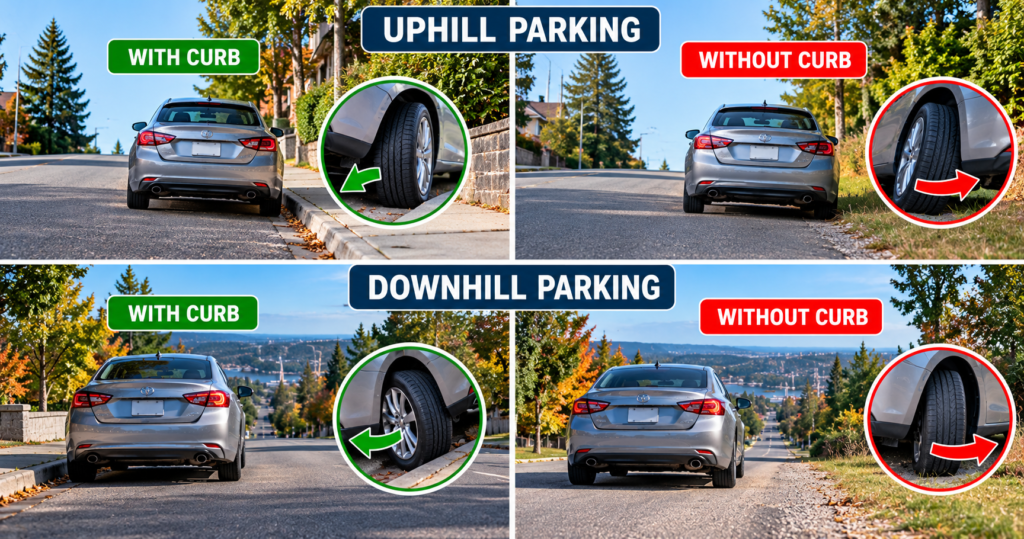
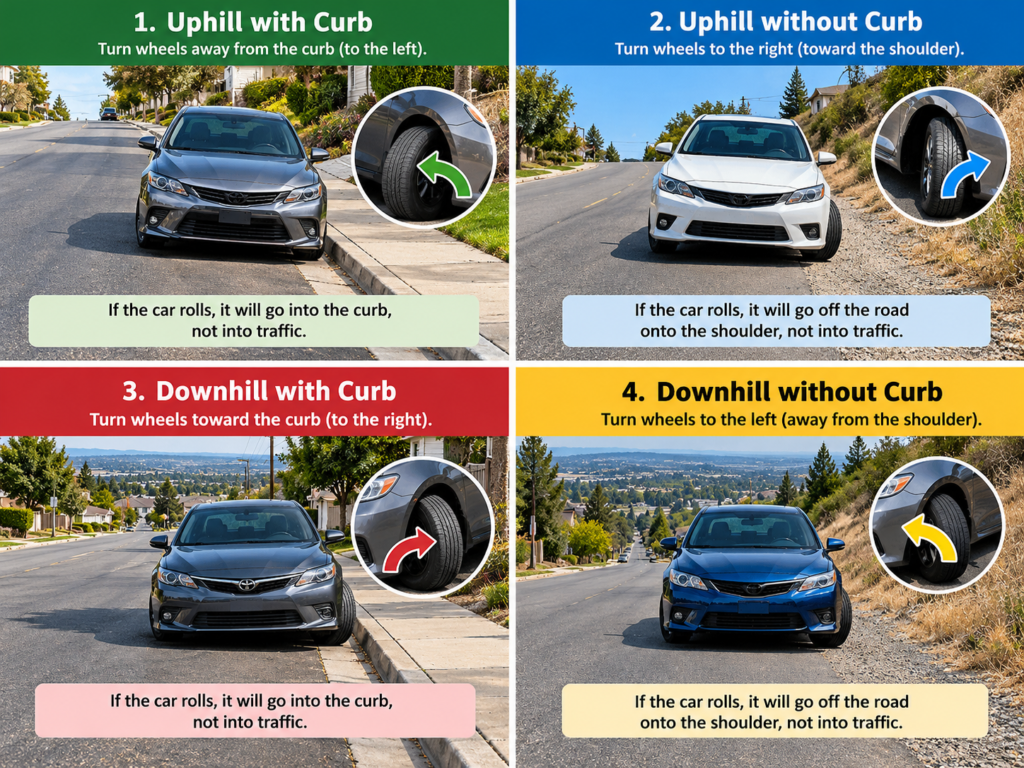
Uphill with a curb: turn your wheels left, away from the curb. Uphill without a curb: turn right. Downhill, with or without a curb: turn right, toward the curb or shoulder. Then always set the parking brake.
| Parking situation | Turn your front wheels | Why |
| Uphill with a curb | Left, away from the curb | If the car rolls back, the front tire stops against the curb |
| Uphill without a curb | Right, sharply | If the car rolls back, it rolls off the road, not into traffic |
| Downhill with a curb | Right, toward the curb | If the car rolls forward, the front tire stops against the curb |
| Downhill without a curb | Right, toward the shoulder | If the car rolls forward, it rolls off the road |
Easy way to remember it: “Up, up and away.” Uphill with a curb is the only time you turn your wheels away from the edge of the road. In every other case, turn them right, toward the curb or shoulder.
Want to practise hill parking before your road test? Book a G2 driving lesson in Barrie with an MTO-approved instructor.
How to Park Uphill With a Curb
This is the one that trips most new drivers up.
- Pull up close and parallel to the curb, and stop where you want to park.
- Turn your steering wheel to the left so your front wheels point toward the road. This is exactly what the MTO handbook says to do.
- Let the car roll back slowly, with your foot covering the brake, until the back of the front right tire gently touches the curb.
- Set the parking brake and shift into park.
Now if the brakes ever fail, the car rolls back only a few centimetres before the tire stops against the curb.
How to Park Uphill Without a Curb
When there’s no curb, for example on a rural road with a gravel shoulder, there’s nothing to catch your tire.
- Pull over as far right as you safely can.
- Turn your wheels sharply to the right, toward the edge of the road (MTO handbook).
- Set the parking brake and shift into park.
If the car rolls back, it will roll away from the road instead of backward into traffic.
How to Park Downhill With or Without a Curb
Downhill is simple: turn your front wheels toward the curb or right shoulder, according to the MTO handbook.
- With a curb: turn your wheels right, then creep forward slowly until the front of the right front tire touches the curb.
- Without a curb: turn your wheels right, toward the shoulder.
Then set the parking brake and shift into park. If the car rolls forward, the curb stops it, or it rolls off the road.
Always: Set the Parking Brake and Choose the Right Gear
Turning your wheels is your backup. Your first line of defence is the brake and the gear. Whenever you park, the MTO handbook says you should:
- always set the parking brake; and
- move the gear selector into park, or, with a manual transmission, shift into first or reverse gear.
A common tip from instructors: on a hill, set the parking brake before you shift into park. That way the brake holds the car’s weight instead of the transmission.
How to Leave a Hill Parking Spot Safely
- Start the engine with your foot firmly on the brake.
- Shift into drive (or reverse, if you need to back out).
- Release the parking brake.
- Signal, check your mirrors and do a shoulder check for traffic and cyclists.
- Straighten your wheels as you pull smoothly away from the curb.
On a steep uphill, give the car a little gas as you release the brake so it doesn’t roll back.
Hill Parking on the G1 Test and Road Test
On the G1 knowledge test, “Which way should you turn your wheels when parking uphill with a curb?” is a classic question. The table and the “up, up and away” trick above are all you need. For more on the test, see our G1 licence guide for Ontario.
On your road test, you may be asked to park along a curb, possibly on a slope. Examiners pay attention to:
- getting close and parallel to the curb;
- turning your wheels the right way for the slope;
- setting the parking brake;
- signalling and shoulder-checking when you pull out again.
See our guides to common G2 road test mistakes and how to pass your G2 test in Barrie. If your G test is next, our full G road test preparation covers every manoeuvre.
Winter Hill Parking Tips
Simcoe County winters make hill parking harder:
- avoid parking on a steep, icy slope if you have a flatter option;
- leave extra space from other cars, because tires can slide on ice;
- turn your wheels correctly every time; on ice it matters even more;
- clear snow away from the curb so your tire actually reaches it.
Our guide to winter driving safety in Canada has more cold-weather tips.
Other Ontario Parking Rules to Know
Wherever you park, uphill, downhill or on flat ground, the MTO handbook says do not park:
- within 3 metres of a fire hydrant;
- within 9 metres of an intersection, or 15 metres if it has traffic lights;
- within 15 metres of the nearest rail of a level railway crossing;
- on or within 100 metres of a bridge;
- where you’d block a sidewalk, crosswalk or road entrance.
Practise Parking With Road Safety Canada
Reading the rules is easy. Doing it smoothly with an examiner beside you is easier when you’ve practised. At Road Safety Canada, our MTO-approved instructors teach new drivers across Barrie, Innisfil, Bradford, Orillia, Angus, Alliston and Collingwood. Lessons include hill parking, parallel parking and every other road test manoeuvre.
Call 705-300-5570 or register online to book your first lesson.
Conclusion:
Hill parking is one of the easiest rules to remember once it clicks:
- Uphill with a curb: turn your wheels left, away from the curb.
- Uphill without a curb: turn them right.
- Downhill, curb or not: turn them right, toward the curb or shoulder.
- Every time: set the parking brake and shift into park.
Get it right and you’ll ace the G1 question, impress your road test examiner, and keep your car exactly where you left it.
When you’re ready to practise hill parking and every other road test manoeuvre, Road Safety Canada can help. Our MTO-approved instructors serve Barrie and all of Simcoe County. Book your lesson today or call 705-300-5570.
Frequently Asked Questions
Which way do you turn your wheels when parking uphill with a curb?
Turn your steering wheel to the left so your front wheels point toward the road, away from the curb. Then let the car roll back slowly until the front right tire gently touches the curb, and set the parking brake.
Which way do you turn your wheels when parking uphill without a curb?
When parking uphill without a curb, turn your front wheels sharply to the right, toward the edge of the road. If the car rolls back, it will roll away from the road instead of into traffic.
Which way do you turn your wheels when parking downhill?
When parking downhill, turn your front wheels to the right, toward the curb or the right shoulder. This applies whether or not there is a curb. Then set the parking brake and shift into park.
Why do you turn your wheels when parking on a hill?
Turning your wheels means that if your brakes or gears ever fail, the car rolls into the curb or off the road instead of rolling into traffic. It is a simple backup that can prevent a serious collision.
Do you need to use the parking brake on a hill?
Yes. Whenever you park, set the parking brake and move the gear selector into park. With a manual transmission, shift into first or reverse gear. On a hill, the parking brake is your main protection against rolling.
Is hill parking on the G1 test?
Yes. Questions about which way to turn your wheels when parking uphill or downhill are common on the Ontario G1 knowledge test. Remember: uphill with a curb, turn left; in every other case, turn right.
What is an easy way to remember hill parking rules?
Remember the phrase up, up and away. When parking uphill with a curb, turn your wheels away from the curb. In every other case, uphill without a curb or downhill, turn your wheels right, toward the curb or shoulder.
Ready to practise with an MTO-approved instructor?
Build real confidence in traffic with G2 lessons and Full G road test preparation in Barrie and across Simcoe County.