Learning to drive is one of those milestones that feels equal parts thrilling and terrifying. One moment you’re excited about the freedom a driver’s license brings, and the next you’re gripping the wheel with white knuckles at a four-way stop. That’s completely normal.
This guide walks you through everything a new driver in Canada needs to know from the checks you should run before you even start the engine, to handling snow, nervous moments, and everything in between.
Whether you’re on a G1 permit in Ontario, a Class 7 learner’s licence in BC, or just brushing up before your road test, these driving tips for beginners will help you build real, lasting confidence behind the wheel.
There’s no shortcut that skips practice altogether, but there is a smarter way to practice. Understanding exactly what trips new drivers up and working on those specific things on purpose gets you to “comfortable” a lot faster than just racking up random hours behind the wheel.
How to Drive Better as a Beginner?
Getting better at driving isn’t about memorizing every rule in the handbook overnight. It’s about building small, repeatable habits hecking your mirrors, staying calm, keeping a safe following distance until they become second nature.
Most confident drivers weren’t born that way. They just put in consistent, low-pressure practice, paid attention to their mistakes, and slowly stopped thinking so hard about every single movement. Give yourself the same permission to be a work in progress.
The fastest way to improve is simple: drive often, drive with someone experienced beside you when you can, and treat every trip even a five-minute one to the grocery store as practice.
It also helps to focus on one skill at a time instead of trying to perfect everything at once. Spend one drive purely on smooth braking, another on lane changes, and another on parking. Trying to nail all of it simultaneously is exactly what makes the early weeks feel overwhelming.
Don’t underestimate the value of narrating your actions out loud in the early days saying “checking mirror, signaling, checking blind spot” as you do it. It sounds silly, but it forces your brain to slow down and actually complete each step instead of skipping ahead in a rush.
What Are the 7 Steps Before You Start Your Car?
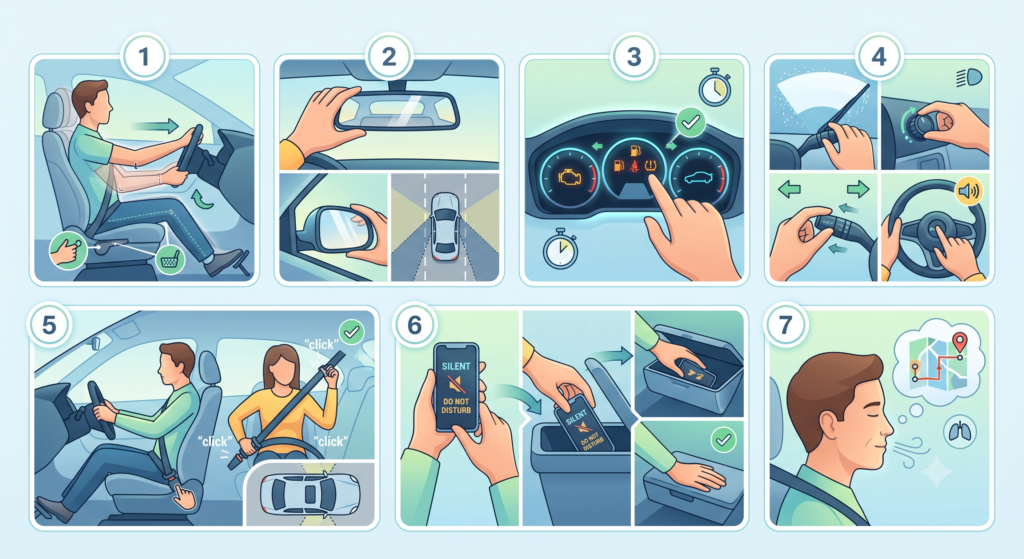
Before you even turn the key, there’s a quick pre-drive routine that experienced drivers do almost without thinking. For a beginner, running through it consciously every single time builds a habit that will protect you for years.
- Adjust your seat so your feet comfortably reach the pedals and your elbows stay slightly bent on the wheel.
- Set your mirrors — your rearview mirror should frame the entire back windshield, and your side mirrors should just barely overlap with that view to kill your blind spots.
- Check your dashboard for any warning lights — fuel, engine, tire pressure — before you move an inch.
- Locate the essentials — wipers, headlights, indicators, and horn — so you never have to look away from the road to find them.
- Buckle up, and make sure every passenger does too.
- Put your phone away or on silent, ideally out of reach entirely.
- Take one calm breath and mentally note your route before you shift into drive.
None of these steps take more than a few seconds individually, but together they set the tone for a safe, focused drive.
What Do Beginner Drivers Struggle With the Most?
Almost every new driver hits the same handful of speed bumps, so if you’re struggling, you’re in good company. Parallel parking tops the list for most people, closely followed by merging onto highways at speed.
Judging distance is another big one new drivers often follow too closely or brake too early because their sense of spacing simply hasn’t developed yet. That comes with time behind the wheel, not overnight.
Nerves themselves are often the real obstacle. It’s hard to execute a smooth lane change when your hands are shaking, so managing anxiety is just as important as learning the mechanical skills.
Roundabouts and multi-lane intersections also catch a lot of beginners off guard, simply because there’s more happening at once — signals, pedestrians, other cars choosing lanes at the last second. The good news is that all of these get dramatically easier with repetition; they rarely stay hard forever.
Every confident driver starts by learning the rules of the road. If you’re preparing for your Ontario learner’s licence, our guide on How Many Mistakes Are Allowed in the G1 Test? explains the passing score, common mistakes, and expert tips to help you pass your G1 test with confidence before applying these beginner driving tips on the road.
What Are the Top 3 Distractions While Driving?
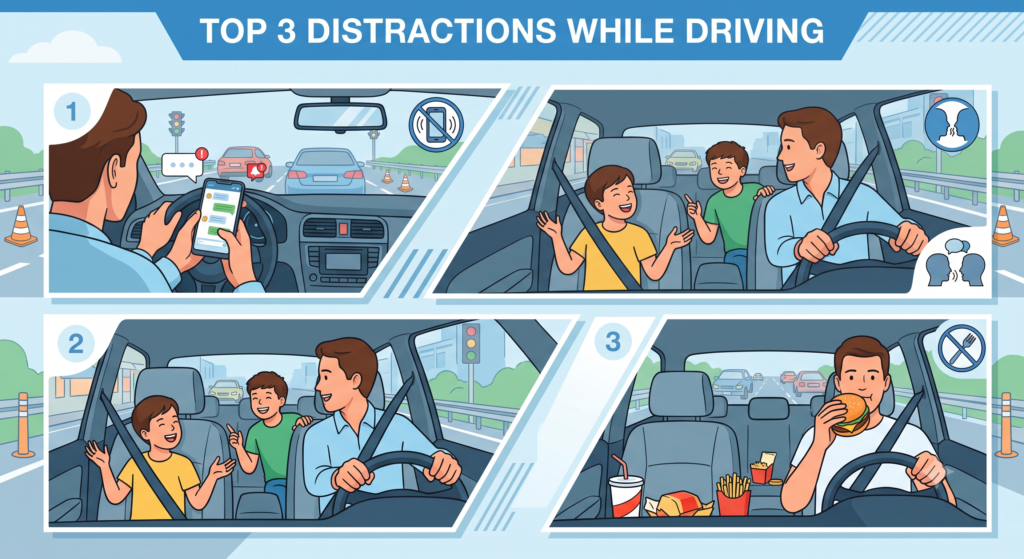
Distraction is the single biggest threat to a new driver’s safety, and it usually comes down to three culprits.
Your phone is the obvious one — texting, notifications, even glancing at a map app for two seconds can mean missing something critical ahead. Set your GPS and playlist before you start moving, not while you’re rolling.
Passengers are a close second. Friends chatting, kids in the backseat, or someone giving last-minute directions can pull your focus away at exactly the wrong moment. It’s okay to ask people to keep it down while you’re still learning.
Eating, drinking, or fiddling with the radio rounds out the top three. They seem harmless individually, but they all take a hand off the wheel and your eyes off the road, even if just for a second.
A good rule of thumb: if something can wait until you’ve stopped the car, it should wait. That text, that song change, that snack — none of it is worth the split-second of missed attention that causes most beginner fender-benders.
How to Learn Driving Basics for Beginners
Good driving comes down to a handful of core techniques, and once these feel natural, everything else gets easier.
Steering should be done with both hands, roughly at the 9 and 3 o’clock positions on the wheel. Use a push-pull motion — one hand pushes up while the other pulls down — rather than crossing your arms over each other.
Accelerating and braking should always be gradual. Ease onto the gas, and when braking, press firmly first and then ease off as the car slows, so you come to a smooth stop instead of a jerky one.
Turning and changing lanes always start with a signal, followed by a mirror and blind-spot check. Wait for a safe gap in traffic, then move smoothly into the new lane while keeping a steady speed.
Basic Parking Techniques for Beginners
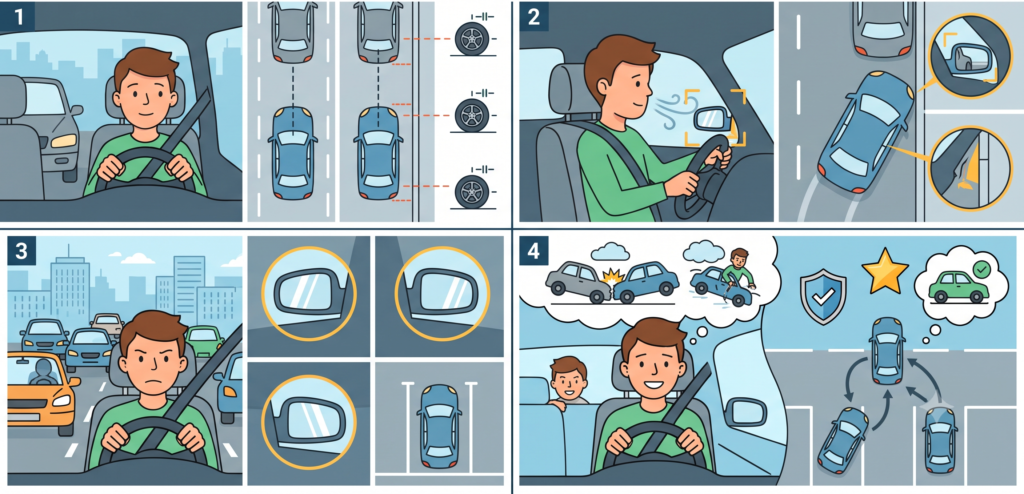
Parking intimidates almost every new driver, but it breaks down into a few repeatable moves. For parallel parking, line your rear wheels up with the rear bumper of the car ahead, turn the wheel sharply toward the curb, and reverse in slowly while checking your mirrors.
For perpendicular parking, use your side mirrors to center yourself in the space as you pull in, rather than relying only on the windshield view. Practicing both in an empty lot before trying them on a real street will save you a lot of stress later.
Don’t be afraid to take a few extra seconds to reposition if your first attempt isn’t clean. Experienced drivers reset and re-angle their cars all the time — it’s the pausing to check, not the perfection, that actually keeps everyone safe.
Defensive Driving Tips for New Drivers
Defensive driving simply means assuming other drivers might make mistakes, and staying ready to react if they do. It’s one of the most valuable mindsets you can build early on.
Keep a following distance of at least two seconds behind the car in front of you, and stretch that to three or four seconds in rain, snow, or heavy traffic. This gives you room to brake without panicking.
Check your mirrors and blind spots constantly, not just before a lane change. And never fully trust a green light — glance both ways before entering an intersection, since not every driver stops when they should.
Defensive driving also means resisting the urge to match everyone else’s pace. If traffic around you is speeding or tailgating, that’s not a reason to do the same — staying at a safe, steady speed protects you even when it feels like you’re the odd one out.
How to Handle Road Rage as a New Driver
Sooner or later, an aggressive driver will tailgate you, honk, or cut you off, and it can rattle even experienced drivers. The safest response is almost always to do nothing confrontational at all.
Slow down slightly and let them pass rather than matching their energy. If someone seems to be following you aggressively, keep your doors locked and head toward a busy, well-lit area like a police station or gas station rather than stopping on an empty road.
Driving Tips for Nervous Drivers
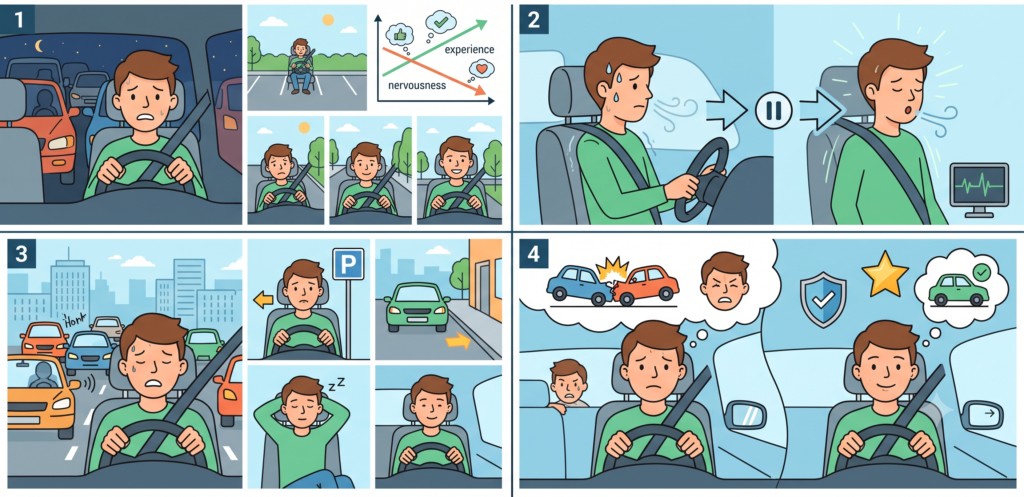
Feeling nervous behind the wheel is one of the most common experiences for beginners, and it doesn’t mean you’re not cut out for it. It just means your brain is still building confidence through repetition.
When anxiety spikes, a slow breath in through the nose, held for a few seconds, and released slowly through the mouth can genuinely calm your nervous system enough to refocus. Do this before you even start driving if you’re feeling tense.
Give yourself permission to pull over if you’re overwhelmed. Finding a safe spot to stop, collect yourself, and continue is always better than pushing through a panic while moving.
It also helps to reframe what nervousness actually means. It’s not a sign you’re a bad driver — it’s a sign you’re taking the responsibility seriously, which is exactly the mindset that keeps beginners safe in those first few months.
Practicing in Low-Traffic Areas First
Empty parking lots, quiet residential streets, or industrial areas on a weekend are ideal for early practice. They let you get comfortable with steering, braking, and parking without the pressure of merging traffic or impatient drivers around you.
Once basic control feels automatic, gradually move to busier streets and eventually highways. Rushing this progression is one of the most common reasons new drivers stay nervous longer than they need to.
21 Useful Driving Tips for New Drivers
Here’s a quick-reference roundup to keep in your back pocket as you build experience:
- Start with a proper driver’s education course if one is available to you.
- Always carry a valid learner’s permit or licence.
- Adjust your seat, mirrors, and steering wheel every single drive.
- Get rid of distractions before you start moving, not after.
- Don’t overthink every rule at once — focus on the road first.
- Practice breathing techniques to calm pre-drive nerves.
- Even 15–20 minutes of regular practice adds up fast.
- Stick to familiar roads while you’re still building confidence.
- Avoid highways until you feel steady on local streets.
- Learn the rules of the road properly — they exist to make everyone predictable.
- Walk around your car and learn where everything is before driving it.
- Ignore what other drivers might think of your pace — safety comes first.
- Choose calm, helpful passengers while you’re learning.
- Treat mistakes as lessons, not proof you can’t drive.
- Never respond to road rage — stay away and stay calm.
- Never drive under the influence of alcohol or drugs, ever.
- Scan far down the road, not just the car directly ahead.
- Keep music low enough to hear your surroundings clearly.
- Learn basic car maintenance — checking oil, tire pressure, and lights.
- Keep a small emergency kit in your car — jumper cables, a flashlight, a first-aid kit.
- Always buckle up, and make sure everyone in the car does too.
Automatic Car Driving Tips for Beginners
Automatic cars remove one major variable — there’s no clutch to manage — which makes them a popular starting point for new drivers. Still, a few habits make a real difference.
Keep your right foot ready to move between the gas and brake pedals, but never rest it on both at once. Automatic transmissions also “creep” forward when you take your foot off the brake, so always keep your foot covering the brake at stop signs and lights.
Get comfortable with the gear selector — knowing exactly where Park, Reverse, and Drive are without looking down will save you from fumbling in the moment.
One habit worth building early: always shift fully into Park and engage the parking brake on hills, rather than relying on the transmission alone. It’s a small extra step that protects both your car and anyone parked nearby.
Manual Car Driving Tips for Beginners
Manual transmissions add an extra layer — clutch control — but plenty of new drivers learn on them too, especially with older or performance vehicles. The biggest early hurdle is finding the “bite point” where the clutch starts to engage.
Practice finding that point on flat, empty ground before attempting hills or intersections. Stalling is completely normal at first; even experienced manual drivers stall occasionally, so don’t let it shake your confidence.
Shifting smoothly comes with repetition — listen to the engine rather than watching the tachometer, and you’ll start to feel when it’s time to shift up or down.
Hill starts tend to worry new manual drivers the most, since it means balancing the clutch, gas, and handbrake all at once. Practicing this specific move on a quiet slope, away from traffic, will save you a lot of stress the first time you meet a hill at a red light.
Driving Tips for Beginners in Canada
Learning to drive in Canada comes with a few things that don’t apply everywhere else, starting with graduated licensing. Most provinces use a staged system — Ontario’s G1/G2/G, British Columbia’s Class 7, Alberta’s GDL — where new drivers move through learner and probationary stages before earning a full licence.
Each stage comes with its own restrictions, like passenger limits, blood alcohol requirements, or highway driving rules, so it’s worth checking your specific province’s rules early on. Booking your road test well in advance is also smart, since wait times can stretch to several weeks in busier cities.
Weather is the other big factor. Canadian winters mean you’ll almost certainly need to drive in snow and ice at some point during your first year, so it’s worth practicing those conditions specifically rather than avoiding them entirely.
It’s also worth getting familiar with your province’s specific road test format ahead of time — some include highway driving, others focus more on city and residential routes. A quick look at your provincial transportation website before booking will help you know exactly what to expect on test day.
Beginners Driving Tips in Snow
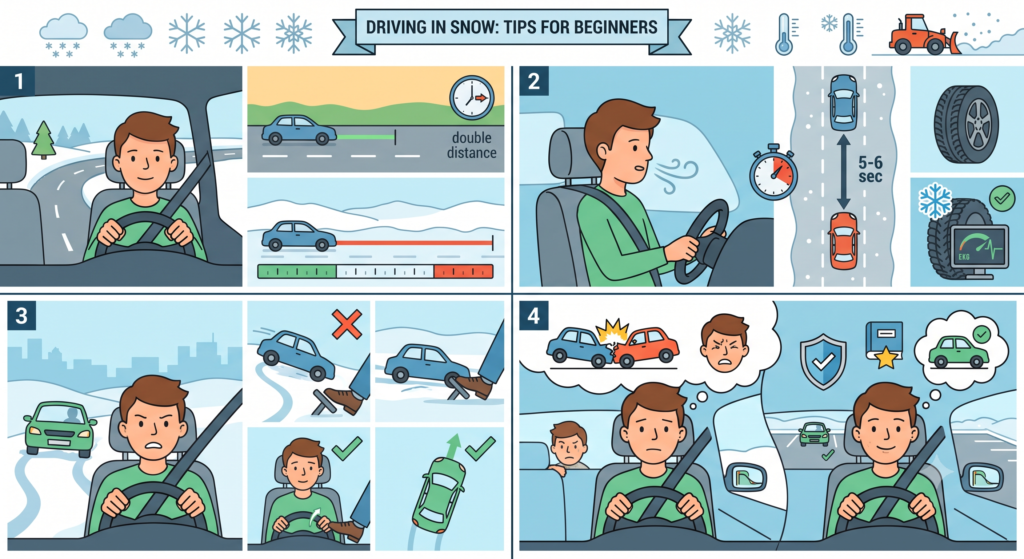
Winter driving asks for a completely different rhythm than dry-road driving. Slow down well before turns and stops, since braking distances can double or triple on icy roads.
Winter tires make a real difference in cold-weather grip — they’re even legally required in Quebec — and they’re worth the investment if you’re driving through a Canadian winter. Keep a bigger following distance than usual, ideally five to six seconds, to account for reduced traction.
If your car starts to skid, resist the urge to slam the brakes. Ease off the gas and steer gently in the direction you want to go until you regain control.
Before winter hits, it’s worth practicing gentle braking on an empty, snow-covered lot so you know how your specific car handles in those conditions. Every vehicle responds a little differently, and that knowledge is far more useful learned safely in a parking lot than discovered for the first time on a busy road.
Conclusion
Every confident driver on the road today was once a nervous beginner gripping the wheel too tightly. The difference between them and where you are now is simply time, repetition, and a handful of good habits practiced consistently.
Take these tips one at a time, be patient with your own progress, and remember that even small, boring drives to the store are quietly building the skills you’ll rely on for the rest of your life.
If you’re looking for professional guidance to become a safer, more confident driver, Road Safety Canada is here to help. We offer G1 Online Classes to help you prepare for your written test, G2 Driving Lessons with experienced instructors, and Full G Road Test Preparation to build the skills and confidence you need to pass your test successfully.
Whether you’re just starting your driving journey or getting ready for your next road test, our personalized training and expert instruction will help you become a safe, responsible, and confident driver.
Ready to get behind the wheel with confidence? Contact Road Safety Canada today and take the next step toward earning your driver’s licence.
Frequently Asked Questions
How can I overcome my fear of driving?
Start in low-traffic areas like empty lots, and build up gradually. Confidence comes from repeated, low-pressure practice, not from forcing yourself into stressful situations too early.
How long does it take to become a confident driver?
It varies by person, but most new drivers start feeling genuinely comfortable after a few months of consistent, regular driving.
What’s the biggest mistake beginner drivers make?
Following too closely and misjudging distance tops the list, mostly because spacing awareness takes real seat time to develop.
Is it harder to learn manual or automatic first?
Automatic is generally easier for beginners since it removes clutch control entirely, but manual isn’t out of reach — it just takes a bit more early practice.
Do I need winter tires to drive in Canada?
They’re not mandatory everywhere, but they’re legally required in Quebec and strongly recommended across the rest of the country for anyone driving through snow and ice.