If you’re preparing to get your driver’s licence in Ontario, the first step is passing the G1 test. And if you’re like most beginner drivers, your very first question is probably: how many questions are on the G1 test?
In this complete guide, we’ll answer that question in detail, break down the exact test format, explain how many questions you can get wrong, and — most importantly give you 200 free G1 test practice questions with answers so you can study smart and pass on your first attempt.
Whether you’re a newcomer to Canada, a teenager preparing for your first licence, or simply brushing up before test day, this guide covers everything you need.
How Many Questions Are on the G1 Test? Quick Answer
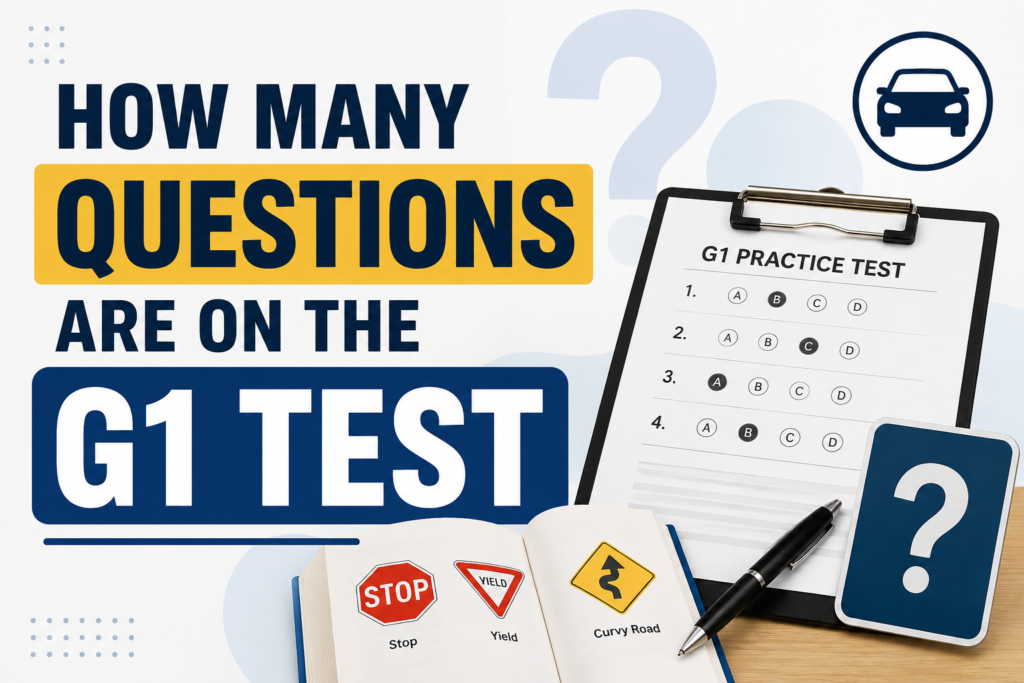
The Ontario G1 test consists of 40 multiple-choice questions, split into two sections:
| Section | Number of Questions | Passing Requirement |
| Road Signs | 20 questions | Must answer 16/20 correctly |
| Rules of the Road | 20 questions | Must answer 16/20 correctly |
| Total | 40 questions | Must pass both sections separately |
This means it’s not enough to just get an overall passing score — you must score at least 80% (16 out of 20) in each section individually. If you fail one section but pass the other, you fail the entire test and must retake both sections.
There is generally no strict time limit for the G1 knowledge test, but most test-takers finish within 20–30 minutes.
G1 Test Format Breakdown
Road Signs Section
This section tests your ability to recognize and understand Ontario’s traffic signs, signals, and pavement markings. You’ll be shown an image of a sign and asked to identify what it means or how to respond to it.
Rules of the Road Section
This section focuses on driving laws, right-of-way rules, speed limits, safety regulations, and general road knowledge from the official Ontario Driver’s Handbook.
Multiple Choice Format
Every question on the G1 test is multiple choice, typically with 3 or 4 answer options. You simply select the one correct answer.
How the Test Is Scored
Each correct answer counts as one point. As mentioned, you need 16 out of 20 in both sections — scoring 32/40 overall isn’t good enough if it’s unevenly distributed (for example, 20/20 on signs and 12/20 on rules would still be a fail).
What Topics Are Covered In Ontario G1 Test Questions
The Ontario G1 test questions are drawn directly from the MTO (Ministry of Transportation) driver’s handbook. Key topics include:
- Traffic signs, signals, and road markings
- Right-of-way rules at intersections and roundabouts
- Speed limits in different zones (school zones, highways, residential areas)
- Parking rules and restrictions
- Seatbelt and child car seat laws
- Alcohol and drug-impaired driving laws
- Highway and 400-series expressway driving rules
- Sharing the road with cyclists, pedestrians, and motorcycles
- Winter and adverse weather driving rules
- Demerit points and graduated licensing (G1, G2, G rules)
Studying the official handbook alongside practice questions is the most effective way to prepare.
Sample of G1 Test Questions and Answers
Before we get to the full list of 200 practice questions, here are a few examples of how questions typically appear on the real test:
Q: What does a solid yellow line on your side of the road mean?
A: You may not pass.
Q: What is the speed limit in a school zone unless otherwise posted?
A: 40 km/h
Q: When must you use your headlights in Ontario?
A: From half an hour before sunset to half an hour after sunrise, and any time visibility is reduced.
Q: What should you do when approaching a yellow traffic light?
A: Stop if you can do so safely; otherwise proceed with caution.
Now let’s move to the complete practice set.
Also Read:21+ Beginner Driving Tips That Will Boost Your Confidence Fast
200 G1 Test Practice Questions with Answers
Use this free G1 practice test bank to test your knowledge. Questions are organized into three categories to match the real exam structure: Road Signs, Rules of the Road, and Mixed/Scenario-Based questions.
Road Signs Practice Questions Q1–70
Q: A red octagon-shaped sign means?
A: Stop
Q: A yellow diamond-shaped sign indicates?
A: Warning of a hazard ahead
Q: A round sign with a black and white design usually indicates?
A: Railway crossing
Q: What does a white rectangular sign generally represent?
A: Regulatory information (speed limits, rules)
Q: What shape are most warning signs in Ontario?
A: Diamond
Q: A red circle with a diagonal line through a symbol means?
A: That action is prohibited
Q: What does a sign with an arrow curving mean?
A: Curve ahead
Q: What does a triangular sign pointing down at an intersection mean?
A: Yield
Q: What colour are most regulatory signs?
A: White with black or red text
Q: What colour are construction zone signs?
A: Orange
Q: What does a blue sign typically indicate?
A: Services (hospitals, gas stations, rest areas)
Q: What does a green sign typically show?
A: Directional/guide information
Q: A sign showing a pedestrian symbol indicates?
A: Pedestrian crossing area
Q: A sign with a bicycle symbol means?
A: Bicycle route or shared lane
Q: What does a “No U-Turn” sign look like?
A: A U-shaped arrow with a red circle and slash
Q: A sign showing “One Way” with an arrow means?
A: Traffic moves only in the direction shown
Q: What does a “Do Not Enter” sign look like?
A: A white horizontal bar on a red circle
Q: What does a school zone sign indicate?
A: Reduced speed area near schools
Q: A sign with a deer symbol warns of?
A: Wildlife crossing
Q: A sign showing merging arrows means?
A: Lanes merging ahead
Q: A sign with “RR” inside an X shape means?
A: Railway crossing ahead
Q: What does a slippery road sign look like?
A: A car with wavy skid marks
Q: A sign showing steep grade percentage warns of?
A: A steep hill ahead
Q: A sign with a traffic light symbol warns of?
A: Signal ahead
Q: What does a “No Parking” sign look like?
A: A red circle with a P and diagonal slash
Q: A sign showing “No Stopping” means?
A: Stopping is prohibited at any time in that area
Q: What does a divided highway sign indicate?
A: The road ahead splits into a median-divided highway
Q: A sign with two arrows pointing opposite directions means?
A: Two-way traffic ahead
Q: A sign showing a narrow bridge means?
A: The bridge ahead is narrower than the road
Q: What does a chevron alignment sign indicate?
A: A sharp curve or turn ahead
Q: A sign with a truck on a downgrade means?
A: Steep hill – trucks use lower gear
Q: What does an amber/yellow flashing light at an intersection mean?
A: Proceed with caution
Q: What does a red flashing light mean?
A: Stop completely, then proceed when safe (like a stop sign)
Q: What does a solid red traffic light mean?
A: Come to a complete stop
Q: What does a flashing green light mean at some Ontario intersections?
A: Advanced green – protected left turn
Q: A sign with “Keep Right” and an arrow means?
A: Traffic must keep to the right of a median/obstruction
Q: A sign showing a roundabout symbol means?
A: A roundabout ahead
Q: What does a sign with “Lane Ends Merge Left” mean?
A: Right lane is ending, merge left
Q: A sign with an airplane symbol warns of?
A: Low-flying aircraft or airport nearby
Q: A sign showing a snowflake symbol may indicate?
A: Seasonal road conditions/winter maintenance
Q: What does a diamond HOV lane sign mean?
A: High-occupancy vehicle lane
Q: A sign showing “Fasten Seatbelt” reminds drivers to?
A: Wear seatbelts, required by law
Q: A sign with a hospital symbol (H) indicates?
A: Hospital nearby
Q: A sign with a picnic table symbol indicates?
A: Rest area/picnic area ahead
Q: What does a sign showing maximum height mean?
A: Maximum vehicle clearance height for a bridge/tunnel
Q: What does a “Reduce Speed Ahead” sign indicate?
A: Speed limit decreases ahead
Q: A sign showing two vehicles side by side with arrows means?
A: Passing lane ahead
Q: What does a “Do Not Pass” sign indicate?
A: Passing not allowed in that zone
Q: A sign showing “Keep Left” means?
A: Traffic must stay to the left of a median/obstruction
Q: What does a construction worker symbol sign mean?
A: Road workers ahead, reduce speed
Q: A sign showing traffic circle with arrows means?
A: Direction of travel in a roundabout
Q: A sign with “Winding Road” and multiple curves means?
A: Series of curves ahead
Q: What does a sign with a car and a wavy arrow overlapping mean?
A: Slippery when wet
Q: A red and white triangle at an intersection means?
A: Yield the right-of-way
Q: What does a “No Left Turn” sign look like?
A: A left arrow with a red circle and slash
Q: What does a “No Right Turn” sign look like?
A: A right arrow with a red circle and slash
Q: A sign showing a horse and rider means?
A: Equestrian crossing area
Q: A sign with “Bump” text means?
A: Road bump/uneven surface ahead
Q: A sign showing a train symbol at a level crossing means?
A: Prepare to stop for a train if signals activate
Q: A sign with a ferry symbol indicates?
A: Ferry crossing ahead
Q: A sign showing “Road Closed” means?
A: The road ahead is not passable
Q: A sign with “Detour” and an arrow means?
A: Alternate route due to road closure
Q: What does a sign showing “Speed Limit 50” mean?
A: Maximum legal speed is 50 km/h in that zone
Q: A sign with “Minimum Speed” indicates?
A: The slowest speed permitted on that road
Q: A sign showing a tunnel indicates?
A: Tunnel ahead, headlights may be required
Q: What does a sign with “Yield to Pedestrians” mean?
A: Drivers must give way to people crossing
Q: A sign with “School Bus Stop Ahead” means?
A: Prepare to stop for a stopped school bus
Q: A sign showing “Playground” symbol means?
A: Reduced speed area near a playground
Q: A sign with “Traffic Signal Ahead” and a light symbol means?
A: A signalled intersection is coming up
Q: A sign showing “Road Narrows” means?
A: The road ahead becomes narrower
Rules of the Road Practice Questions
Q: What is the default speed limit in a residential area unless posted otherwise?
A: 50 km/h
Q: What is the speed limit in a community safety zone during posted hours?
A: As posted, often 40 km/h, with doubled fines
Q: When approaching a school bus with flashing red lights on an undivided road, what must you do?
A: Stop, regardless of direction, until lights stop flashing
Q: On a divided highway, do you need to stop for a school bus travelling the opposite direction?
A: No, only if there’s no physical median dividing the lanes
Q: What is the minimum following distance recommended in good conditions?
A: A 2-second gap
Q: What should you do at a four-way stop when two vehicles arrive at the same time?
A: The vehicle on the right has the right-of-way
Q: What is the legal blood alcohol concentration (BAC) limit for G1/G2 drivers in Ontario?
A: Zero tolerance – 0 BAC
Q: How many demerit points before a G1 licence may be suspended?
A: 9 or more points can trigger a review/suspension
Q: What is required to accompany a G1 driver in the vehicle?
A: A fully licensed driver with at least 4 years of experience and under 0.05 BAC
Q: Can a G1 driver drive on 400-series highways?
A: No, unless accompanied and specific exceptions apply (with restrictions)
Q: What is the maximum number of passengers a G1 driver can carry (besides supervisor)?
A: Number equal to the seatbelts available, but no more passengers than seatbelts
Q: What time restrictions apply to G1 drivers?
A: Cannot drive between midnight and 5 a.m.
Q: Is it mandatory to wear a seatbelt in Ontario?
A: Yes, for driver and all passengers
Q: What is the rule for children under a certain height/weight regarding car seats?
A: Must use an appropriate child car seat or booster seat
Q: What must you do when an emergency vehicle approaches with lights/siren on?
A: Pull over to the right and stop
Q: How far should you stay back from a stopped emergency vehicle with lights flashing?
A: Slow down and move over if possible (Slow Down, Move Over law)
Q: What is the right-of-way rule at an uncontrolled intersection?
A: Yield to the vehicle already in the intersection or arriving first
Q: When turning left, who has the right-of-way — you or oncoming traffic?
A: Oncoming traffic going straight has the right-of-way
Q: What should you do before changing lanes?
A: Check mirrors, shoulder check, and signal
Q: What is the rule regarding using a handheld cellphone while driving?
A: Prohibited – distracted driving law
Q: What is Ontario’s graduated licensing system called?
A: The Graduated Licensing System (G1, G2, G)
Q: How long must you hold a G1 before taking the G2 road test (with driver’s ed)?
A: At least 8 months
Q: How long must you hold a G1 without driver’s ed before taking G2?
A: At least 12 months
Q: What is required before your G1 licence expires?
A: You must pass the G2 test within 5 years
Q: What should you do if your vehicle starts to skid?
A: Ease off the gas and steer in the direction you want to go
Q: What is hydroplaning?
A: When tires lose contact with the road due to water buildup
Q: What should you do in fog?
A: Use low-beam headlights and reduce speed
Q: When should you use high beam headlights?
A: On unlit roads with no oncoming traffic
Q: What should you do when an oncoming vehicle’s high beams are on?
A: Look toward the right edge of the road, avoid looking directly at lights
Q: What is the rule when merging onto a highway?
A: Match the speed of traffic and merge safely
Q: What lane should slower traffic use on a multi-lane highway?
A: The right lane
Q: When can you pass another vehicle on the right?
A: On a multi-lane road where it’s safe and legal, not on undivided two-lane roads
Q: What must you do before making a U-turn?
A: Ensure it is legal and safe, with clear visibility both ways
Q: Where are U-turns generally prohibited?
A: Near hills, curves, intersections with signals (unless permitted), and where signs prohibit them
Q: What does “defensive driving” mean?
A: Anticipating hazards and driving to avoid collisions
Q: What should you do if you’re being tailgated?
A: Increase following distance ahead and allow the tailgater to pass if possible
Q: What is road rage and how should you respond to it?
A: Aggressive driving behavior; respond by staying calm and avoiding confrontation
Q: What is the rule for parking near a fire hydrant?
A: Must park at least 3 metres away
Q: How close can you park to a stop sign?
A: Not within 9 metres (30 feet), unless posted otherwise
Q: Can you park in a bike lane?
A: No, it’s prohibited
Q: What must you check before opening your car door in traffic?
A: For approaching cyclists or vehicles (dooring law)
Q: What is the safe passing distance for cyclists in Ontario?
A: At least 1 metre where possible
Q: What should you do when approaching a roundabout?
A: Yield to traffic already in the roundabout
Q: In a roundabout, which direction do vehicles travel in Ontario?
A: Counter-clockwise
Q: What is the rule about texting while driving?
A: Illegal — hands-free devices only
Q: What are the penalties for a first distracted driving conviction?
A: Fines, demerit points, and possible licence suspension
Q: What should new drivers know about G2 restrictions?
A: Fewer restrictions than G1, but passenger limits may still apply for young drivers
Q: What is the rule about driving with worn/bald tires?
A: It is illegal and unsafe — tires must meet minimum tread depth
Q: What should you do if your brakes fail?
A: Pump the brakes, downshift, and use the parking brake gradually
Q: What is the correct hand position on the steering wheel recommended today?
A: 9 and 3 o’clock position
Q: What should you do at a railway crossing with flashing lights?
A: Stop and wait until the lights stop flashing
Q: How far should you stop from railway tracks when a train is approaching?
A: At least 5 metres from the nearest rail
Q: What should a driver do when approaching a pedestrian crossing with a pedestrian waiting?
A: Stop and yield the right-of-way
Q: Is jaywalking a factor drivers should still watch for?
A: Yes, always watch for pedestrians regardless of rules
Q: What is the proper response to a “Yield” sign?
A: Slow down and give way to traffic/pedestrians as needed
Q: What is the rule for driving in a construction zone?
A: Reduce speed, follow posted signs, fines are often doubled
Q: What must a driver do when involved in a collision with property damage only?
A: Exchange information and report if damage exceeds the threshold
Q: What must a driver do if involved in a collision with injury?
A: Call police and emergency services immediately
Q: What should you do if you witness a collision?
A: Stop only if safe and it’s necessary to assist; call 911 if needed
Q: What does “implied consent” mean regarding alcohol testing?
A: By driving, you agree to provide a breath sample if requested by police
Q: What is the penalty for refusing a breathalyzer test?
A: Treated the same as, or more severely than, failing the test
Q: What is a “warn range” suspension?
A: A licence suspension for a BAC between 0.05 and 0.079
Q: What is the legal requirement for vehicle insurance in Ontario?
A: Mandatory liability insurance for all drivers
Q: What must you always carry while driving?
A: Valid licence, vehicle registration (permit), and proof of insurance
Q: What should you do when your vehicle breaks down on the highway?
A: Move to the shoulder, turn on hazard lights, and stay safe
Q: What is the rule about headlights during rain?
A: Headlights must be on when wipers are in continuous use
Q: What is the rule for driving with only daytime running lights at night?
A: Not sufficient — full headlights are required
Q: What should you do when approaching a curve at high speed?
A: Slow down before entering the curve
Q: What is the effect of alcohol on driving ability?
A: Slows reaction time and impairs judgment, even in small amounts
Q: What is the effect of fatigue on driving?
A: Similar to impairment — slows reactions, reduces awareness
Q: What is the rule about eating or grooming while driving?
A: Not illegal directly but considered distracted driving if it impairs control
Q: What must a learner driver (G1) always ensure before driving?
A: A qualifying supervising driver is present in the front seat
Q: Can a G1 driver drive alone under any circumstance?
A: No, never — a supervisor must always be present
Q: What is the rule about following a snowplow?
A: Keep well back and do not pass unless safe
Q: What is the rule for headlights on a vehicle at all times while driving in Ontario?
A: Must be in good working order and used as required by conditions
Q: What should you do in fog?
A: Use low-beam headlights and reduce speed
Q: When should you use high beam headlights?
A: On unlit roads with no oncoming traffic
Q: What should you do when an oncoming vehicle’s high beams are on?
A: Look toward the right edge of the road, avoid looking directly at lights
Q: What is the rule when merging onto a highway?
A: Match the speed of traffic and merge safely
Q: What lane should slower traffic use on a multi-lane highway?
A: The right lane
Q: When can you pass another vehicle on the right?
A: On a multi-lane road where it’s safe and legal, not on undivided two-lane roads
Q: What must you do before making a U-turn?
A: Ensure it is legal and safe, with clear visibility both ways
Q: Where are U-turns generally prohibited?
A: Near hills, curves, intersections with signals (unless permitted), and where signs prohibit them
Q: What does “defensive driving” mean?
A: Anticipating hazards and driving to avoid collisions
Q: What should you do if you’re being tailgated?
A: Increase following distance ahead and allow the tailgater to pass if possible
Q: What is road rage and how should you respond to it?
A: Aggressive driving behavior; respond by staying calm and avoiding confrontation
Q: What is the rule for parking near a fire hydrant?
A: Must park at least 3 metres away
Q: How close can you park to a stop sign?
A: Not within 9 metres (30 feet), unless posted otherwise
Q: Can you park in a bike lane?
A: No, it’s prohibited
Q: What must you check before opening your car door in traffic?
A: For approaching cyclists or vehicles (dooring law)
Q: What is the safe passing distance for cyclists in Ontario?
A: At least 1 metre where possible
Q: What should you do when approaching a roundabout?
A: Yield to traffic already in the roundabout
Q: In a roundabout, which direction do vehicles travel in Ontario?
A: Counter-clockwise
Q: What is the rule about texting while driving?
A: Illegal — hands-free devices only
Q: What are the penalties for a first distracted driving conviction?
A: Fines, demerit points, and possible licence suspension
Q: What should new drivers know about G2 restrictions?
A: Fewer restrictions than G1, but passenger limits may still apply for young drivers
Q: What is the rule about driving with worn/bald tires?
A: It is illegal and unsafe — tires must meet minimum tread depth
Q: What should you do if your brakes fail?
A: Pump the brakes, downshift, and use the parking brake gradually
Q: What is the correct hand position on the steering wheel recommended today?
A: 9 and 3 o’clock position
Q: What should you do at a railway crossing with flashing lights?
A: Stop and wait until the lights stop flashing
Q: How far should you stop from railway tracks when a train is approaching?
A: At least 5 metres from the nearest rail
Q: What should a driver do when approaching a pedestrian crossing with a pedestrian waiting?
A: Stop and yield the right-of-way
Q: Is jaywalking a factor drivers should still watch for?
A: Yes, always watch for pedestrians regardless of rules
Q: What is the proper response to a “Yield” sign?
A: Slow down and give way to traffic/pedestrians as needed
Q: What is the rule for driving in a construction zone?
A: Reduce speed, follow posted signs, fines are often doubled
Q: What must a driver do when involved in a collision with property damage only?
A: Exchange information and report if damage exceeds the threshold
Q: What must a driver do if involved in a collision with injury?
A: Call police and emergency services immediately
Q: What should you do if you witness a collision?
A: Stop only if safe and it’s necessary to assist; call 911 if needed
Q: What does “implied consent” mean regarding alcohol testing?
A: By driving, you agree to provide a breath sample if requested by police
Q: What is the penalty for refusing a breathalyzer test?
A: Treated the same as, or more severely than, failing the test
Q: What is a “warn range” suspension?
A: A licence suspension for a BAC between 0.05 and 0.079
Q: What is the legal requirement for vehicle insurance in Ontario?
A: Mandatory liability insurance for all drivers
Q: What must you always carry while driving?
A: Valid licence, vehicle registration (permit), and proof of insurance
Q: What should you do when your vehicle breaks down on the highway?
A: Move to the shoulder, turn on hazard lights, and stay safe
Q: What is the rule about headlights during rain?
A: Headlights must be on when wipers are in continuous use
Q: What is the rule for driving with only daytime running lights at night?
A: Not sufficient — full headlights are required
Q: What should you do when approaching a curve at high speed?
A: Slow down before entering the curve
Q: What is the effect of alcohol on driving ability?
A: Slows reaction time and impairs judgment, even in small amounts
Q: What is the effect of fatigue on driving?
A: Similar to impairment — slows reactions, reduces awareness
Q: What is the rule about eating or grooming while driving?
A: Not illegal directly but considered distracted driving if it impairs control
Q: What must a learner driver (G1) always ensure before driving?
A: A qualifying supervising driver is present in the front seat
Q: Can a G1 driver drive alone under any circumstance?
A: No, never — a supervisor must always be present
Q: What is the rule about following a snowplow?
A: Keep well back and do not pass unless safe
Q: What is the rule for headlights on a vehicle at all times while driving in Ontario?
A: Must be in good working order and used as required by conditions
Also Read:How Many Mistakes Are Allowed in the G1 Test
Free G1 Test Questions: Practice Tips to Pass Your Driving Test
Practicing with free G1 test questions is the fastest way to build confidence. Here’s how to study effectively:
- Take practice tests repeatedly until you consistently score above 90%
- Review wrong answers carefully — understand why the correct answer is right
- Study the official Ontario Driver’s Handbook alongside practice questions, since real test questions are pulled directly from it
- Time yourself to simulate real test conditions
- Focus extra time on road signs, since many test-takers lose points here due to unfamiliarity
- Retake the test a day before your actual appointment to refresh your memory
Canada G1 Test Questions – Provincial Differences
It’s important to note that the G1 test is specific to Ontario. Other Canadian provinces have different licensing systems and knowledge tests:
- Alberta & Saskatchewan: Class 7 Learner’s Licence
- British Columbia: Class 7 (L) Learner’s Licence
- Quebec: Learner’s Licence with its own knowledge test structure
- Manitoba: Stage 1 Learner’s Licence
While the core road knowledge (signs, right-of-way, safety rules) is similar across Canada, the exact number of questions, passing scores, and test structure vary by province. If you’re a newcomer researching “Canada G1 test questions,” make sure you’re studying materials specific to Ontario, since that’s where the G1 licence applies.
How to Book Your G1 Test in Ontario
- Visit a DriveTest Centre in person (no appointment needed for the G1 knowledge test in most locations, but check current wait times)
- Bring two pieces of ID, with at least one showing your signature
- Pay the applicable licensing fee
- Take a vision test before the written test
- Complete the 40-question G1 knowledge test on a computer or paper format
- If you pass, you’ll receive your G1 licence the same day
Common Mistakes to Avoid Before Taking the G1 Test
- Not reading the official handbook — many questions come directly from its wording
- Relying only on memorized answers without understanding the reasoning
- Skipping road sign practice, which trips up a large percentage of first-time test takers
- Not reviewing recent Highway Traffic Act updates, such as distracted driving rules
- Rushing through the test without carefully reading each question
Frequently Asked Questions
Q: How many questions are on the G1 test in Ontario?
A: There are 40 questions total — 20 on road signs and 20 on rules of the road.
Q: How many questions can I get wrong on the G1 test?
A: You can get a maximum of 4 wrong in each section (need 16/20 per section to pass).
Q: Is the G1 test hard?
A: It’s manageable with proper preparation. Most people pass by studying the handbook and practicing sample questions.
Q: How many road sign questions are on the G1 test?
A: There are 20 road sign questions on the G1 test.
Q: Can I retake the G1 test if I fail?
A: Yes, you can retake it, though you may need to pay the test fee again and there may be a waiting period.
Q: Are G1 test questions the same every time?
A: No, questions are randomly selected from a larger question bank, so the exact set varies each time.
Conclusion
To summarize: the G1 test consists of 40 multiple-choice questions — 20 on road signs and 20 on rules of the road — and you need to score at least 16 out of 20 in each section to pass. Understanding the exact format takes away much of the uncertainty around test day.
The best way to prepare is by combining the official Ontario Driver’s Handbook with consistent practice using resources like the 200 G1 test questions and answers provided in this guide. Work through them a few times, focus on your weak areas, and you’ll walk into your test with confidence.If you need G2 and Full G Driving Leeson then We Road Safety Canada Provide the best driving lesson in barrie.
Good luck on your G1 test — and safe driving!