
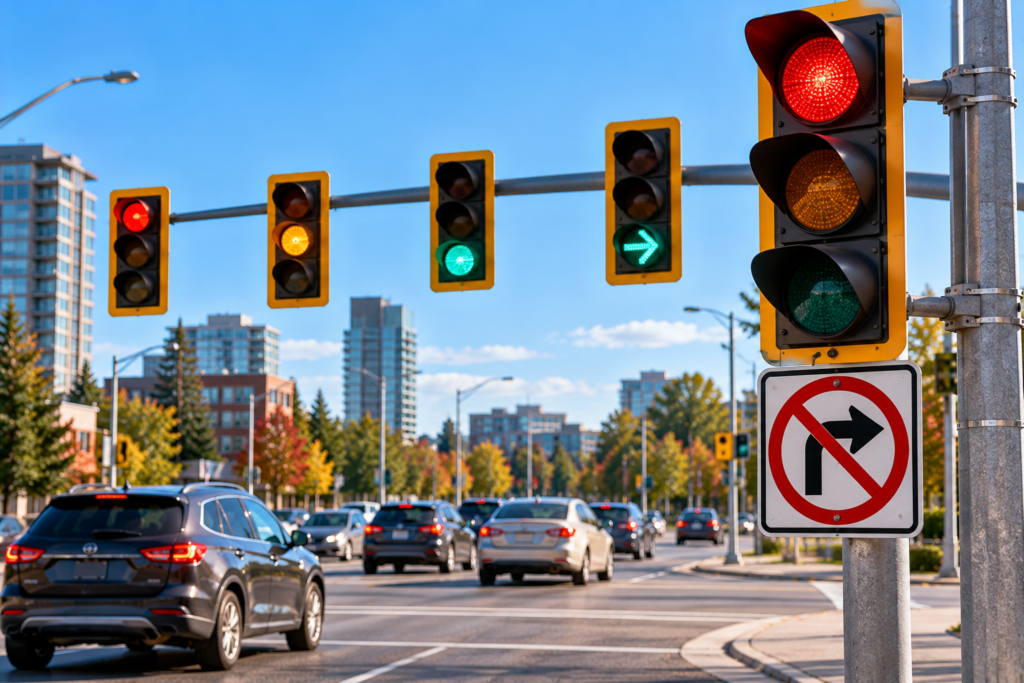
Red means stop and green means go. Every new driver knows that much.
But what about a flashing green? A red light with a green arrow? A signal that’s gone completely dark after a winter storm? Those are the moments when new drivers hesitate, and when mistakes happen at busy Barrie intersections.
This guide explains every type of traffic lights in Ontario, based on the Official MTO Driver’s Handbook. You’ll learn exactly what each signal means, when you can turn on a red, and what to do when the lights stop working. It will help you pass your G1 test and drive through intersections with confidence.
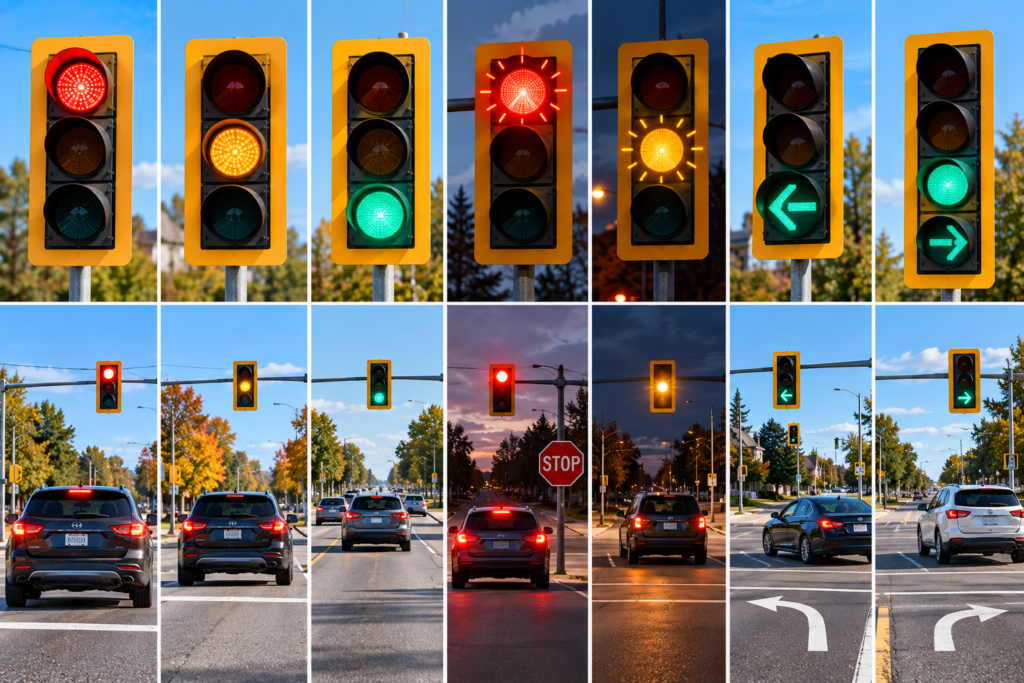
Traffic Lights in Ontario at a Glance
| Signal | What it means | What you do |
| Solid green | Go, after yielding | Go straight or turn, yielding to vehicles and pedestrians already in the intersection |
| Green arrow | Protected turn | Turn in the direction of the arrow |
| Flashing green (advance green) | Oncoming traffic has a red | Turn left, go straight or turn right from the correct lane |
| Solid amber (yellow) | Red is coming | Stop if you can do so safely; otherwise go with caution |
| Solid red | Stop | Stop and wait for green (turns on red allowed in some cases) |
| Flashing red | Treat as a stop sign | Stop completely, then go when safe |
| Flashing amber | Caution | Slow down and drive through carefully |
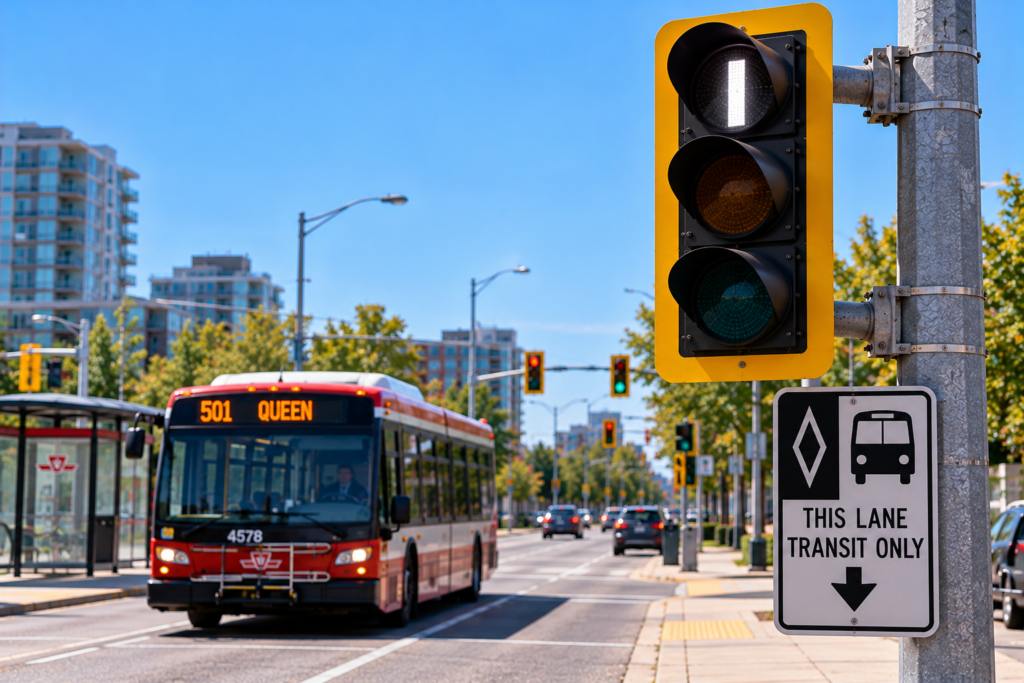
| White vertical bar | Transit priority signal | Yield to buses and streetcars |
| No lights (power out) | Signal not working | Treat as an all-way stop |
Green Lights: Go, but Yield First
Solid Green Light
A solid green light means you may go straight, turn left or turn right. But green doesn’t mean the road is automatically clear.
The MTO handbook says you must first yield to vehicles and pedestrians already in the intersection. When you turn, you must also yield to pedestrians crossing the road you’re turning onto.
Turning Left on a Solid Green
To turn left on a regular green light, you need a safe gap in oncoming traffic:
- Move into the intersection with your wheels pointing straight ahead. If you’re hit from behind, straight wheels stop you being pushed into oncoming traffic.
- Wait for a safe gap, and check for pedestrians on the road you’re turning onto.
- If the light turns amber or red while you’re waiting in the intersection, complete your turn as soon as it’s safe. You’re already in the intersection, so don’t stop or back up.
Advance Green and Green Arrows
What Does a Flashing Green Light Mean in Ontario?
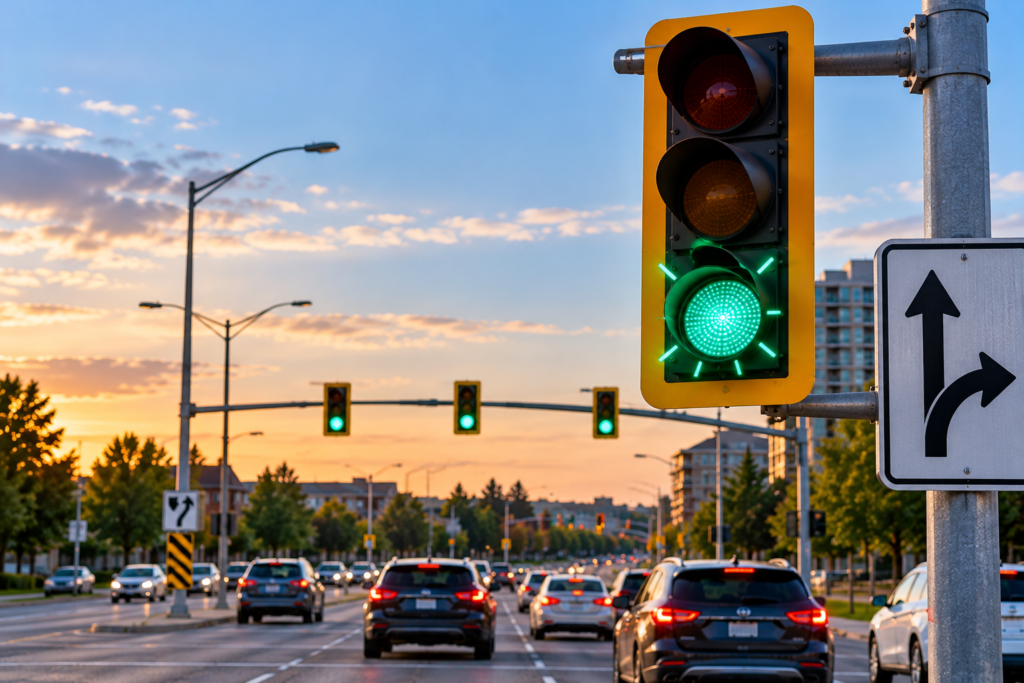
A flashing green light is an advance green. It means oncoming traffic is still facing a red light, so you get a head start. From the correct lane, you may:
- turn left,
- go straight, or
- turn right.
The same applies when you see a left-turn green arrow together with a solid green light. It’s called an advance green because you move before oncoming traffic does.
Pedestrians may not cross on a flashing green light unless a pedestrian signal tells them to.
Left-Turn Green Arrow With a Red Light
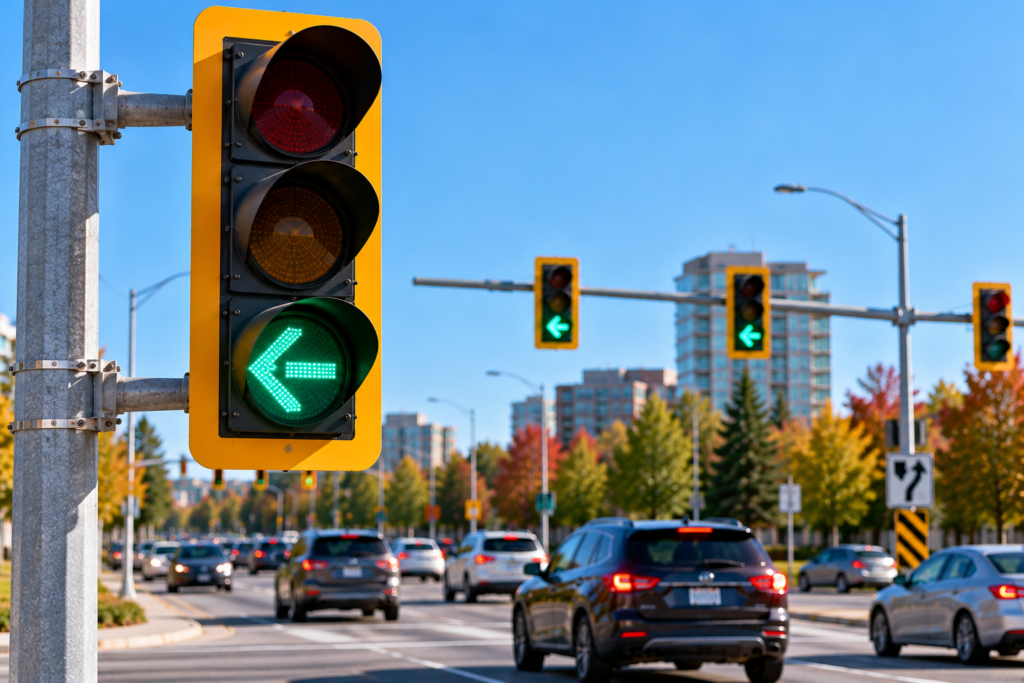
When a left-turn green arrow shows together with a red light, you may turn left from the left-turn lane only. Traffic going straight must wait for its own green.
When the arrow ends, a yellow arrow may appear. It means the turn signal is ending, so don’t start your turn. Stop if you can do so safely.
Fully Protected Left Turn
Some intersections give left-turning traffic its own phase:
- left turners get a green arrow while through traffic faces red;
- the arrow is followed by a yellow and then a red, for left turners only;
- you can’t begin a left turn once the green light appears for traffic going straight or turning right.
If the light turns yellow while you’re already in the intersection, finish the turn with caution.
Amber (Yellow) Lights: Stop If You Safely Can
An amber light, also called a yellow light, means the light is about to turn red. The MTO rule is simple: you must stop if you can do so safely; otherwise, go through with caution.
In practice, it comes down to your “point of no return”:
- Far from the intersection when the light turns amber? Brake smoothly and stop at the line.
- So close that braking hard would put you in the intersection or risk a rear-end crash? Continue through carefully.
What you should never do is speed up to “beat the amber.” It’s a common cause of crashes, and on your road test it shows the examiner poor judgement.
A simple habit helps here. When a green light has been on for a while as you approach (a “stale green”), ease off the gas so you’re ready to stop.
Red Lights and Turning on Red in Ontario
Where to Stop at a Red Light
Stop at the stop line if there is one. If there’s no stop line, stop at the crosswalk, marked or not. If there’s no crosswalk, stop at the edge of the sidewalk, and if there’s no sidewalk, stop at the edge of the intersection.
Then wait until the light turns green and the intersection is clear.
Can You Turn Right on a Red Light in Ontario?
Yes. You may turn right on a red light in Ontario after you:
- come to a complete stop;
- yield to pedestrians and traffic; and
- make sure the way is clear.
The exception is a “no right turn on red” sign. If one is posted, you must wait for the green. Rolling through a right turn on red without stopping fully is one of the most common road test mistakes.
![Car stopped before turning right on a red light in Ontario]](https://roadsafetycanada.com/wp-content/uploads/2026/10/Urban-Intersection-at-Red-Light-1024x683.png)
Can You Turn Left on a Red Light in Ontario?
Only in one situation: when you’re turning from a one-way road onto another one-way road. Even then, you must come to a complete stop first and wait until the way is clear.
On a regular two-way street, turning left on a red light is not allowed.
Not sure when to turn on red? Practise real intersections with an MTO-approved instructor. Book a G2 driving lesson in Barrie.
Running a Red Light: Fines and Demerit Points
If a police officer stops you for running a red light in Ontario, the ticket costs $325 including the victim fine surcharge, and you’ll get 3 demerit points. For G1 and G2 drivers, a conviction can also lead to novice-driver penalties and much higher insurance. See our guide to car insurance for G2 drivers in Ontario.
Red light camera tickets work differently. They’re sent to the vehicle owner, so no demerit points are added.
Flashing Red and Flashing Amber Lights
What Does a Flashing Red Light Mean?
A flashing red light means you must treat the intersection like a stop sign. Come to a complete stop, yield to traffic and pedestrians, and go only when it’s safe.
You’ll often see flashing reds late at night, or at intersections where one road has less traffic.
What Does a Flashing Amber Light Mean?
A flashing amber (yellow) light means drive with caution. You don’t have to stop, but slow down, watch for cross traffic and pedestrians, and be ready to stop if needed.
Traffic Beacons
A beacon is a single flashing light. It may hang over an intersection or sit above a warning sign or obstruction.
- A flashing red beacon works like a stop sign: stop completely, then go when safe.
- A flashing amber beacon means drive with caution through the area.
What to Do When Traffic Lights Are Out
Ice storms and power outages happen in Simcoe County. When traffic lights go completely dark, the rule is clear:
Treat the intersection as an all-way stop.
- Come to a complete stop.
- Yield to vehicles already in the intersection.
- Yield to vehicles entering from your right if you arrive at the same time.
- Go only when the way is clear.
Never drive through a dark signal as if you have the right-of-way. Other drivers may be treating it as a stop.
Transit and Pedestrian Signals
Transit Priority Signals
A transit priority signal is a round signal showing a white vertical bar on a dark background, mounted above the regular lights. When it’s on, buses or streetcars may go straight or turn while other traffic faces a red. Traffic and pedestrians must yield to the transit vehicle.
Pedestrian Signals
- White walking symbol: pedestrians may start crossing. Once they’re crossing, they have the right-of-way over all vehicles.
- Orange hand (flashing or steady): pedestrians must not start to cross. Anyone already crossing should keep going to a safe spot, and they still have the right-of-way.
- Intersection pedestrian signals: found where a busy road meets a smaller one. Pedestrians press a button to get the walk signal, and the side street usually has stop signs.
As a driver, always check for pedestrians before you turn, even on a green light.
Traffic Lights on Your G1 Test and Road Test
On the G1 Knowledge Test
Traffic signals come up often on the G1 knowledge test. Expect questions like “What does a flashing green light mean?” or “When can you turn left on a red light?” Read our breakdown of how many questions are on the G1 test and our full G1 licence guide for Ontario.
On Your G2 and G Road Test
Examiners watch closely at intersections. Common mistakes include:
- rolling through a right turn on red without a full stop;
- stopping past the stop line or in the crosswalk;
- speeding up for an amber light;
- not yielding to pedestrians when turning on a green;
- turning the wheels left too early while waiting to make a left turn.
Our guides to common G2 road test mistakes and why drivers fail the G2 road test cover more of what examiners look for.
Practise Real Intersections in Barrie
Reading the rules is a great start. Getting comfortable at real intersections, with traffic, pedestrians and changing lights, takes practice with a good instructor.
At Road Safety Canada, our MTO-approved instructors teach new drivers across Barrie, Innisfil, Bradford, Orillia, Angus, Alliston and Collingwood.
- Online driving classes: learn traffic signals and the rules of the road at your own pace.
- G2 driving lessons in Barrie: practise turns, advance greens and right-on-red stops in real traffic.
Call 705-300-5570 or register online to book your first lesson.
Conclusion:
Ontario traffic lights follow a clear logic, and most of it fits in one line each:
- Green means go, but yield first.
- A flashing green or a green arrow gives you a protected turn.
- Amber means stop if you safely can.
- Red means stop, with right turns allowed after a full stop, and left turns allowed only from one one-way road onto another.
- A flashing red is a stop sign, and a dark signal is an all-way stop.
Know those rules and you’ll handle the G1 test, your road tests and busy intersections with confidence. When you’re ready for real-world practice, Road Safety Canada can help. Our MTO-approved instructors serve Barrie and all of Simcoe County. Book your lesson today or call 705-300-5570
Frequently Asked Questions
What does a flashing red light mean in Ontario?
A flashing red light means you must treat the intersection like a stop sign. Come to a complete stop, yield to traffic and pedestrians, and go only when it is safe.
What does a flashing green light mean in Ontario?
A flashing green light is an advance green. Oncoming traffic still faces a red light, so you may turn left, go straight or turn right from the correct lane. Pedestrians may not cross on it unless a pedestrian signal allows them to.
Can you turn left on a red light in Ontario?
Only when you are turning from a one-way road onto another one-way road. You must come to a complete stop first and wait until the way is clear. On a regular two-way street, turning left on a red light is not allowed.
Can you turn right on a red light in Ontario?
Yes. You may turn right on a red light in Ontario after coming to a complete stop and making sure the way is clear, unless a sign prohibits it. You must still yield to pedestrians and other traffic.
What should you do at an amber light?
You must stop at an amber light if you can do so safely. If you are too close to stop safely, go through the intersection with caution. Never speed up to beat an amber light.
What do you do if traffic lights are not working?
When traffic lights are out, treat the intersection as an all-way stop. Come to a complete stop, yield to vehicles already in the intersection and to vehicles entering from your right, and go only when it is safe.
What is the fine for running a red light in Ontario?
A police ticket for running a red light in Ontario costs $325 including the victim fine surcharge, and it adds 3 demerit points to your licence. Red light camera tickets go to the vehicle owner and carry no demerit points.

