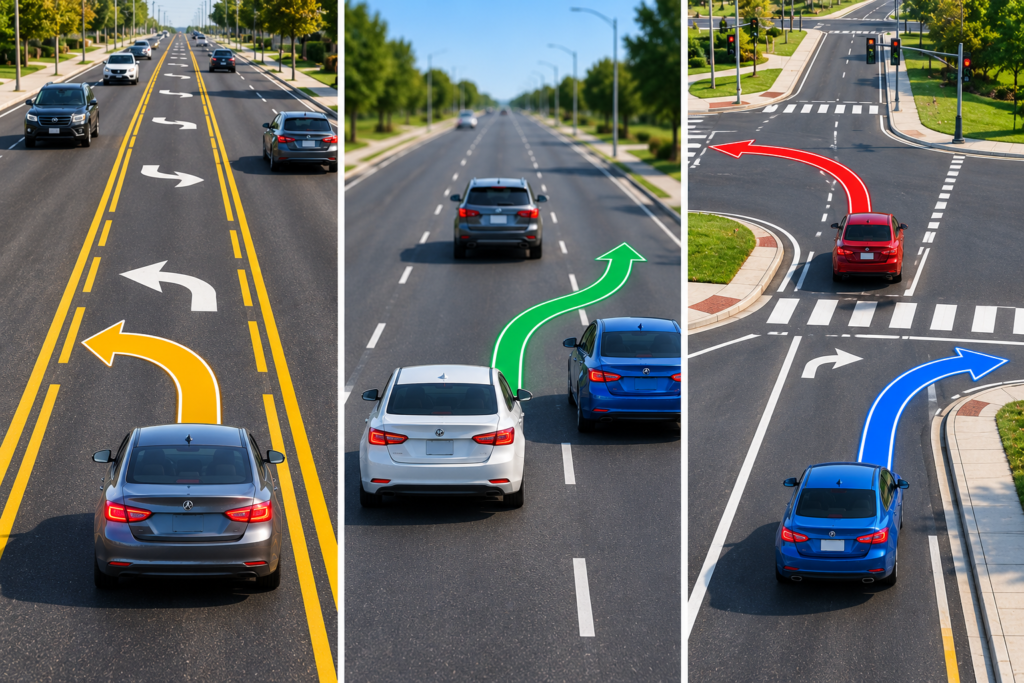
You’re driving down a busy Barrie street and the car ahead pulls into the centre lane a full block before its turn. Another driver zips past you on the right. A third makes a U-turn halfway up a hill.
Are any of those legal? Some are, some aren’t, and knowing the difference keeps you safe and keeps points off your road test.
This guide explains the lane rules in Ontario that new drivers get wrong most often. It covers which lane to turn from, how to use a two-way left turn lane, when passing on the right is allowed, and where U-turns are illegal. The rules come from the Official MTO Driver’s Handbook and the Highway Traffic Act.
In this guide11 sections
- Basic Lane Rules in Ontario
- Which Lane to Turn From and Into
- How to Use a Two-Way Left Turn Lane
- Unprotected Left Turns
- Passing Rules in Ontario
- U-Turn Rules in Ontario
- Is It Illegal to Change Lanes in an Intersection?
- Lane Mistakes on Your Road Test
- Practise Lane Skills With Road Safety Canada
- Conclusion
- Frequently Asked Questions
Basic Lane Rules in Ontario
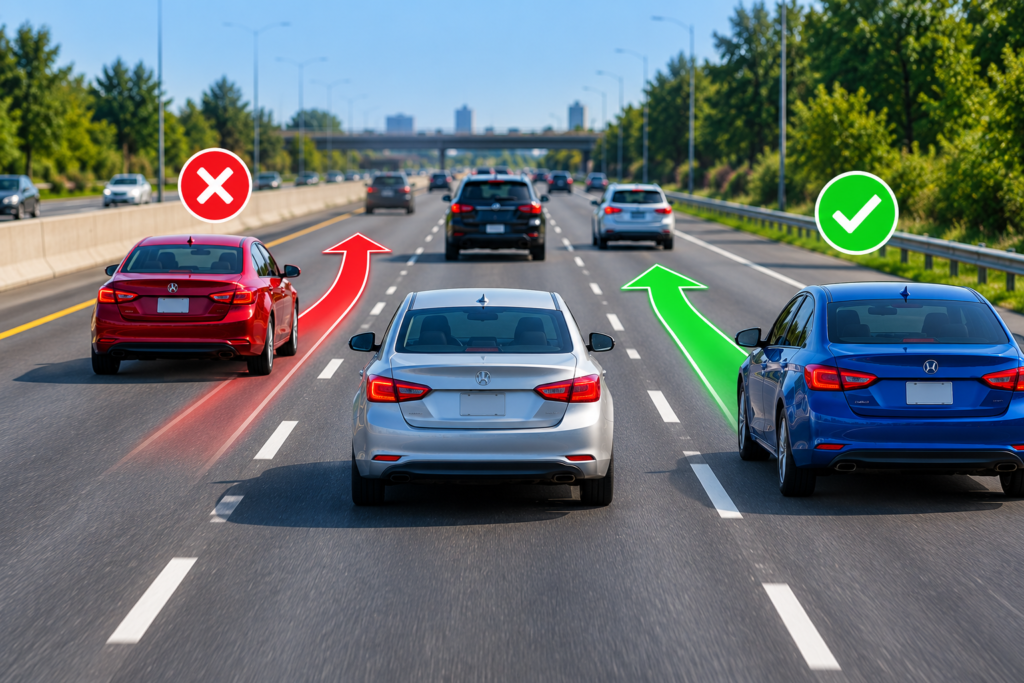
- Keep right except to pass. On roads with two or more lanes in your direction, slower traffic stays right. The left lane is for passing.
- Don’t camp in the far-left lane on highways. Pass, then move back to the right.
- Never cut in front of faster traffic. The MTO handbook calls it dangerous and illegal for a slower vehicle to cut in front of a faster one.
- Check before every lane change. Mirrors, signal and shoulder check, every time.
What Is the Curb Lane?
The curb lane is the lane closest to the curb, or the right edge of the road. On a one-way street, the far-left lane next to the left curb is also a curb lane. You’ll see the term in the handbook’s turning rules below.
For more on changing lanes and merging safely, see our guide to the zipper merge, lane changes and blind spots.
Which Lane to Turn From and Into
Turning from the wrong lane, or swinging into the wrong lane, is one of the most common road test mistakes. Here’s what the MTO Driver’s Handbook says.
Right Turns
Always begin and end a right turn close to the right side of the road, unless signs or pavement markings tell you otherwise. If there’s no marked right lane, keep as far right as you safely can.
Avoid swinging wide to the left before you turn right. It confuses drivers behind you and leaves room for a cyclist or car to squeeze in on your right.
Left Turns
Always begin and end a left turn in the far left lane for your direction. The exact path depends on the roads:
| Turning from → to | Start in | Finish in |
| Two-way road → two-way road | Lane closest to the centre line | Lane just right of the centre line |
| Two-way road → one-way road | Lane closest to the centre line | Left curb lane |
| One-way road → two-way road | Left curb lane | Lane just right of the centre line |
| One-way road → one-way road | Left curb lane | Left curb lane |
Follow a smooth arc, and don’t cut the corner.
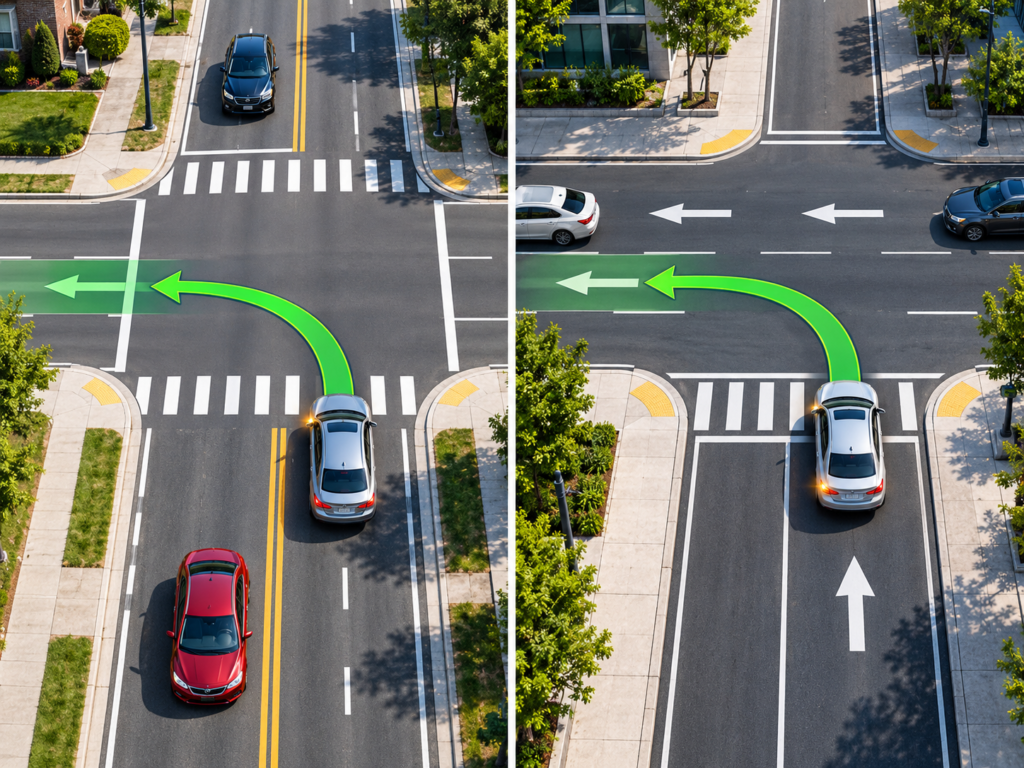
Two Cars Turning Left From Opposite Directions
When you and an oncoming driver are both turning left, each of you turns to the left of the other, after yielding to pedestrians and oncoming traffic.
Keep Your Wheels Straight While You Wait
While waiting to turn left, don’t turn your steering wheel left until you can complete the turn. If you’re hit from behind with your wheels already turned, you could be pushed into oncoming traffic.
How to Use a Two-Way Left Turn Lane
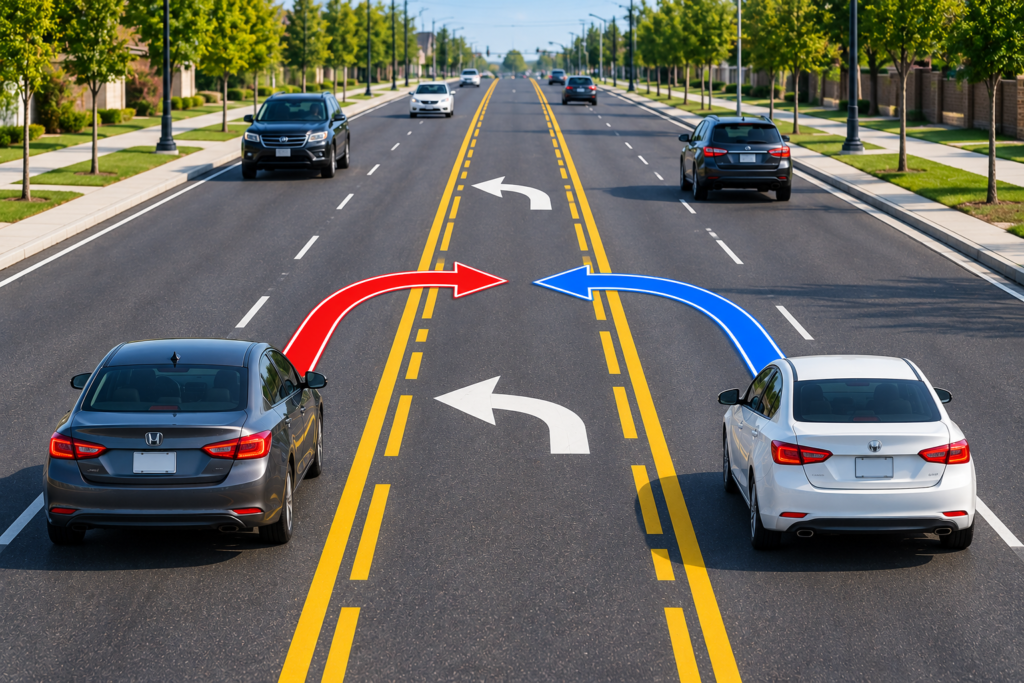
A two-way left turn lane is a centre lane shared by left-turning drivers from both directions. It’s marked with solid and broken yellow lines on each side, often with left-turn arrows pointing both ways. It lets left-turning drivers wait for a gap without holding up traffic behind them.
To use one:
- Signal left.
- Check your mirrors and blind spot.
- Move into the centre lane shortly before your turn. Don’t drive in it a long way.
- Wait for a safe gap in oncoming traffic, and watch for drivers coming the other way who may be using the same lane.
- Turn only when you’re sure the way is clear.
The golden rule: two-way left turn lanes are never used for passing.
Unprotected Left Turns
An unprotected left turn is a left turn on a solid green light with no green arrow. You don’t have a protected signal, so you must yield to oncoming traffic and pedestrians before turning.
- Move into the intersection with your wheels straight.
- Wait for a safe gap in oncoming traffic, and check the crosswalk you’re turning across.
- If the light turns amber or red while you’re in the intersection, finish the turn when it’s safe.
Our guides to Ontario traffic lights and right-of-way rules cover advance greens, green arrows and who yields at every kind of intersection.
Passing Rules in Ontario
How to Pass Safely
- Make sure passing is allowed and that you have enough clear road ahead.
- Check your mirrors, signal, and do a shoulder check.
- Move out smoothly and pass at a steady speed.
- Signal back, and return to your lane only when you can see the vehicle you passed in your rear-view mirror.
Can You Pass on the Right in Ontario?
Yes, in some situations. Under section 150 of the Highway Traffic Act, you may pass another vehicle on the right if it can be done safely and one of these conditions applies:
- the vehicle you’re passing is turning left, or signalling a left turn;
- the road has room for two or more lanes of traffic in your direction;
- the road is a one-way street.
An MTO spokesperson told The Globe and Mail that you only need to meet one of the three conditions. The MTO still encourages drivers to use the left lane for passing whenever possible, because passing on the right is less predictable for other drivers.
Never Pass on the Shoulder
The paved shoulder is not a travel lane. Don’t use it to pass a car that’s turning left, to get around a traffic jam, or to beat a merge. Emergency vehicles may need the shoulder, and cyclists and pedestrians may be on it.
Passing Lanes and Climbing Lanes
On some two-lane highways, a passing lane or climbing lane is added for a short stretch, often on hills. When a “passing lane ahead” sign appears, slower vehicles should keep right so faster traffic can pass safely in the left lane.
When You’re Being Passed
Stay in your lane and keep a steady speed. Don’t speed up to stop someone passing you. Ease off slightly if you need to, so they can get back in safely.
U-Turn Rules in Ontario
U-turns aren’t illegal everywhere in Ontario, but they are illegal in several places. According to the MTO Driver’s Handbook, you must not make a U-turn:
- on a curve in the road;
- on or near a railway crossing;
- on or near a hilltop;
- where a sign prohibits it.
You should also never make a U-turn unless you can see at least 150 metres in both directions. Before you turn, signal for a right turn, check your mirror and look over your shoulder. Then make the turn when the way is clear.
Is It Illegal to Change Lanes in an Intersection?
Ontario’s Highway Traffic Act has no specific rule against changing lanes in an intersection. Any lane change that isn’t made safely can still be charged as an unsafe lane change, though, and intersections are where most conflicts happen. The safest habit is to choose your lane before you reach the intersection.
Lane Mistakes on Your Road Test
Examiners watch your lane position closely. Common mistakes include:
- swinging wide before a right turn;
- turning left into the wrong lane, such as the far-right lane of a multi-lane road;
- turning the wheels left too early while waiting to turn;
- driving too far in the two-way left turn lane;
- skipping the shoulder check on lane changes;
- staying in the left lane on the highway section of the G test.
See our guides to common G2 road test mistakes and full G road test preparation.
Practise Lane Skills With Road Safety Canada
Lane position becomes automatic with good practice. At Road Safety Canada, our MTO-approved instructors teach new drivers across Barrie, Innisfil, Bradford, Orillia, Angus, Alliston and Collingwood. That includes turns, two-way left turn lanes and highway passing on real local roads.
- G2 driving lessons in Barrie: build safe lane habits.
- Full G road test preparation: master the highway section.
Call 705-300-5570 or register online to book your first lesson.
Conclusion:
Most lane rules come down to being predictable:
- Turn right from the right, and turn left from the far left.
- Use the two-way left turn lane only to turn, never to pass.
- Keep right except to pass, and pass on the right only when the law allows it and it’s safe.
- Never use the shoulder to pass.
- Make U-turns only where you can see clearly in both directions and no sign or hazard prohibits them.
When you’re ready to build these habits on real roads, Road Safety Canada can help. Our MTO-approved instructors serve Barrie and all of Simcoe County. Book your lesson today or call 705-300-5570.
Frequently Asked Questions
How do you use a two-way left turn lane?
Signal left, check your mirrors and blind spot, and move into the centre lane shortly before your turn. Wait for a safe gap in oncoming traffic and turn only when the way is clear. Never use a two-way left turn lane for passing.
Is it legal to pass on the right in Ontario?
Yes, if it can be done safely and one condition applies: the vehicle ahead is turning left, the road has two or more lanes in your direction, or it is a one-way road. The MTO still encourages passing on the left whenever possible.
Can you pass on the shoulder in Ontario?
No. The paved shoulder is not a travel lane, so do not use it to pass, to get around a traffic jam or to beat a merge. Emergency vehicles, cyclists and pedestrians may need the shoulder.
Which lane should you turn left from?
Begin and end a left turn in the far left lane for your direction. On a two-way road, turn from the lane closest to the centre line into the lane just right of the centre line, following a smooth arc.
Are U-turns illegal in Ontario?
U-turns are not illegal everywhere in Ontario, but you must not make one on a curve, on or near a railway crossing or hilltop, or where a sign prohibits it. You should be able to see at least 150 metres in both directions.
What does keep right except to pass mean?
It means slower traffic should drive in the right lane, and the left lane should be used for passing. After you pass, move back to the right instead of staying in the far-left lane.
What is an unprotected left turn?
An unprotected left turn is a left turn made on a solid green light with no green arrow. You must yield to oncoming traffic and pedestrians, and turn only when there is a safe gap.
Ready to practise with an MTO-approved instructor?
Build real confidence in traffic with G2 lessons and Full G road test preparation in Barrie and across Simcoe County.