You can handle a highway merge, but a crowded Saturday parking lot makes your palms sweat. That’s normal. Parking lots squeeze cars, pedestrians and shopping carts into a tiny space, and most bumps there happen at walking speed.
The fix isn’t luck. It’s a repeatable method.
In this guide you’ll learn how to reverse park step by step, how to pull forward into a perpendicular space, and how to back out safely. You’ll also see what an examiner is really watching when you park on your Ontario road test: your control, your observation and your speed.
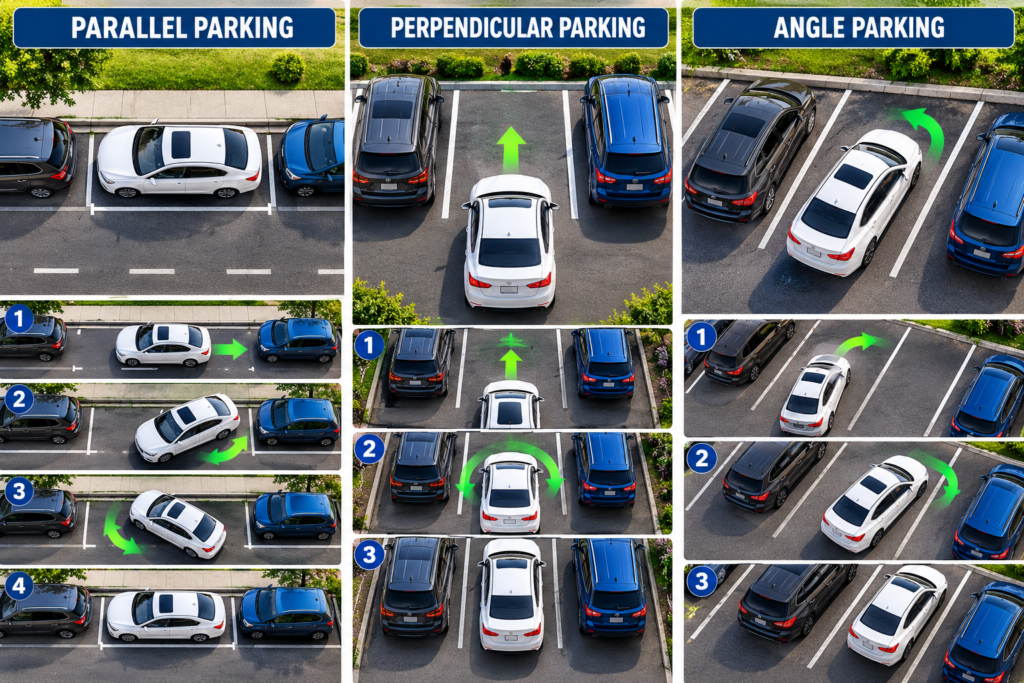
The 3 types of parking
- Perpendicular parking: the car sits at 90 degrees to the curb or aisle. This is the standard layout in most parking lots.
- Angle parking: spaces are set at an angle, so you drive in forward easily. It’s common on some downtown streets.
- Parallel parking: the car sits in line with the curb, between two parked cars, on the street.
In this guide12 sections
- Why Reverse Parking Is Worth Learning
- Before You Start: Setup and Observation
- How to Reverse Park Step by Step
- How to Do Perpendicular Parking Forward (Nose-In)
- How to Back Out of a Parking Space Safely
- Angle Parking in Brief
- Parking on the Ontario Road Test: What Examiners Watch
- Common Parking Mistakes and Quick Fixes
- Practise Somewhere Easy First
- Get Road-Test Ready With Road Safety Canada
- Conclusion
- Frequently Asked Questions
Why Reverse Parking Is Worth Learning
Backing into a parking space feels harder at first, but many driver handbooks recommend it for lot stalls where it’s allowed. Saskatchewan’s handbook, for example, does. Here’s why:
- The tight turn happens in the open aisle. It doesn’t happen between two parked cars, so the front end of your car swings into empty space.
- You back into a space you’ve just seen is empty. You don’t back out blind into moving traffic.
- You leave forward, with a full view. That makes leaving much safer, especially in busy lots or when snowbanks shrink the spaces in a Barrie winter.
One exception: some lots and spaces are signed “head-in only” or “no back-in parking.” Always follow the signs.
Before You Start: Setup and Observation
Good parking is about 80% looking and 20% steering. Before any parking move:
- Set your mirrors and seat so you can see both sides of the car and turn to look back comfortably.
- Use creep speed. Ease off the brake and let the car roll. In most automatic cars you won’t need the gas pedal at all.
- Do a 360-degree check. Look in all your mirrors and shoulder-check both sides. A back-up camera helps, but it doesn’t replace turning your head. Snow, dirt or glare can hide what’s there.
- Signal. Let other drivers know you’re about to stop and turn into a space.
For the tight part of the turn, use hand-over-hand steering. Our guide to steering wheel hand position explains how.
How to Reverse Park Step by Step
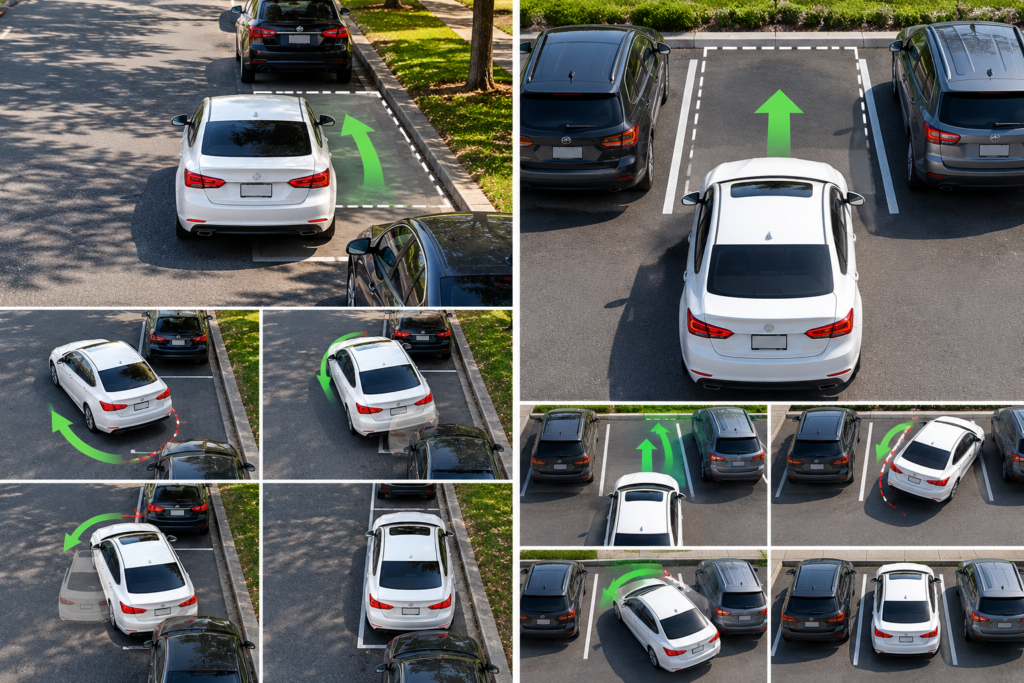
Here’s how to reverse park into a standard perpendicular space. The reference points are common instructor tips. Every car is a bit different, so adjust them as you practise.
- Pick your space and signal. Choose a space with room around it while you’re learning. Signal toward it.
- Drive past the space. Keep about one car width away from the parked cars. Stop when your rear bumper is about one to two spaces past the space you want.
- Do a full 360-degree check. Check your mirrors, shoulder-check both sides, and look out for pedestrians and cars coming down the aisle.
- Reverse slowly and turn the wheel fully toward the space. Look back over your shoulder in the direction you’re turning, and glance at your side mirrors.
- Watch both side mirrors for the lines. When the car looks equally spaced between the two lines, start straightening the wheel.
- Back straight in. Stop when your side mirrors line up with the side mirrors of the cars next to you, or when you feel the rear wheels touch the parking stopper. Don’t hit the curb.
- Secure the car. Put it in park, apply the parking brake, and check that your wheels are straight.
Ended up crooked? There’s no shame in fixing it. Pull forward a little, straighten up, and reverse again. That’s far better than leaving the car on the line.
How to Do Perpendicular Parking Forward (Nose-In)
Forward parking is quicker, and in head-in-only lots it’s the only option. Here’s how to do it well:
- Position yourself. Drive down the aisle about one car width from the parked cars, at creep speed. Signal.
- Find your turning point. Many instructors teach you to start turning when your side mirror passes the first line of the space you want.
- Turn sharply and slowly. Use hand-over-hand steering and watch your front corner so it clears the car beside you.
- Straighten when you’re centred. Once the car lines up between the lines, unwind the wheel with your hands.
- Stop before the line or curb. Leave a little room in front.
If the space directly ahead is empty, some drivers “pull through” so they can leave forward. Only do it where the lot allows it, and check for cars in the next aisle first.
How to Back Out of a Parking Space Safely
If you parked nose-in, you’ll have to reverse out. This is where most lot collisions happen.
- Do a full 360-degree check: mirrors, both shoulders, and look back through the rear window.
- Reverse at creep speed. Your front end swings out the opposite way to your turn, so watch the car beside you.
- Yield to pedestrians and to cars already moving in the aisle.
- If a van or truck blocks your view, inch out slowly and keep looking until you can see clearly.
Angle Parking in Brief
Angle spaces are set so you can drive in forward with only a small turn. Signal, keep to the correct side of the aisle, and turn in once you can see straight into the space.
Leaving is the tricky part. Reverse very slowly, shoulder-check, and make sure the aisle is clear before you swing out.
Parking on the Ontario Road Test: What Examiners Watch
DriveTest doesn’t publish a fixed list of manoeuvres for every test, so you may or may not be asked to park. Being ready either way takes the stress off.
When parking does come up, examiners are generally looking at:
- Observation. Mirror checks and shoulder checks before and during the move. Missing these is one of the most common reasons for lost marks.
- Speed control. Slow and steady, not rushing.
- Accuracy. Ending up inside the lines, reasonably straight, without touching the curb or another car.
- Signalling. Showing your intention before you turn in.
What about parallel parking? It was removed from the G road test in 2022, according to news reports, and it may still come up on the G2. We’ll cover parallel parking in its own guide. Meanwhile, see common G2 road test mistakes and why drivers fail the G2 road test.
Common Parking Mistakes and Quick Fixes
| Mistake | Quick fix |
| Going too fast | Creep on the brake. No gas in a parking space. |
| No shoulder check | Turn your head before and during every move. |
| Turning too early | Wait until your mirror passes the first line. |
| Turning too late | Start the turn sooner next time, or pull forward and redo it. |
| Relying only on the camera | Use the camera as a backup and your eyes first. |
| Ending up crooked | Pull forward, straighten, and reverse again. |
| Forgetting to straighten the wheels | Centre the wheel before you shift into park. |
Practise Somewhere Easy First
- Start in an empty lot. Early Sunday mornings at a big-box store or a school lot are ideal.
- Use the painted lines as targets. Pretend there are cars on both sides. Pylons or empty boxes help.
- Move to busier lots gradually once your reference points feel natural.
- Practise in winter too. Snow covers lines and shrinks spaces, so you’ll rely on your reference points even more.
Get Road-Test Ready With Road Safety Canada
Parking gets easy fast with someone beside you pointing out your reference points.
Our road test preparation lessons and G2 driving lessons in Barrie include parking practice in real lots, plus the observation habits examiners look for. Check our lesson prices to find a package that fits.
Call 705-300-5570 or book online.
Conclusion:
Learning how to reverse park comes down to three habits:
- crawl at brake speed,
- check all around the car before and during the move,
- use the same reference points every time.
Add forward perpendicular parking and a careful exit, and you can handle almost any parking lot in Ontario, from a quiet plaza to a packed mall on a December weekend.
At Road Safety Canada, our MTO-approved instructors help drivers across Barrie and Simcoe County turn parking from a stress point into a strength before road test day. Call 705-300-5570 or book your lesson to start practising.
Frequently Asked Questions
Is it better to reverse park or park forward?
Backing in is often safer in parking lots. You make the tight turn while the aisle is clear, and you drive out forward with a full view. Always follow head-in-only signs.
How do you reverse park step by step?
Signal, drive past the space, and do a full check around the car. Reverse slowly while turning toward the space, straighten when you are parallel to the lines, and stop when you are centred.
What is perpendicular parking?
Perpendicular parking means parking at a 90-degree angle to the curb or aisle. It is the standard layout in most parking lots.
Do you have to parallel park on the G test in Ontario?
Parallel parking was removed from the G road test in 2022, according to news reports. Check DriveTest for the current requirements before your test.
Will I have to reverse park on my G2 road test?
You may be asked to do a parking manoeuvre. The exact tasks can vary, so practise both backing into and pulling into parking spaces.
Can I use my backup camera during the road test?
Use it as an aid, but keep doing mirror and shoulder checks. Relying only on the camera is unsafe, and examiners watch your observation.
How do I know when to turn into a parking space?
Use a reference point. For forward parking, many instructors teach you to start turning when your side mirror passes the first line of the space.
Ready to practise with an MTO-approved instructor?
Build real confidence in traffic with G2 lessons and Full G road test preparation in Barrie and across Simcoe County.