You’ve driven past your turn on a quiet street in Angus, and there’s no intersection or driveway in sight. How do you turn around safely?
That’s what a three-point turn is for. It’s one of the most useful low-speed manoeuvres you’ll learn, and it can come up on your Ontario road test. This guide walks you through it step by step. It also covers the other ways to turn around (the two-point turn and the U-turn) and what examiners watch for.
In this guide9 sections
What Is a Three-Point Turn?
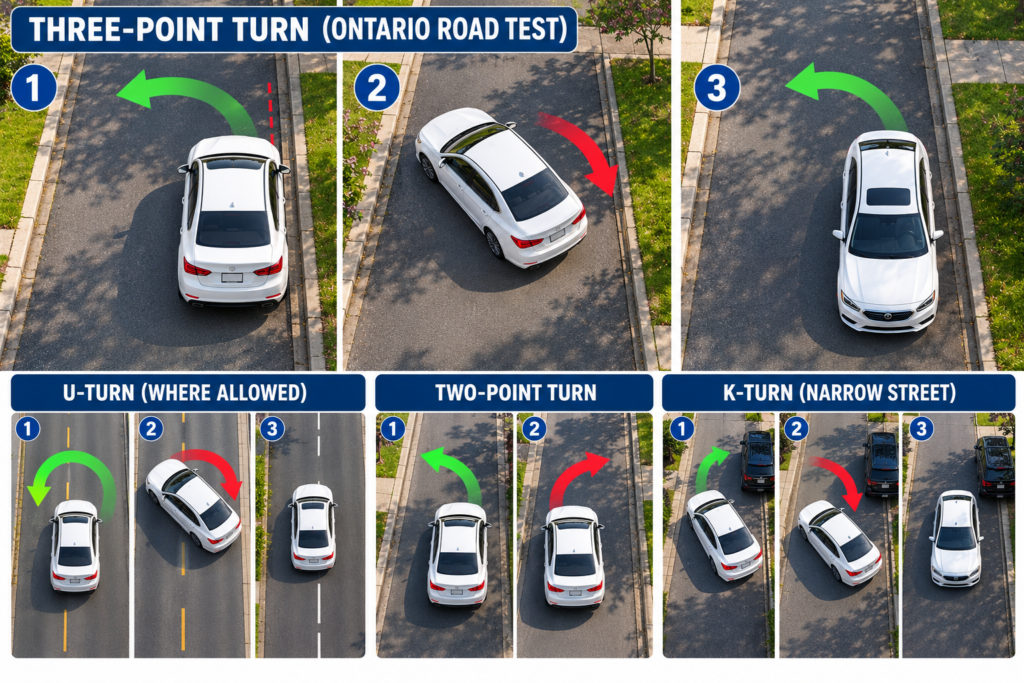
A three-point turn is a way to turn your car around on a narrow road in three moves: forward to the left, reverse to the right, then forward in the new direction. It’s also called a K-turn or a turnabout.
Use it only on a quiet, straight road where you can see clearly in both directions, and only when there’s no driveway or side street you could use instead.
How to Do a Three-Point Turn: Step by Step
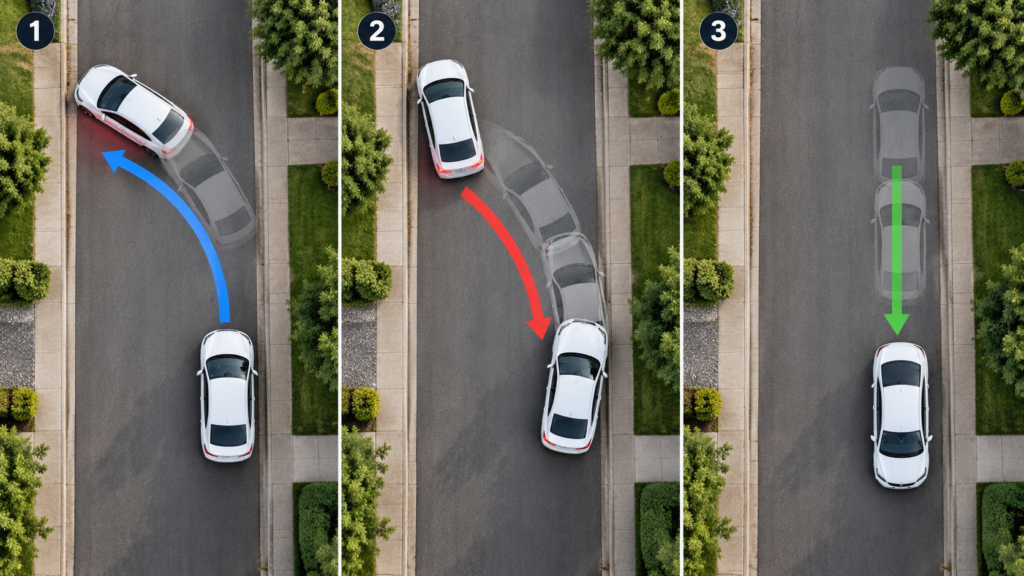
- Pull over and stop at the right curb. Choose a spot where the road is straight, wide enough and quiet, with no driveways, hills or curves nearby.
- Signal left and check everything. Check your mirrors, do a shoulder check over your left shoulder and look all around the car. Wait until there’s no traffic in either direction.
- Move forward, steering sharply left. Creep forward slowly while turning the steering wheel fully left. Stop before your front tires touch the opposite curb.
- Reverse, steering sharply right. Shift into reverse and signal right. Look over your right shoulder and through the rear window, check for traffic again, then back up slowly while turning the wheel fully right. Stop before your rear tires touch the curb behind you.
- Drive forward in the new direction. Shift into drive, check for traffic, steer left to straighten up, and drive away in your lane.
Tips for a Smooth Three-Point Turn
- Keep it slow. A crawl gives you time to steer fully and stop before the curb.
- Steer while moving, not while stopped. It’s easier on your tires and steering.
- Keep looking. Check for traffic before every change of direction, not just at the start.
- Don’t touch the curb. Stop with a little space to spare.
- If traffic comes, stop and let it pass before you continue.
- Narrow road? It’s okay to take an extra back-and-forth move. Safety matters more than doing it in exactly three.
The Two-Point Turn (Using a Driveway)
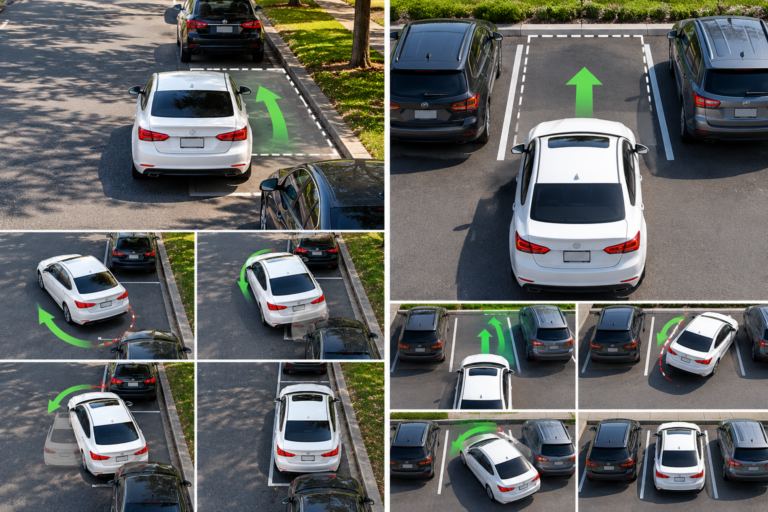
When there’s a driveway or an empty lane nearby, a two-point turn is often easier and safer than a three-point turn.
Backing into a driveway (the version most instructors prefer):
- Drive just past the driveway on your right, signal and stop.
- Check behind you, then back slowly into the driveway.
- Stop, signal left, check both directions, and drive out forward.
Pulling into a driveway works too, but you then have to back out into the road, where your view of traffic is worse. That’s why backing in is usually the safer choice.
Never use a driveway without checking for pedestrians, children or cars coming out.
U-Turns in Ontario
A U-turn turns you around in one continuous move. It’s legal in many places, but not everywhere.
According to the MTO Driver’s Handbook, it’s illegal to make a U-turn:
- on a curve in the road;
- on or near a railway crossing;
- on or near a hilltop;
- where a sign prohibits it.
You should also never make a U-turn unless you can see at least 150 metres in both directions.
To make a U-turn, the handbook says to signal for a right turn and check your mirror and over your shoulder before turning when the way is clear. For more lane and turning rules, see our guide to Ontario lane rules.
Which Turnabout Should You Use?
| Situation | Best choice |
| A driveway or empty lane is available | Two-point turn (backing in) |
| Wide road, light traffic, clear view, U-turns allowed | U-turn |
| Narrow, quiet street with no driveway | Three-point turn |
| Busy road, curve, hill or poor visibility | None. Drive on and turn around somewhere safer |
The safest turnabout is often simply driving around the block.
Three-Point Turns on the Ontario Road Test
On your G2 or G road test, you may be asked to turn your vehicle around on a quiet street. The examiner is less interested in whether you take exactly three moves and more interested in how safely you do it.
They watch for:
- Observation: mirrors, shoulder checks and looking all around before every move;
- Signals: signalling before you pull over and before you move off;
- Control: slow, smooth speed and full steering, without touching the curb;
- Yielding: stopping to let traffic or pedestrians pass.
Common mistakes that cost points:
- hitting or climbing the curb;
- skipping the shoulder check before reversing;
- moving while another vehicle is approaching;
- choosing an unsafe spot (near a hill, curve or driveway).
Our guides to common G2 road test mistakes and why drivers fail the G2 road test cover more of what examiners look for. If your G test is next, see our full G road test preparation.
Practise Turnabouts With Road Safety Canada
Three-point turns feel awkward until you’ve done a few with someone guiding you. At Road Safety Canada, our MTO-approved instructors teach new drivers across Barrie, Innisfil, Bradford, Orillia, Angus, Alliston and Collingwood. We practise every road test manoeuvre, from turnabouts to parallel parking.
Not sure how much practice you need? Read how many G2 driving lessons you need before your road test, or call 705-300-5570.
Conclusion:
A three-point turn is simple:
- Forward left.
- Back right.
- Forward again.
What makes it safe is everything around it: choosing a quiet, straight spot, signalling, checking all around before every move, and keeping the speed at a crawl. When a driveway is handy, a two-point turn is often easier. When the road is wide and clear, a legal U-turn may be quickest. When you’re ready to practise turnabouts and every other road test skill, Road Safety Canada can help. Our MTO-approved instructors serve Barrie and all of Simcoe County. Book your lesson today or call 705-300-5570.
Frequently Asked Questions
What is a three-point turn?
A three-point turn is a way to turn your car around on a narrow road in three moves: forward to the left, reverse to the right, then forward in the new direction. It is also called a K-turn or turnabout.
How do you do a three-point turn?
Stop at the right curb, signal left and check for traffic. Drive forward slowly while steering sharply left, then reverse while steering sharply right. Finally, shift into drive and move forward in the new direction.
Is the three-point turn on the Ontario road test?
You may be asked to turn your vehicle around on a quiet street during your G2 or G road test. Examiners focus on how safely you do it: your observation, signals, control and whether you yield to traffic.
What is a two-point turn?
A two-point turn is a way to turn around using a driveway or empty lane. Most instructors recommend backing into the driveway and then driving out forward, because you get a better view of traffic.
Are U-turns illegal in Ontario?
U-turns are not illegal everywhere in Ontario, but you must not make one on a curve, on or near a railway crossing or hilltop, or where a sign prohibits it. You should be able to see at least 150 metres in both directions.
What are common three-point turn mistakes?
Common mistakes include hitting or climbing the curb, skipping the shoulder check before reversing, moving while another vehicle is approaching, and choosing an unsafe spot near a hill, curve or driveway.
When should you not do a three-point turn?
Do not do a three-point turn on a busy road, on a curve or hill, or anywhere you cannot see clearly in both directions. In those situations, drive on and turn around somewhere safer, such as around the block.
Ready to practise with an MTO-approved instructor?
Build real confidence in traffic with G2 lessons and Full G road test preparation in Barrie and across Simcoe County.