Watch a brand-new driver for one minute and you can usually spot it. Hands clamped at the top of the wheel. Knuckles white. Or one hand draped over the wheel at 12 o’clock like they’ve been driving for 30 years.
Your steering wheel hand position affects how smoothly you turn, how fast you can react, and even how an airbag treats you in a crash. The good news is it’s one of the easiest habits to fix.
This guide covers where your hands should go, why the old 10 and 2 rule changed, and the steering techniques instructors teach for everyday turns, tight parking turns and reversing.
Quick answer: which hand position gives maximum vehicle control? Hold the wheel with both hands at 9 and 3 o’clock, on the outside of the rim, with a relaxed grip and elbows slightly bent. This gives you balanced leverage for quick steering and keeps your arms out of the airbag’s path. 8 and 4 is also acceptable.
In this guide9 sections
- Where Should Your Hands Be on the Steering Wheel?
- Why 10 and 2 Is No Longer Taught
- Set Up Before You Steer: Seat and Wheel Adjustment
- Steering Techniques for Turning
- Steering Habits That Cost Points (and How to Fix Them)
- Steering in Ontario Conditions
- Practise Smooth Steering With a Barrie Instructor
- Conclusion
- Frequently Asked Questions
Where Should Your Hands Be on the Steering Wheel?
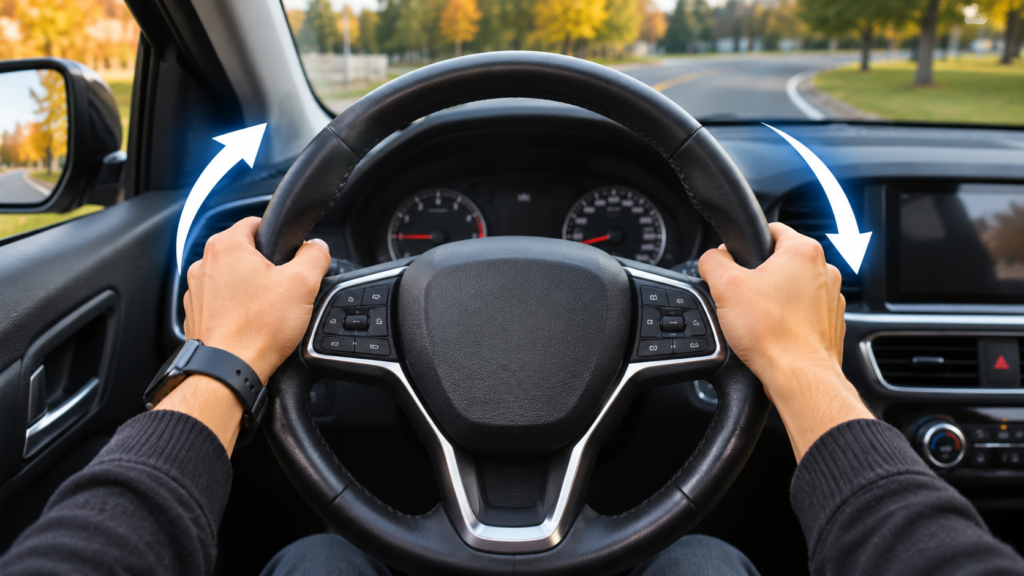
Picture the steering wheel as a clock face. Your left hand goes at 9 o’clock and your right hand at 3 o’clock. That is the 9 and 3 hand position, and it is what most driving schools and provincial handbooks teach today.
Some handbooks, such as Saskatchewan’s, also accept 8 and 4. That is a slightly lower position that some drivers find more comfortable on long drives. Either works, as long as both hands sit at roughly the same height.
How you hold the wheel matters as much as where:
- Fingers on the outside of the rim. Wrap them around the outside, not hooked through the spokes or the inside of the wheel.
- Thumbs resting along the rim. Don’t wrap them tightly inside. If the wheel jerks, for example when you hit a pothole, a hooked thumb can get hurt.
- Relaxed grip. Firm enough to control the car, loose enough that your forearms aren’t tense.
- Elbows slightly bent. Straight arms make small steering corrections harder.
Why 10 and 2 Is No Longer Taught
If your parents learned to drive at 10 and 2, they weren’t wrong for their time. Cars back then had no airbags and no power steering, so drivers needed the extra leverage of a high grip.
Two things changed.
Airbags. A steering wheel airbag inflates from the centre of the wheel in a fraction of a second. Hands at the top of the wheel are in its path. They can be thrown back toward your face and head.
Power steering. Modern cars need very little effort to turn. You don’t need a high grip for leverage anymore, and a lower position is less tiring.
That’s why many safety organizations and handbooks now recommend lower positions such as 9 and 3 or 8 and 4.
Set Up Before You Steer: Seat and Wheel Adjustment
Good hand position starts before you turn the key. If your seat is too far back, you’ll end up reaching with straight arms. Too close, and your elbows jam against your sides.
Try this quick check:
- Sit with your back flat against the seat.
- Stretch one arm straight over the top of the wheel. Your wrist should rest on the rim.
- Adjust the tilt and reach of the wheel, if your car allows it, so the centre points at your chest, not your face.
- Set your mirrors after the seat, never before.
On the road test, this setup is part of the first impression an examiner gets.
Steering Techniques for Turning
Knowing where your hands rest is half the job. The other half is moving them through a turn without losing control.
Push-Pull (Hand-to-Hand) Steering
Push-pull steering is the smooth, controlled method for most everyday turns.
- Start with your hands at 9 and 3.
- To turn left, slide your left hand up toward 11 or 12 o’clock and pull down. At the same time, slide your right hand up loosely.
- As your left hand comes down, your right hand pushes up to keep the wheel turning.
- Repeat until you’ve turned enough.
Your hands never cross over the centre of the wheel. That keeps your arms clear of the airbag and gives you steady, even input.
Hand-Over-Hand Steering
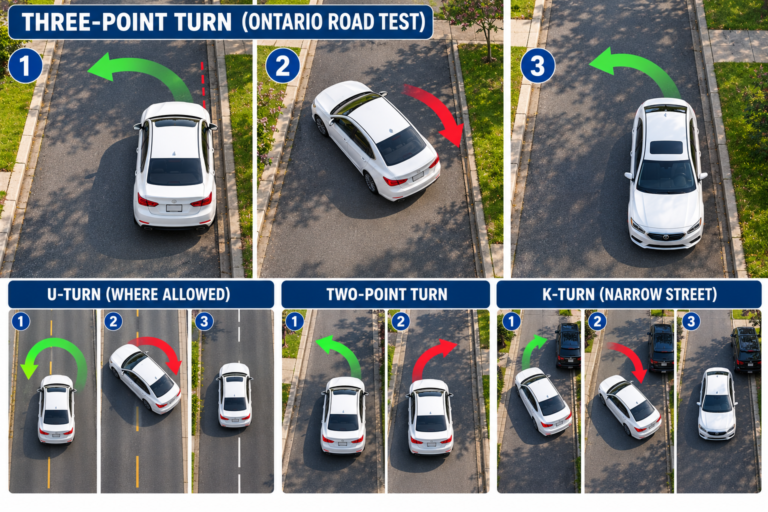
Hand-over-hand steering is for sharp turns at low speed, when you need to turn the wheel a long way quickly. Think parking lots, tight corners and a three-point turn.
- Push the wheel up and across with one hand.
- Reach your other hand over the top, grab the wheel and pull it down.
- Release with the first hand and repeat.
It turns the wheel fast, but your arms cross, so save it for slow speeds.
Recovering the Wheel After a Turn
When the turn is done, straighten the wheel with your hands. Use push-pull or hand-over-hand in reverse.
Don’t let the wheel spin back through your fingers. It’s a very common habit, but you have little control over how fast it spins or where it stops. On a slippery road, that can send you off line.
Steering While Reversing
When you back up, turn the wheel in the direction you want the back of the car to go.
If you’re turning to look over your shoulder, many instructors allow one hand at the top of the wheel, around 12 o’clock, while the other rests on the seat. Keep your speed at a slow crawl and make small corrections.
Steering Habits That Cost Points (and How to Fix Them)
Most steering problems aren’t about knowledge. They’re habits picked up from watching other drivers. Examiners watch for steering control, so these are worth fixing well before your test.
| Habit | Why it’s a problem | The fix |
| One-handed driving | Slower reaction if you need to swerve | Both hands at 9 and 3, except when signalling or shifting |
| Hand resting on the gear shift | Same as above, and a lazy-looking habit | Rest it on the wheel instead |
| Palming the wheel | Poor grip and jerky turns | Grip the rim with your fingers |
| Gripping inside the rim | Thumbs or fingers can be injured if the wheel kicks | Fingers and thumbs on the outside |
| Death grip | Tense arms, over-steering and fatigue | Loosen up and breathe |
| Letting the wheel slide back | No control over the recovery | Straighten it with your hands |
| Steering with your knee | No control at all | Never do it |
If you’re preparing for your road test, our guide to common G2 road test mistakes covers other habits examiners notice.
Steering in Ontario Conditions
Good technique matters most when the road isn’t perfect, and in Simcoe County that’s half the year.
Snow and ice. Use small, smooth steering inputs. Sudden jerks can break your tires’ grip. If the back of the car slides, look and steer gently where you want to go. Read more in our winter driving safety guide.
Highway 400 and crosswinds. At highway speed, tiny corrections are all you need. Look far ahead down your lane rather than at the hood, and your hands will follow your eyes.
Tight parking lots. Slow right down and use hand-over-hand steering. Crawl at brake speed while you turn.
Practise Smooth Steering With a Barrie Instructor
Reading about push-pull steering is one thing. Doing it smoothly through a busy Barrie intersection is another.
In our G2 driving lessons in Barrie, instructors fix hand position and steering habits from the first lesson, so they’re automatic by test day. New to driving? Start with our driving tips for beginners.
Call 705-300-5570 or book a lesson online.
Conclusion:
The right steering wheel hand position is simple. Keep both hands at 9 and 3, on the outside of the rim, with a relaxed grip and slightly bent elbows.
Use push-pull steering for everyday turns and hand-over-hand for tight, slow ones. Always straighten the wheel with your hands instead of letting it spin back.
These habits make you smoother, safer in an airbag deployment, and more confident on test day.
At Road Safety Canada, our MTO-approved instructors in Barrie and across Simcoe County coach these fundamentals from your very first lesson. Ready to build habits that last? Call 705-300-5570 or book your lesson today.
Frequently Asked Questions
Which hand position provides the maximum vehicle control?
Both hands at 9 and 3 o’clock on the outside of the steering wheel. This gives you balanced leverage for quick steering and keeps your arms out of the airbag’s path.
Is 10 and 2 still the correct hand position?
It is no longer recommended. With airbags, hands high on the wheel can be thrown toward your face if the airbag deploys. Lower positions such as 9 and 3 or 8 and 4 are now taught.
What is push-pull steering?
Push-pull steering is when one hand pushes the wheel up while the other slides up and pulls down, so your hands never cross. It is smooth, controlled and keeps your arms clear of the airbag during most turns.
When should I use hand-over-hand steering?
Use hand-over-hand steering for sharp turns at low speed, such as parking, three-point turns and tight corners, when you need to turn the wheel a long way quickly.
Is it OK to drive with one hand on the wheel?
One-handed driving reduces your control and slows your reaction if you need to swerve. Instructors and examiners expect both hands on the wheel, except briefly when signalling or shifting.
How tightly should I hold the steering wheel?
Firmly enough to control the car, but relaxed. A tight grip tenses your arms, tires you out and makes your steering jerky.
How should I hold the steering wheel when reversing?
Turn the wheel in the direction you want the back of the car to go. Many instructors allow one hand at the top of the wheel while you look over your shoulder, as long as you move slowly.
Ready to practise with an MTO-approved instructor?
Build real confidence in traffic with G2 lessons and Full G road test preparation in Barrie and across Simcoe County.